Alaska Sea Kayaking Trips

  • How To Do It?
  • Where To Go?
  • What To Bring?
  • How To Do It Safely?

A man of wisdom delights in water. – Confucius

Introduction

Sea kayaking is a fantastic way to explore wild Alaska. The adventure of paddling across a deep fjord between towering mountains and rolling icebergs is a great experience. Sea kayaking is fun most places, but Alaska is really home to some of the greatest sea kayaking trips and locations anywhere. A coastline that is seemingly infinite, a maze of waterways following spectacular coastal mountain ranges—Alaska offers an array of sea kayaking adventure opportunities.

Sea kayaking trips in Alaska typically involve deep glacial fjords and towering mountains, glaciers and icebergs, wildlife, remote wilderness and solitude, and a healthy dose of peace and quiet. An endless array of islands, channels, bays and waterways make Alaska home to some of the most superb sea kayaking trips in the world.

Sea kayaking in Alaska is typically a quest for solitude, a wilderness experience, seeing the natural world and its dazzling awesomeness without the clunk and thunk of mechanized motors. It’s a great way to get out and touch Alaska a little more closely than riding in an RV, train carriage, or cruise ship. It can also be a good deal of work, and shouldn’t be taken lightly.

Give due consideration to the trip and its various components. Don’t overestimate your abilities and don’t underestimate where you are. This is Alaska and even the peaceful tranquility of a glassy glacial fjord can quickly turn into serious business. It can also offer you an absolutely out-of-this-world experience, offering unmatched vistas and profound beauty.

What This Guide Covers

Entire books have been written about sea kayaking, even specifically about sea kayaking in Alaska. I don’t offer this as a complete guide to sea kayaking, but rather to outline a few of the important things you might want to consider in your planning.

I’ll cover just the basics for each topic. There’s no way to offer a complete review of all things you might need to know about Alaska sea kayaking trips on a website, but I hope this outline helps you in your decision making process.

  • Best Time to Go
  • Costs & Budgeting
  • Fitness & Skill Requirements
  • Trip Types
  • Planning Your Trip
  • Where To Go
  • Gear & Equipment
  • Skills & Safety

As your trip approaches, you’ll probably want a lot more detail and specific information than I can offer here, but I hope this overview helps get you started.

Context Matters

As with all things outdoors, there are very few hard and fast rules to do with sea kayaking in Alaska. The wilderness is a very subjective world and when we try to place square objective guidelines in the fluid and shifting holes of subjectivity we typically fail.

The dos and don’ts are much more contextual than rigid and ironclad. What works best on a sea kayaking trip for one couple might be a complete disaster for another. How best to respond to situation A in location B might not be a wise choice in location C.

This concept applies to all the sections that follow and I recommend bearing that in mind as you read over the various topics.

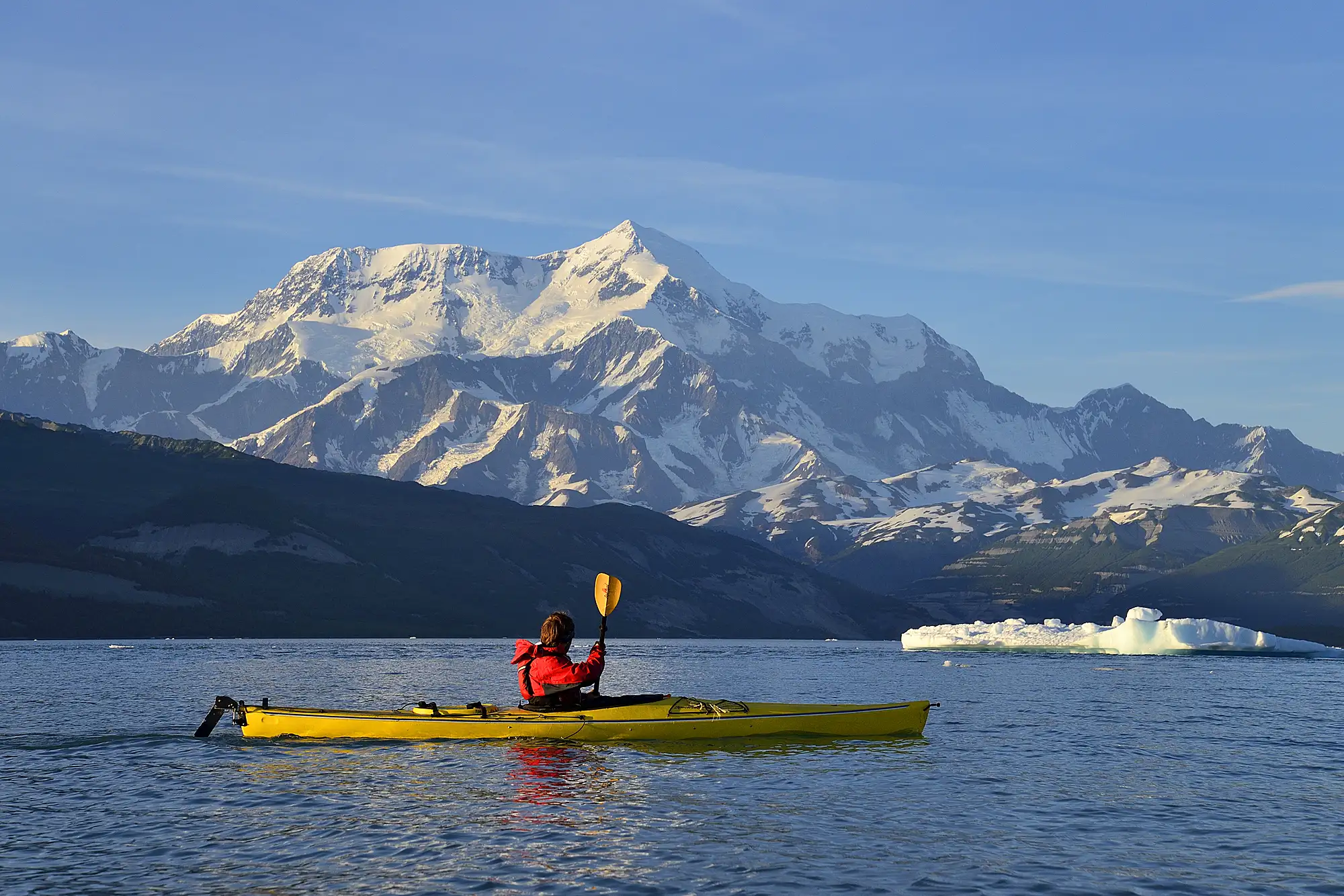
Kayaking near iceberg, Icy Bay, Wrangell-St. Elias National Park, Alaska.

What type of sea kayaking trip will work best for you depends on a host of factors that may very well not apply to someone else, or even to you a month later. The paddling gear you consider for Alaska sea kayaking will very likely not be the same gear you’d want sea kayaking in Baja, California—even sea kayaking in another region of Alaska. The gear you want to bring will depend on your skillset, your group, the type of trip you take, and on and on. The reverse is also true.

The type of sea kayaking trip you consider should also take into account the type of gear you have. The safety gear you want will depend on the group you have, their experience level, the type of trip you undertake, the location of your sea kayaking trip, your level of wilderness first aid training, and on and on. You get the picture.

What you want to do is build a good solid understanding of various basics and apply that knowledge to your decision making. We break things into categories or topics when they’re often so interrelated and connected that these divisions are entirely arbitrary. In reality we can’t separate sea kayaking from sea kayaking gear. We can’t separate sea kayaking gear from locations, or skills. Each are intrinsically tied to the others.

Understanding that is important.

So paddle on.

Getting Started

Generally, Alaska sea kayaking trips base out of southeast and south central Alaska.

The western and north coasts can be home to some rugged and particularly nefarious weather patterns. Paddling here is for the extremely hardy. Most folks enjoy the calmer and more protected waters of the inner coastal passages in southeast Alaska and south central Alaska. But if you’re an experienced paddler and outdoors person, there are countless more places you can explore.

Some of the locations are more accessible than others. Many require a floatplane and/or water taxi just to approach, while others begin right from a parking lot on the side of a road. Expect accessibility to mirror cost—the more inaccessible it is, the higher the costs involved in getting there. Easier access generally will drive down the cost of your trip, and usually very significantly.

Other factors to consider include the type of trip you’re looking for: a point-to-point trip, a loop, a day trip, a basecamp with day trips, a multi-day trip, and so on. In Icy Bay, Wrangell–St. Elias National Park, it’s possible to do both multi-day adventures—moving camp each day to a new location—but equally fun, and a lot easier, to ferry to our basecamp location and do a number of day trips from there.

Best Time to Go

Alaska’s sea kayaking season runs late May through early September, with July and August offering the most reliable weather and warmest water temperatures (still only 45-50°F). Each period offers distinct advantages.

Late May and June bring longer daylight hours—up to 20 hours in southern Alaska—and spring wildlife activity. Migratory birds arrive, seals pup, and coastal bears emerge. However, weather remains unpredictable, and some areas retain ice until mid-June.

July and August provide peak conditions: calmer seas, the most stable weather windows, and active wildlife. Humpback whales feed along the coast, salmon runs attract bears to shorelines, and glaciers calve most actively in warmer temperatures. These months also bring crowds to accessible locations like Kenai Fjords and Glacier Bay. Book guided trips 6-12 months ahead.

September offers solitude and stunning fall colors but requires flexibility. Weather systems intensify, daylight decreases rapidly, and marine conditions become less predictable. Only experienced paddlers should attempt September expeditions. Remote areas like Icy Bay become increasingly difficult to access as flight services wind down operations after Labor Day.
Consider your target wildlife: whales peak June-August, bears feeding on salmon peak July-September, and seabird nesting activity peaks June-July.

Costs & Budgeting

Alaska sea kayaking costs vary widely depending on trip type and location accessibility. Day trips with local outfitters in easily-accessed areas like Resurrection Bay or Kachemak Bay typically run $150-300 per person, including gear and guide. Multi-day guided expeditions range from $400-600 per day, with remote destinations commanding premium prices due to transportation costs.

DIY trips require significant upfront investment in quality gear—expect $2,000-4,000 for a complete setup including kayak, paddle, PFD, spray skirt, and dry bags. However, transportation often becomes the biggest expense. Float plane access to remote locations like Icy Bay or Russell Fjord runs $800-1,500 per person round-trip. Water taxis to closer destinations cost $100-300 per person.

Budget for hidden costs: camping permits (typically free in Alaska’s national parks but sometimes required; check your NPS regs), food resupply drops ($300-500), and emergency evacuation insurance (highly recommended, $50-150). A week-long DIY expedition in a remote area typically costs $3,500-5,500 per person when transportation, food, and incidentals are included.

Prices will vary with group size, as your transportation costs are often per trip, not per person. Accessible locations like Whittier or Homer can cut these costs in half.

Fitness & Skill Requirements

Sea kayaking in Alaska demands honest assessment of your physical capabilities and paddling experience. Alaska’s cold water, remote locations, and unpredictable weather create consequences for overestimating your abilities.

For day trips in protected waters with guides, basic fitness suffices—ability to paddle 3-5 hours with breaks, comfortable getting in and out of a kayak, and swimming ability. No prior kayaking experience required, though any time in boats helps. Age range: kids 12+ to active seniors.

Multi-day basecamp trips require moderate fitness: paddling 4-6 hours daily, carrying gear from kayak to campsite, and managing on uneven terrain. Prior kayaking experience strongly recommended. You should be comfortable in boats and not prone to seasickness.

Expedition trips demand higher standards: strong paddling technique, experience in open water and rougher conditions, solid navigation skills with map and compass, and backcountry camping proficiency. Physical demands include paddling 5-8 hours daily while loaded, lifting and loading heavy kayaks, and maintaining energy over multiple days. Cold water immersion survival training is highly valuable.

Critical non-negotiables across all trip types: ability to swim, comfort with cold and wet conditions, and mental preparedness for wilderness isolation. Medical conditions requiring immediate care or regular medication access aren’t compatible with remote expeditions. If you have concerns about fitness levels, start with guided day trips in accessible areas.
Types of Trips

  • Day Trips
  • Overnight
  • Multiday Basecamps
  • Expeditions

I think it’s useful to identify what type of trip you’re interested in early in the planning process. The type of sea kayaking trip you pursue will definitely steer most of the remaining decisions that lie ahead.

For many folks a simple day trip is the optimal sea kayaking trip. Anywhere from a few hours to an all day paddle.

Others will prefer an overnight sea kayaking trip, camping overnight or possibly staying the night in a cabin somewhere. If you’re the hotel type, a lodge might be better. For multi day sea kayaking trips, you can consider a basecamp trip, where you set up a single camp, and do various day trips, kayaking out each day and returning to your same campsite.

For an expedition you break camp each day, paddle with all your gear to a new location, and then make camp again. This might be a 3-4 day sea kayaking trip, or a 1-2 week trip, or even longer. You definitely want to have some experience for these trips. Risk factors increase significantly. The reward factor as well, everything has its tradeoff.

Sea Kayaking Trips

Sea kayaking trips are a great way to travel some beautiful areas of Alaska.

  • Easier than backpacking
  • quieter and less intrusive than mechanized travel,
  • maintain the freedom and self-reliance you might on a real wilderness expedition.

Take a lesson or two before you head out.

Sea Kayak Day Trip

A great way to get an introduction to Alaska sea kayaking trip. For many people, even 4 hours on the water is time enough. The comforts of a lodge or hotel afterward might be too tempting to pass up.

A good option for this kind of trip is to hire a ferry service to drop you off somewhere for the day, you paddle around a fjord, etc, and the ferry can pick you up at a pre-arranged time and place. Or, you can paddle back. This can be a good way to really get out somewhere remote, and still only be gone for a day.

Without the ferry ride, if you take off sea kayaking right from Seward or Whittier or Homer, you’ll see some great scenery, etc, but you won’t get out to the really cool stuff in a few hours, or even a full day paddle. Taking a shuttle is a great option.

But remember; you’ll DEFINITELY want your overnight gear. It’s Alaska and you never can really know what the weather or other conditions might do. It’s quite possible that your day trip turns into an overnight sea kayaking trip. Even the best laid plans can fall apart off the Alaska coast. Bring a shelter, rain gear, fire starter, food, water, and if possible some kind of contact device like a sat phone or inreach, etc.

Multiday Sea Kayaking Trips

Overnights

Even one night out in Alaska is worth it. Considering you should bring overnight gear even on a day trip sea kayaking, you may as well plan on using it and make your trip an overnighter.

Don’t bite off more than you can chew and plan for stopping to set up camp around 4 or 5 (even in summer when it won’t get dark until late). It’ll take you longer than you think and it may (that is, very likely will) take you longer to make the paddle that you schedule and get to your destination. Even if all goes well and you set up camp smoothly you’ll be able to sit back and enjoy the wonderful Alaska evenings. Go for a hike and explore the area a little.

Taking a ferry or air taxi to shuttle you out to a remote spot is a good option and I definitely recommend you do that.

Base camps

Take a ferry or air taxi out to some awesome location, set up a sweet campsite, and spend each day paddling. An excellent, easy, way to enjoy a sea kayaking trip. Get up in the morning, enjoy breakfast, pack a lunch and some emergency gear, and take off for the day. Give yourself plenty of time again so you don’t struggle to get back to camp before too late.

Do bring some kind of emergency overnight setup. I recommend a small tarp with some guy-lines, a sleeping bag per person, rain gear (or your paddling gear, depending on what you have), fire starter, water and food rations.

Don’t take off for the day and get stuck somewhere, away from camp and not have something to take shelter under if things go awry.

Sea Kayak Expeditions

These sea kayaking trips require more careful planning, preparation and research, more specialized gear, finely tuned packing, and a little more effort. You’ll be breaking and making camp each day, you’ll be paddling a full load in your sea kayak each day, and you’ll work a lot harder both sea kayaking and camping. But the effort can be well worth it as well with the opportunity to really cover some mileage and get out there.

For the super hardy folks take a ferry service to a drop off location, schedule a food and fuel drop with them 7-10 days later. Make it a real expedition sea kayak trip for a few weeks or longer.

You can either schedule your sea kayaking expedition as a point to point trip, a round trip, or an out and back. Just don’t bite off more than you can comfortably chew.

What type of trip you seek is up to you, your schedule, skillset and experience and so on. Each trip type comes with its own pros and cons and you should weigh them all. If you haven’t paddled before, or paddled just a little, a full blown winter sea kayaking expedition circumnavigating the entire Kenai peninsula probably isn’t for you. If you’re an experienced sea kayaker, outdoors person and adventurer, a 2-4 hour paddle around Resurrection Bay probably won’t be quite as rewarding for you either.

Planning A Trip

Planning involves all the above and more. It involves considering your gear, your navigation and paddling skills, the type of trip you’re embarking on, where you’re going, things you’re likely to encounter, or not likely to encounter, and so on.

I think this is one of the more important skills you’ll need. It’s a process you’ll need to be very meticulous with for a sea kayaking trip.

Planning is OK, but ..

Preparation Matters

In Alaska, we prepare more than we plan.

Mice and men, and all that good stuff.

Have a good understanding of the route, even for a day trip. Next, make sure you have multiple backup plans in place for when things don’t go as planned. Further, speak to your ferry captain or air taxi pilot and know as many options as you can for dropoff/pickup locations if you need to change plans.

Find out all you can about local weather patterns, particularly winds and wind directions. Don’t ignore this. Similarly find out all you can about local tides and currents. Don’t ignore this either. Turnagin Arm, for example, is home to one of the most famous bore tides in the world. An inexperienced (or even experienced) sea kayaker caught unawares can have their trip completely ruined by something like this.

If there are any public cabins in the area that might be available, or private cabins in use, at the very least be aware of them.

In case of an emergency, knowledge of the nearest help can be the difference between things ending up OK and things not going so well.

Before you change plans, take your time and consider all the possible outcomes carefully.

Then do it again.

Too often plans changed in haste, under pressure and stressed situations, aren’t sound decisions. So prepare and replan carefully.

Lastly – address all of the points here, and tend to your weakest areas first.

If you’ve never sea kayaked before, and have little to no backcountry camping experience, not only should you consider a guided trip and a shorter trip like a daytrip or overnighter, go somewhere and get comfortable with being on the water in a kayak, even a whitewater kayak in a lake will make a difference.

You’ll be SO much better in a kayak your 2nd or 3rd time around; or you might save yourself a great deal of time and expense and realize that kayaking really isn’t for you. I recommend figuring that out before you leave home rather than half way across Prince William Sound.

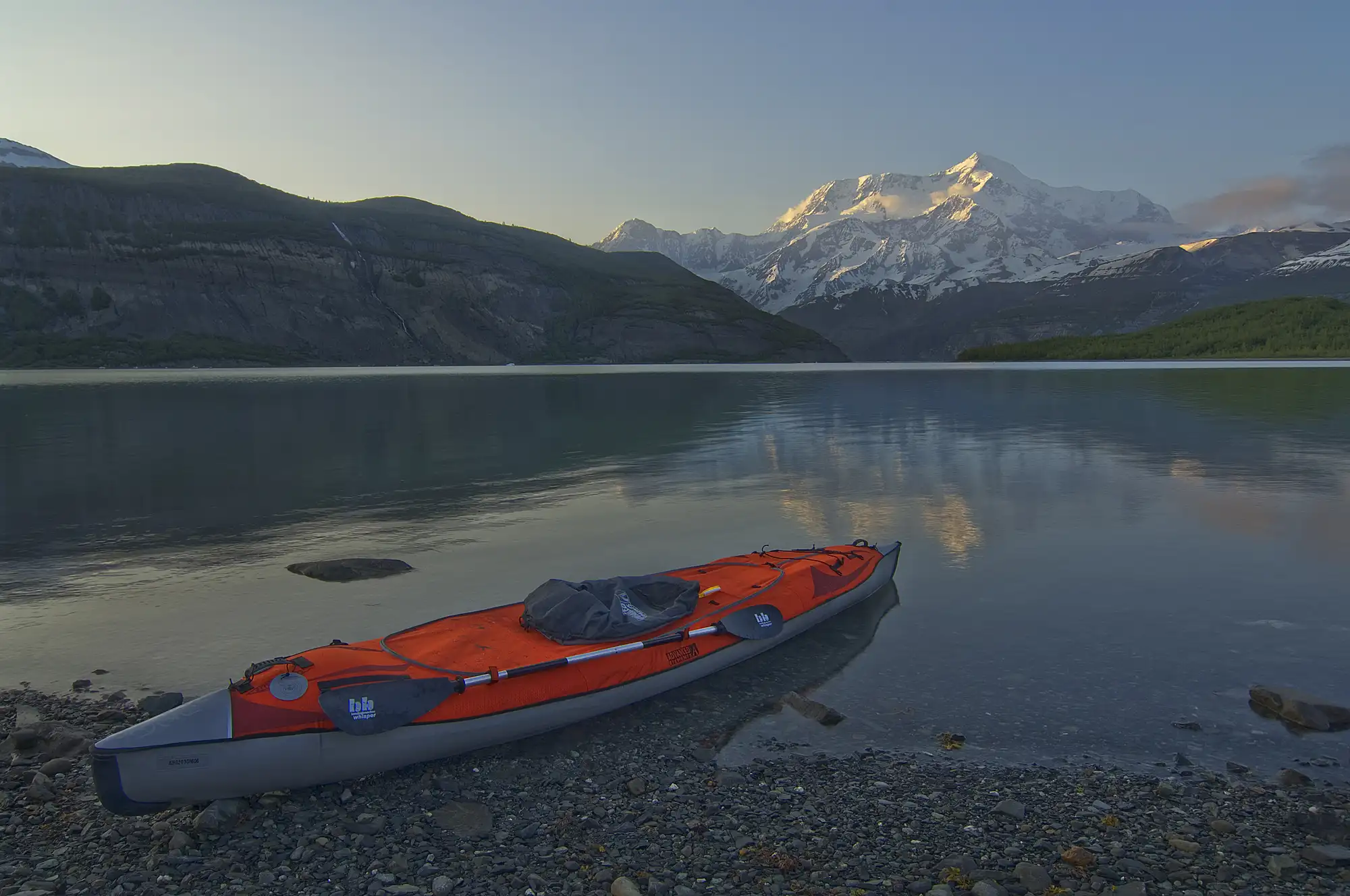
Sea kayaking trips Alaska Sea Kayak, Icy Bay, Mt. St. Elias, Wrangell-St. Elias National Park, Alaska.

Gear Matters

So does your know-how.

Sea Kayaking Gear & Equipment

Entire books can be written on this subject. Entire books might be written simply on what type of boat to choose. So consider this just a brief outline of some of your considerations. As you get further into your planning you’ll start narrowing down choices, etc, and those will shape many of your gear considerations.

Sea Kayaks

While some generalizations hold, the big factor here is going to be what type of sea kayaking trip you’re embarking on. An expedition will require a big, burlier boat with more storage, and you’ll likely want a faster boat as well. For a 4 hour day trip sea kayaking a smaller boat will be fine and you won’t need anywhere near the storage capacity.

I won’t go into a lot of detail here about boat shapes and models, etc. If you’re visiting Alaska for a sea kayaking trip, you’re probably either bringing your own boat with you or renting one. Speak to the outfitter and/or guide about what will best suit your trip and experience. Inflatables are nice and portable for fly in trips, but slower and generally won’t pack as much gear for longer expeditions. I’d recommend a hard sided boat for most folks. Collapsible sea kayaks can be a good choice if you need to travel with it.

I also (strongly) recommend a boat with a rudder system for most beginner and even intermediate sea kayakers. I generally think single kayaks are a better option than a tandem as well, even though tandems will generally be faster and get you further. Having a 2nd boat is a good option for most folks, so for couples, go with single boats.

What sea kayaks do we use?

At the moment we’re using Delta 17s by Delta Kayaks. They have been awesome. In the past we’ve used various folding kayaks, and other older hard boats as well.

The Orus are actually pretty good, and they continue to improve those boats. If you need portability, they’re hard to beat.

Kayak facts

  • Kayaks are intrinsically Alaskan.
  • The Aleut and Inuit of the Arctic invented Kayaks.
  • An Alaska Sea Kayak Trip is probably about as inherently Alaskan a trip as you can possibly imagine.

Sea Kayaking Gear

Personal Flotation Devices, or “buoyancy aids” are critical. They’re no longer called lifejackets or life vests. They’re called Personal Flotation Devices. PFDs. Think about that for a while.

You need one per person, and you need to fit and to wear them. Every time you and your boat get in the water.


Every. Single. Time.


Your boat should come with a spray deck, or spray skirt. We’ve had great luck with Seals Skirts.

I generally don’t worry about a helmet for most Alaska sea kayaking, but if you intend to run the surf, put one on. If you’re on a big open water expedition, consider a bilge pump amongst your gear critical. At the very least have a sponge or 2 handy. If you have room, some form of flotation for your sea kayak, such as air bags.

You’ll definitely want dry bags, and for longer more adventurous trips, the more the better. A deck bag or water proof fanny pack for the gear you keep outside the boat (camera, compass, maps, etc). Just be sure to secure it safely to the boat, and somewhere that it won’t interfere with your paddling.

We prefer many small bags to one single large expedition duffel. It’s easier to fill all those nooks & crannies of the boats with smaller bags.

Clothing

Dry suits or wet suits are great, and definitely recommended for expedition trips in rougher water. For a 2-4 hour daytrip, with a guide, etc, you might only go with a splash jacket, and capilene layers. Generally, you will want to dress for the water temperature, not the ambient air temperature.

If it’s chilly have some kind of fleece handy. Powerstretch fleece is probably the best if you can find it. So a drysuit or wetsuit is recommended but not critical. Neoprene booties and gloves, sunglasses, hat, lip balm, sunscreen. Camping clothes and something comfortable to hike in.

A lot of the guides favorite footwear for sea kayaking is a knee-high pair of rubber boots; Xtratufs are the boot of choice in coastal Alaska.

Don’t wear your sandals as your footwear in the sea kayak. They can restrict an exit in an emergency. Booties are the way to go.

More stuff

Bring a first aid kit. Bring some form of towline with a quick release system. Communication device, such as a sat phone (NOT a cell phone), Spot Messenger, VHF Radio, etc. Bring a repair kit as well. Even a roll of duct tape and a roll of Tyvek tape (you can find it at Lowe’s) comes in handy, along with a Leatherman type tool, or pliers and a screwdriver, and a tube of Aquaseal.

I won’t go into detail about camping gear. It’ll depend almost completely on your trip type, but you should plan on bringing some kind of shelter provisions even on short daytrips. Because ya just never know.

Bring dry bags. Plenty of dry bags.

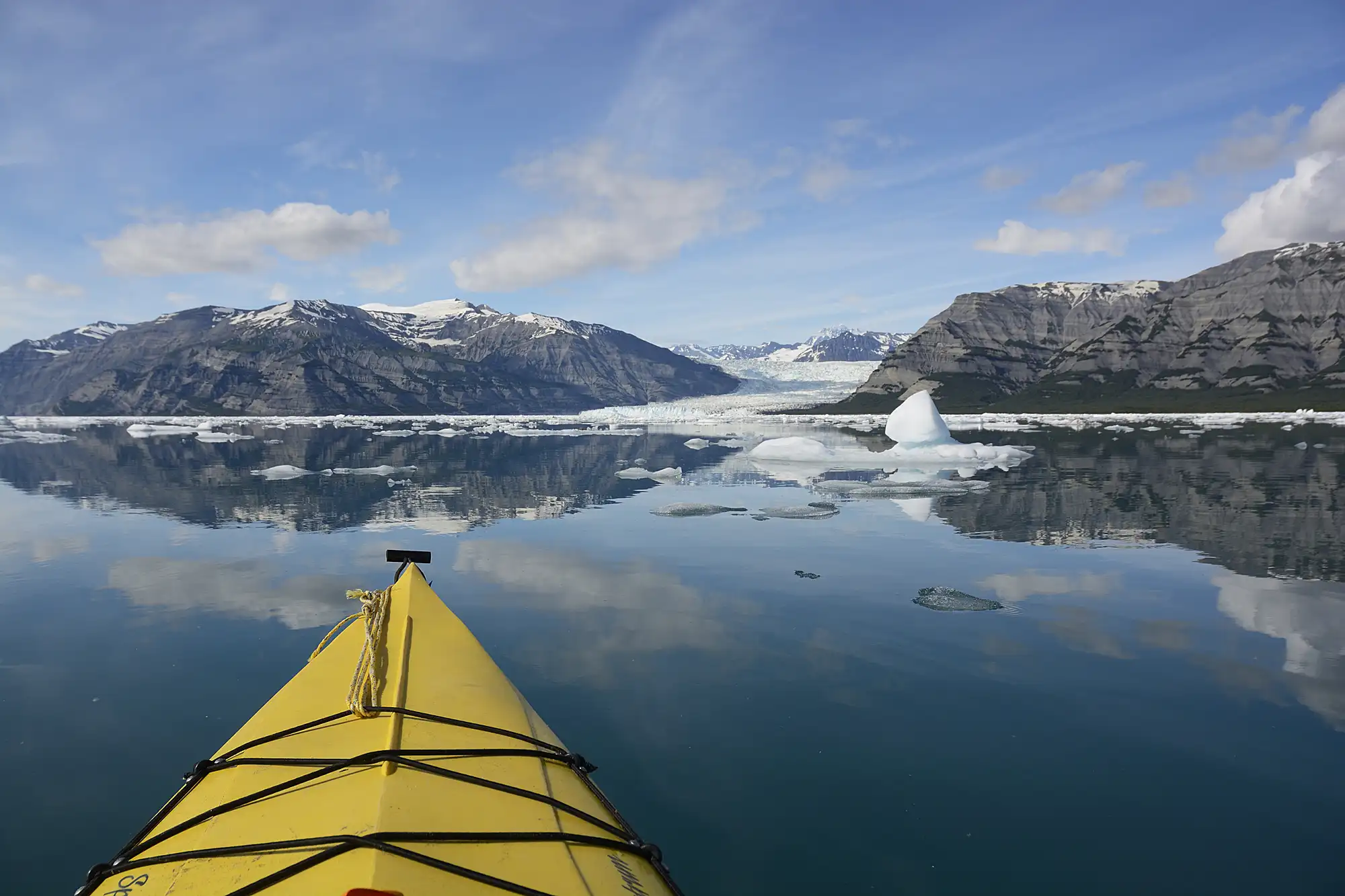
Sea kayaking locations in Alaska Glassy calm water, Icy Bay, Wrangell-St. Elias National Park, Alaska.

Where To Go Kayaking.

Alaska, for sure.

Nothing compares.

Sea Kayaking Destinations

Alaska is home to some of the greatest sea kayaking locations in the world. Glaciers and icebergs, wild fjords and wild forests, filled with even wilder animals make an unbelievable wilderness experience possible here, and the great Alaska coastline offers virtually boundless opportunities.

The Best Places to Sea Kayak in Alaska

Which one of the places is “the best kayaking in Alaska”?

Impossible to say. The best known sea kayaking places of Alaska are the fjords
and bays and channels of Southeast and Southcentral Alaska. Here’s how they compare:

Location Difficulty Access Best For Season Highlights
Kenai Fjords Beginner-Int Road + short boat ($) First-timers, wildlife June-Aug Glaciers, sea otters, whales, accessible from Seward
Prince William Sound Beginner-Int Road access ($) Variety, accessibility May-Sept Protected waters, multiple put-ins, orcas, Columbia Glacier
Kachemak Bay Beginner-Int Road + short ferry ($) Easy logistics, culture May-Sept Seldovia charm, eagles, seals, Homer base, Grewingk Glacier
Icy Bay Beginner-Int-Adv Float plane ($$$) Icebergs, solitude, serious wilderness June-Aug World Heritage Protected Site, 4 tidewater glaciers, Mt. St. Elias views, super remoteness
Glacier Bay Intermediate Float plane/boat ($$-$$$) Classic glaciers, whales June-Aug UNESCO site, humpback whales, permits required, park rangers
Russell Fjord Intermediate-Adv Float plane ($$$) Remote, massive glaciers June-Aug Hubbard Glacier (largest tidewater in North America), seals, wilderness
Key:
Difficulty Beginner (calm water, short days), Intermediate (open water, full days), Advanced (expedition conditions, self-rescue required)
Access $ = under $200 pp transport, $$ = $200-500, $$$ = $500+
Season Optimal paddling months (some areas accessible wider window with experience)

Let’s look at a few of these in detail.

Kenai Fjords

Kenai Fjords is home to literally dozens of paddling options, a diversity of sea kayaking trips from half day and full day trips, overnights through to multi-week expeditions. Cool but accessible little shoreline towns like Seward mean you can get there reasonably easily and cheaply, and find a number of local companies setup to ferry sea kayakers out to well known dropoff locations. There are a number of local outfitters and sea kayaking guide companies that specialize in the area.

You can also head out of Homer and paddle Kachemak Bay. Excellent choice.

Prince William Sound

Whittier, Cordova and Valdez areas offer some great sea kayaking. Each host a number of possibilities for different types of trips. The local guides and outfitters provide a multitude of alternatives and this has become a very popular sea kayaking destination. Whittier is an easy, cheap access place, a short-drive from Anchorage.

Favorite Destination?

What’s the best place for kayaking in Alaska? Icy Bay, of course. Take a look at our Icy Bay Sea Kayaking Trip.

Icy Bay and Yakutat

The panhandle area of Alaska, near Yakutat, is home to Russell Fjord and Icy Bay. Icy Bay offers absolutely world class sea kayaking. Less accessible than many of the other well known locations, Icy Bay receives a fraction as many kayakers each season as virtually any other sea kayaking destination in Alaska.

Icy Bay also offers views of the highest coastal mountain in the world, the largest coastal mountain range in the world, the 2nd tallest mountain in both the United States and Canada, abundant marine mammals and wildlife, sea birds, 4 massive glaciers, countless icebergs, and some of the most remote and beautiful landscapes of the Alaska coastline. It’s an amazing location and definitely my favorite sea kayaking place in Alaska.

Russell Fjord is another awesome location near Yakutat.

Southeast Alaska

In Southeast Alaska, iconic places like Misty Fjords or Glacier Bay National Parks are well-favored sea kayaking locations. From Haines and Skagway south to Ketchikan and Sitka there are virtually an infinite number of options.

Glacier Bay is one of the most popular areas.

Gustavus is a great place to head out from with a number of options for ferrying you out to a base or air taxis to really get you out there.

If you want specifics, contact me, or check out Jim Howard’s great book here.

Skills & Safety

Practice Makes You Better

I’ll outline just some of the skills you’ll need to learn and the safety information you’ll wish to be familiar with for sea kayaking in Alaska. Revisit this stuff if you’re familiar with it; go into a lot more detail if you’re setting out on your first trip.

The main thing I can’t stress heavily enough is to go beyond simply learning this cognitively. Practice it and get it down. Practice it some more.

In Brief

  • Learn Your Fundamentals
  • Most people don’t practice nearly enough.
  • Caution Over Cavalier
  • Watch The Weather. Closely
  • Know Your Limits
  • Know Your Group Limits
  • Stay Dry and Warm

What We’ll Look At

  • Safety
  • Communication
  • Camping
  • Navigation
  • Paddling
  • Planning

It’s a lot to work on.

Sea Kayaking Safety

Someone in your group must have solid wilderness first aid knowledge, and a complete Basic Life Support kit.

A guide should have Wilderness First Responder certification. Someone in your group should also have water safety and rescue competency.

Everyone should paddle with a Personal Flotation Device (PFD).

I highly recommend bringing some kind of communication device, be it a sat phone, a Spot, powerful 2-way radio. A whistle is a good tool for each paddler to have, as well.

Have a short and long tow strap and quick release carabiner. Know what a buddy rescue is. Know how to get back in your boat, or get someone else back in their boat, in open water. Spend some time practicing these skills before your trip, or at the very least, the very beginning of your trip.

For most people, hypothermia will be the biggest concern. Sea kayaking in Alaska means cold water and that = hypothermia. Tending to situations quickly is important, but not more important than being careful to not exacerbate the situation.

#1 is prevention.
#2 is prevent the situation getting worse.
#3 is tend to the person in trouble.

Knowing how to deal with cold situations and potential hypothermia is critical. Other environmental safety issues include icebergs and glaciers, wildlife, weather. Tidal variation in Alaska can be much larger than many other places, so be sure to camp and tie off your boats well above the high tide mark; don’t be slack on this issue.

Icebergs can easily flip you over, so don’t get too close. Remember the bulk of the ice (90% of it) is under the water, so stay back. Glaciers calve and crash huge chunks of ice into the water. The calmest surface can quickly turn into a 5 foot tall wave if a towering chunk of ice crashes down. Wildlife can be anything from bears to moose to marine mammals like seals, sea lions and whales. Be careful.

Weather can change drastically, quickly, and it’s much better to be standing on dry ground waiting out a storm than sitting in your boat or swimming in open water waiting out a storm. Pay attention to what’s going on.

Sea Kayaking Icy Bay, Mt. St. Elias, Wrangell-St. Elias National Park, Alaska.

It's Further Than You Think.

Distances can be deceiving across water. Always check with your map and GPS rather than estimate how far it might be to XYZ. Double it if you’re paddling out and back.

Staying Upright

Sea kayaking safety also involves staying right side up in your kayak. You’re probably not going to learn to roll, or be able to roll, your sea kayak. If you already can you probably aren’t reading this article. Ideally a roll is something you should work on and learn.

If you can’t roll, at least take some time to try and get somewhat comfortable and confident in your ability to stay calm when you flip over. Do this by having a few safe practice flips. Remember, the key above all else is to tuck forward your face towards the boat. NOT leaned backward over the back deck of your boat.

Whether you roll or not, you want to be leaning curled forward over the front of your boat if you flip.

In the short term, you should definitely be familiar with the techniques and practice for rescues. Self rescue and buddy rescues. Know how to do a wet exit. Know to keep a hold on your kayak (and paddle) once you come out of it. Know how to empty your kayak of water once you retrieve it and are ready to get back in. If you’re in open water, you can use your group’s boat/s to lift one end of the upturned kayak and drain it. You can break the suction by rolling the boat side to side.

Self rescue, like all rescue, starts with prevention, so practice a low brace, and a high brace, and know how to use them.

Learn, and try to practice, re-entry. Scramble on to your now rightside up boat from the back, not the side.

Group Dynamics

Your Safety

Group dynamics are important; if someone in your group flips over, the absolute bottom rule for all backcountry safety is CYOAF .. Cover Your Own A$$ First.

Do NOT make matters worse by rushing into a bad situation and end up with 2 people swimming. Always, always always assess the situation before involving yourself. One person out of 3 upside isn’t a disaster, but 2 out of 3 is 5 times worse .. and 3 out of 3 is a recipe for something to end badly.

Rescuer Is In Charge

And my rule for rescue is (always) the rescuer is in command.

The rescuer tells the person in trouble what to do, and makes all the rules. The person swimming, for example, doesn’t. If there are more than one rescuer, the person in trouble is at the bottom of the chain of command. And if a swimmer doesn’t do as you say, paddle away from them. Instruct the swimmer, clearly, what to do, and when.

Clear Instruction

I also recommend you use someone’s name when you instruct them “Robbie, grab on to my rudder” is much better communication than “grab on to my rudder”. Have them grab the nose or tail of your boat, not the side of the kayak where they’re more likely to tip it over.

Size Matter

Watch out for ships and boats, and stay out of their way. Let them have the right of way.

These are just a few of the safety concerns you should pay attention to. If you’re an inexperienced sea kayaker, definitely get some good practice in, and/or consider taking a guided trip.

Communication

Often you’ll be out of earshot with your group. Learn basic signals to effectively communicate with one another.

Point positive. In other words, pointing to your left means go left. You don’t point at things you want to avoid, but point in the direction you want to go.

A paddle held vertically means ‘come to me’.

Moving the paddle up and down, somewhat vigorously, tells the others to come faster. More for emergency situations, etc.

Holding your paddle horizontally tells others to stop, and hold steady.

“Go back” is signaled by waving your paddle blades up and down.

There are a number of standard signals used by boaters, not just for sea kayaking – whitewater kayaking, canoeing, rafting, and so on. It’s best to learn these and use them rather than make up your own. But if this is a one time trip for you, just make sure your group members are ALL aware of what your signals mean with each other.

One of the simplest and most useful signals is simply asking if someone is OK. Point at the person, and tap the top of your head. If that person is OK, they should tap the top of their head in response. If not, wave your arms or paddle side to side. That’s a pretty universal sign of distress.

And remember these signals can be used to communicate to rescuers or other people you may run into on your trip. People in a boat for example or on land. It’s FAR more effective than shouting.

Wildlife Considerations

Wildlife can be a wonderful part of your Alaska sea kayaking trip. Wildlife can also be a considerable danger. The key difference is distance and awareness.

Marine Mammals

You might see humpback whales, harbor seals, sea otters, Steller sea lions, and dolphins or orcas while paddling. All of them are a treat to encounter. All of them can also easily flip you out of your boat.

Humpback whales feed actively in Alaska’s coastal waters from May through September. A surfacing whale creates massive water displacement—enough to swamp or capsize a kayak within 50 feet. They’re not trying to hurt you; they simply don’t see you or don’t care that you’re there. Federal law requires 100 yards minimum distance from whales, but frankly that’s not far enough in a kayak. Give them 200+ yards and let them approach you if they’re curious.

Sea otters are playful and curious but surprisingly large—up to 100 pounds. They’ll often approach kayaks. Enjoy the encounter but don’t try to touch them or block their path. They can dive under your boat and surface unexpectedly, causing you to react and potentially flip.

Camping

For overnight trips, whether it’s just a one night trip or a multi-day sea kayaking expedition, you’ll want to know wilderness camping, and camping in bear country protocols.

You’ll want to know how to choose a good campsite in the kind of landscape you’ll likely be camping in, what the most likely potential hazards might be, and how best to avoid them.

Storms are frequent here, and picking a campsite that won’t get flooded out, won’t get destroyed by strong winds, or flooded when the tides rise is critical.

ALWAYS

  • Know what a sheltered campsite is.
  • Don’t camp on or close to animal paths.
  • Know how to prepare your food, make and break camp, and keep your gear dry.
  • Know how to, and have the requisite tools, to get a fire started.

Navigation

Navigation Tools

Bring all the requisite maps, keep them handy in a waterproof bag, and know how to read them. Have a good compass, and know how to use it; don’t just think you know how to use it. Definitely be aware of the angle of declination – in Alaska it can be 30 degrees or more, which can easily throw you off route. I also recommend satellite images you can print out from google earth or google images. Those can often be a better tool than a standard topo maps in the coastal regions. The key is , as with all equipment, know how to use it.

Protocols

Paddling in the fog is tough. Stick close to shorelines when possible, and be sure to stick close together as a group. In open water, try to make enough noise that any other boaters nearby will know to avoid you. Also, in open water crossings, it’s better to aim for land and then follow it one way or the other as needed, rather than aim to bypass the land and skirt a point or head.

Maintain Course

Good navigation is all about knowing where you are. Maintain that knowledge at all times.

It’s not so much about finding how to get back on route. Don’t wait until you’re lost, or even unsure, before you check your location. You don’t wait until you’re starving before you eat, or soaked to the bone before you put on a jacket; don’t wait until you’re lost before you look at your map.

A GPS can be a great backup as well. Keep it dry, batteries charged, and know how to use it.

Paddling Techniques

Start with learning how to safely enter and exit your boat. The number one likelihood of ending up swimming is getting in or out of the kayak. Keep your weight low and centered over the boat. And take your time.

Loading zones are where you get in and out of your sea kayak. Pick a good one. Calmer water, flat solid footing and good visibility are helpful. Don’t come ashore in the middle of crashing waves, or rocky headlands or areas where you can’t see 3’ from the water’s edge. If you must, holler first to warn any potential wildlife hazards you’re there, and then go in one person at a time. And be careful. But better to pick a better, safer loading zone.

At the very least, you should know the most basic of paddling strokes, forward and reverse propulsion strokes. Know what a brace is. Know how to scull, what a sweep stroke is, and how to paddle efficiently. Sit up straight, use your torso for power, and relax. Know turning and steering strokes.

The old adage that applies to virtually any activity is keep your eyes posted where you WANT to go. Don’t look at things you don’t want to run into. It’s just like riding a bike or driving your car.

The Small Stuff

Another important thing to practice before you jet out across miles of deep, cold open water is the small stuff. Grabbing your water bottle from under your spray skirt or your rain jacket or camera. You’ll definitely want to keep somethings handy on top, but you can’t keep everything out of your boat.

Even something as benign as lifting up a set of binoculars and looking through them (or a viewfinder of your camera) can radically alter your perception and balance. Be comfortable doing this before you head out across open water.

FInal Preparation

Sea kayaking in Alaska is serious business. Cold water, remote locations, unpredictable weather, and genuine wilderness conditions mean mistakes have consequences.

But it’s also profoundly rewarding. There’s something about paddling silently through a fjord filled with icebergs, watching a glacier calve in the distance, or watching a humpback whale surface fifty yards from your boat that changes you.

The key is preparation. Know your skills. Know your limits. Practice your rescues. Respect the environment. Don’t cut corners on safety gear or training.

If you’re new to Alaska sea kayaking, go with a guide first. Learn from someone who knows the water, the weather, the wildlife. Build your skills in accessible areas before tackling remote expeditions.

If you’re experienced, you know the drill. Plan carefully, prepare for contingencies, and err on the side of caution.

Either way, give Alaska’s waters the respect they deserve.

Expeditions Alaska
Visit the wild