
Hey Folks,
Introduction to Backcountry First Aid
- Brief overview of the importance of first aid in the wilderness.
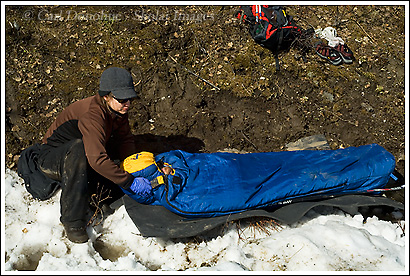
With the summer season just around the corner, a few tips on some basic First Aid might be helpful. In this simulation, you can see my friend and Wilderness First Responder, Lisa, stabilizing the patient’s (Jason) neck.
Spine Stabilization in Critical Care
Stabilizing a patients spine is super-important in critical care for all patients who have suffered major trauma, or where the mechanism of injury is unknown. In other words, when the rescuer doesn’t know what happened, and why the patient is suffering.
The best position for a patient whose may have a spine injury is flat on their back, with a rescuer holding their head in what’s called ‘anatomical position’ – basically, as straight as possible. Moving the head, or allowing the spine to flop around, can easily cause the spinal cord to be ruptured, or severed, causing permanent disabilities to the patient.
When Spine Injuries Occur
One of the things about spinal injuries is that it’s quite possible for someone to be up and walking around even if they’ve suffered spinal injuries – including a broken back. It’s critical to carefully get the patient into a stable position, where the spine is supported and stable before any harm can be done to the spinal cord.
Proper Positioning for Patients
In this simulation, Lisa and her partner found the patient lying in a pool of water, which meant a few things:
a) they needed to get him out of the water, out of his wet clothes, and dry as quickly as possible, and
b) they needed to get him into a spine stable position.
Handling Patients in Challenging Environments
Removing the Patient from Water
The foam pad underneath the patient helps immensely in keeping him warm. Up to 15% of heat loss is due to conduction, with water being 25% more conductive than air, concrete or stone is approximately 100 times more conductive, and the ground lies somewhere between water and stone, depending on its composition. So keeping the patient off the ground really makes a big difference to keeping them warm.
Using Foam Pads and Litter Transport
This simulation eventually required packing Jason up and placing him in a litter (a newer fancier backboard) and carrying him out of the field. That situation will require a number of people and assistants. The critical part, however, is the initial treatment. Once he’s warm and dry and stable, we can keep him there until further help arrives (assuming no further injuries such as increasing intra-cranial pressure or internal bleeding, etc).
The Role of Wilderness First Aid Training
Course Options
If you haven’t taken any wilderness first aid courses, or have only a rudimentary understanding and knowledge of basic first aid, I’d highly recommend taking a course. There are some elementary differences between general first aid and wilderness first aid protocols, so it might be wise to look into a class framed for the backcountry.
Most places that teach these kinds of courses offer:
- Wilderness First Aid course
- Wilderness Advanced First Aid course
- Wilderness First Responder course
- Wilderness EMT course
Why Training Matters
A basic Wilderness First Aid course is probably a great place to start.
If that’s not possible, any first aid class is better than none (in general). The bigger critical care situations, such as this one with Jason and Lisa, can happen anywhere but are, fortunately, uncommon. But stuff like blisters, aching muscles, abrasions and bruises, allergies, etc, are very common, and it’s a good idea to be comfortable with them before you get back out in the woods.
Practical Tips for Everyday Backcountry Injuries
Stuff like blisters, aching muscles, abrasions, bruises, allergies, etc., are very common, and it’s a good idea to be comfortable with them before you get back out in the woods. Any first aid class is better than none.
Conclusion
Take a course and be prepared for backcountry emergencies. Understanding how to stabilize a patient, keep them warm, and manage minor injuries can make a huge difference in the wilderness.
Cheers
Carl
And if things DO go wrong for you, be sure to be aware of proper Emergency Protocols for Backcountry travel in Alaska.