Understanding one of the last great wild rivers in North America
The Noatak River begins on the north flank of Mt. Igikpak, the highest peak in the Brooks Range, and flows 425 miles to the Chukchi Sea. Its entire course lies above the Arctic Circle. Its entire watershed lies within protected wilderness. No other major river in North America can make both claims.
In Inupiaq, the river’s name is Nuataam Kuuŋa. Early translations rendered it as “passage to the interior” or “the river from deep within“. Both fit. For at least 10,000 years, the Noatak River has been a corridor for human movement through the western Brooks Range, connecting coastal communities with the interior. The people who named it understood what the river was: a path into a vast and wild country.
Largest Undisturbed Watershed in North America
The statistics are staggering. The Noatak drains 12,600 square miles. The Noatak National Preserve alone encompasses 6.5 million acres. Combined with Gates of the Arctic National Park, the protected area exceeds 13 million acres of contiguous, roadless wilderness.
More importantly, the watershed remains essentially unaltered by human activity. No dams. No roads. No significant development. The only permanent settlement along the river’s 400-mile length is the Inupiaq village of Noatak, population 400, located near the coast. Upstream, the country looks the same as it did when the glaciers retreated.
This is not an accident. The Noatak basin was designated a National Wild and Scenic River in 1980, protecting 330 miles from the headwaters to the Kelly River. It’s also an International Biosphere Reserve, one of a handful of places on earth recognized for global ecological significance. These designations matter. They’re why the river remains wild when so many others have been dammed, diverted, or developed.
10,000 Years of Human History
The Noatak valley has been a travel corridor for millennia. Archaeological evidence places humans in the upper basin at least 10,000 years ago, during the period when the Bering Land Bridge connected Asia and North America. These early peoples followed game into the Brooks Range and left behind stone tools that still surface on eroding bluffs.
The headwaters contain one of the densest concentrations of prehistoric sites in the Arctic. Lake Matcharak, where many modern float trips end, has yielded artifacts spanning at least 6,000-7,000 years. People camped on those shores before the invention of the wheel, before the construction of the Egyptian pyramids. They hunted caribou, fished for grayling and char, and navigated the same braided channels that paddlers float today.
By historical times, the Noatak basin was home to the Noatagmiut, a group of Inupiaq people who lived along the river and its tributaries. Early records sometimes call them Noatagamutes, meaning “Noatak peoples“. They practiced a seasonal subsistence pattern: salmon fishing on the coast in summer, caribou hunting in the interior in fall, trapping and ice fishing through the winter. Many descendants still live in the village of Noatak and continue these practices today.
The first English name for the river was “Inland River”, recorded by Royal Navy surgeon John Simpson on an 1853 map. Simpson was translating from Inupiaq, though the exact derivation is unclear. Over the years, maps have recorded the name as Noatok, Noatuk, Nunatok, Notoark, Nunatak, and Nunulak before settling on the modern spelling.
Glacial Geology
The broad valley of the upper Noatak is a textbook example of glacial carving. During the Pleistocene, ice thousands of feet thick filled these valleys, grinding down mountains and sculpting the U-shaped troughs that define the landscape today. When the glaciers retreated, they left behind moraines, kettle lakes, and vast outwash plains of gravel and cobble.
The river has spent the past 10,000 years reworking this legacy. It meanders across the valley floor, cutting new channels, abandoning old ones, building gravel bars and eroding banks in an endless cycle. A few small remnant glaciers cling to the highest peaks of the Schwatka Mountains, but they contribute almost nothing to the river’s flow. The Noatak is fed primarily by snowmelt and rain.
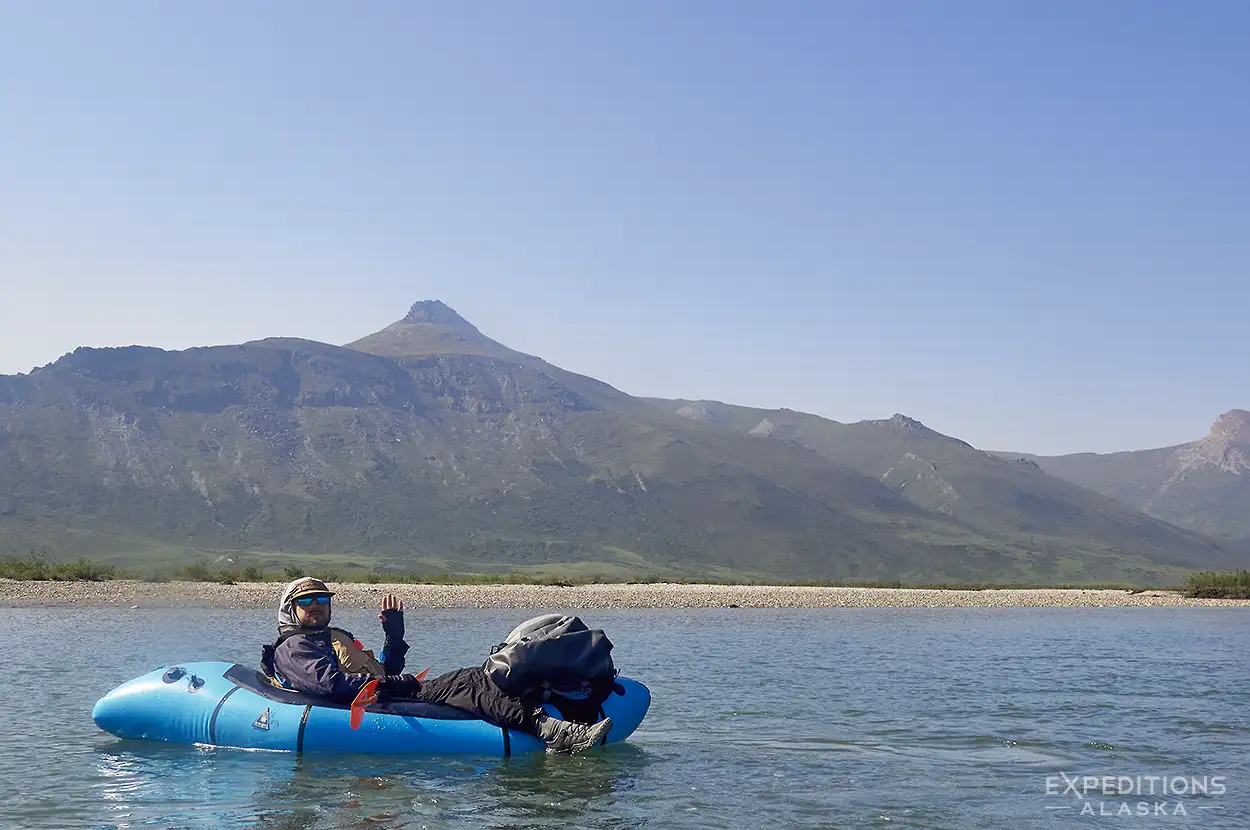
The highest point in the watershed is Mt. Igikpak at 8,510 feet. From the river’s origin at around 4,000 feet, it drops gradually across its 425-mile course to sea level at Kotzebue Sound. The gradient is gentle, which is why the Noatak offers such easy paddling despite its remote and dramatic setting.
Ecological Transition Zone
The Noatak valley sits at a critical ecological boundary. This is where the boreal forest ends and the arctic tundra begins. The edge of the Brooks Range.
In the upper basin, where most float trips take place, the landscape is treeless. Willow and dwarf birch are the largest plants, rarely reaching higher than a person’s waist. The ground cover is a mosaic of tundra mosses, lichens, grasses, and low shrubs: bearberry, blueberry, cranberry, and Labrador tea. In late summer, the tundra blazes with reds and golds as plants prepare for the long winter.
Further downstream, past the canyon sections, spruce forest reappears on the valley floor. This is the northwestern edge of the boreal zone, the last trees before the coastal tundra takes over. Cottonwoods line some banks. The transition is visible from the air: a sharp line where green forest gives way to open tundra.
Wildlife
The Noatak basin supports one of the most intact large-mammal communities remaining in North America.
Caribou: The Western Arctic Caribou Herd, one of the largest in the world, migrates through the Noatak valley. Herds follow traditional routes that have been used for thousands of years, their trails visible across the tundra as parallel grooves worn into the earth. Timing a float trip to coincide with migration can mean watching hundreds of animals swim the river in front of your boat.
Grizzly Bears: Brown bears are common throughout the basin. They dig for ground squirrels, graze on vegetation, and feast on salmon when the fish run in the lower river. Bears in the upper Noatak are generally wary of humans and often flee at the sound of voices. Muskox, after being hunted out of the region in the 19th century, have been successfully reintroduced and now roam the valley in small herds.
Dall Sheep: The white sheep of Alaska frequent the upper ridges and steep terrain above the river. On a clear day, you can often spot them from the water, small white dots moving across distant cliffs.
Wolves: Present but less frequently seen than bears. Their howls carry for miles across the tundra.
Birds: The Noatak supports impressive raptor populations. Gyrfalcons, including the rare white phase, nest in the upper basin. Peregrine falcons occupy the canyon cliffs downstream. Arctic loons call from the lakes, their haunting cries one of the signature sounds of the region. Ptarmigan flush from the tundra as you hike.
Fish: Arctic grayling are the most abundant game fish, found in nearly every pool and run. Arctic char, Dolly Varden, and whitefish are also present. Northern pike inhabit the lakes. Salmon run in the lower river, drawing bears to tributary mouths in late summer.
Trip Anecdote
Last summer, one of our guides was leading a day hike above Pingo Lake when the group spotted movement on the ridge ahead. They dropped low, crawled the last fifteen feet to the crest, and peered over. A grizzly was grazing on the far side of the plateau, maybe a quarter mile off, completely absorbed in digging. The group watched for twenty minutes before the bear wandered over a rise and disappeared. Nobody spoke above a whisper the whole time.
That’s the Noatak.
You don’t go looking for wildlife encounters; they find you. On another trip, a guide and his clients were paddling a quiet stretch when they noticed something on the opposite bank. A muskox, ambling downriver. They drifted and watched. Then someone spotted a second shape following behind: a large grizzly, trailing the muskox at a distance. The group floated in silence, directly across from the bear, until it caught their scent and bolted over a ridge. Two animals, two apex Arctic species, in the span of ten minutes.
Earlier that same trip, on a morning hike up a side creek, the guide glanced uphill and froze. A wolf, an Arctic wolf, pale gray. was greeting two pups at the mouth of a den. The group watched from a distance until the wolves slipped into the willows and were gone.
These aren’t rare events dressed up for brochures. They’re field notes from the last two seasons.
Why It Endures
Most of the world’s great rivers have been transformed by human activity. Dams, diversions, pollution, development. The Noatak has escaped this fate through a combination of geography, climate, and deliberate protection.
Geography: The river is simply too remote, too far from population centers, too ice-bound for most of the year to be economically exploited.
Climate: The harsh winters and short growing season limit agricultural potential. There is no irrigation demand, no reservoir need.
Protection: The Alaska National Interest Lands Conservation Act of 1980 placed the entire Noatak watershed under federal protection. Wild and Scenic River designation prevents dam construction. Biosphere Reserve status adds international recognition.
The result is a river that functions today essentially as it did 10,000 years ago. Water flows from mountain to sea without interruption. Salmon spawn in the same tributaries they always have. Caribou follow the same migration routes. Bears fish the same riffles. Humans remain visitors, passing through in small numbers, leaving little trace.
This is what a wild river looks like. This is what we’ve lost almost everywhere else.
Cheers
Carl
Expeditions Alaska offers guided packraft trips through the upper Noatak basin. Experience one of the last great wild rivers in North America.