
Tips From Five Seasons Shooting Humpback Whales
Whale photography is humbling. You can have 30 years behind a lens, a camera body that costs more than your truck, and the fastest autofocus system money can buy, and a humpback whale will still make you look like an amateur.
They’re fast. They’re unpredictable. They surface where you’re not looking, breach when you’ve just put your camera down, and vanish when you’ve finally got your settings right. The ocean is moving, the boat is moving, you’re moving, and the whale is doing whatever it wants.
I’ve been running our Hungry Whales Photo Tour in Southeast Alaska for five seasons now. Here’s what I’ve figured out so far. Emphasis on “so far” because the whales keep teaching me things.
Why Southeast Alaska Is Different
A humpback whale fluke looks about the same whether you photograph it in Alaska, Cape Cod, or Antarctica. What sets Southeast Alaska apart is the context around the whale.
The backdrop matters. Moss-draped old-growth Sitka spruce, dark water, cloud layers sitting on the ridgelines. When a whale flukes against that shoreline, there’s no ambiguity about where the photo was made. Place changes everything in a wildlife photograph.
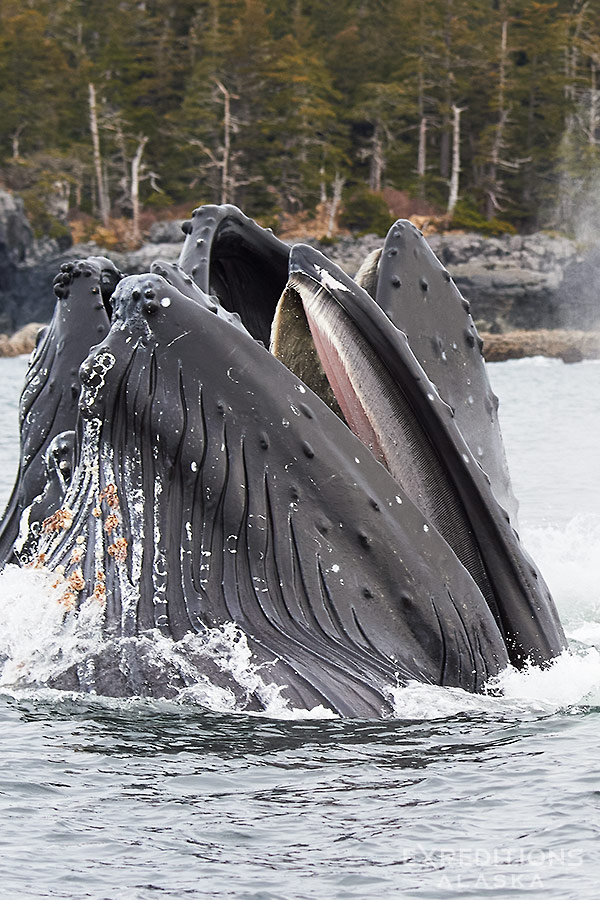
Then there’s the behavior. Spring here coincides with the Pacific herring spawn, which draws hundreds of humpbacks into concentrated feeding. The bubble-net feeding that results is among the most visually dramatic wildlife events on the planet. Groups of whales lunging through the surface together, mouths wide, herring flying. That’s a fundamentally different subject than a lone whale fluking on the horizon somewhere.
And the proximity. During bubble-net feeding, the whales can work right next to the boat. We’ve had seven whales lunge within 30 feet of us. At that range you don’t need a 600mm lens. You need a wide angle and quick hands.
Gear: Less Than You Think
The instinct is to bring the biggest lens you own. Fight that instinct. I will die on this hill. If you want to improve your wildlife photography, approach the gear aspect it with a “less is more” approach.
During active bubble-net feeding, whales can surface anywhere within a 180-degree arc in front of you, and they give you maybe two seconds of warning. A big telephoto on a tripod is a liability out here. You can’t swing it fast enough, and a tripod on a boat transmits every vibration from the engine and the chop straight into your lens barrel. Monopods are marginally better but still limit your range of motion when the action is happening everywhere at once.
Handheld is the way. A 100-400mm or 70-200mm zoom gives you the flexibility to shoot wide when the whales are close and reach out when they’re farther off. If you’re bringing something bigger, a 200-600 or 150-600, make sure you can handhold it comfortably for extended periods. You’ll be holding it all day. Your shoulders will have opinions about this by day three.
For the really close encounters I keep a second body with a wide angle ready. When whales surface 30 feet away, a 400mm shows you grey skin. A 24-70 shows you the whale, the spray, the mountains behind it, the whole scene. Those wide environmental shots are often the strongest images from the trip, and they’re the ones people never think to shoot.
Camera Settings
A few non-negotiables.
Shutter speed. 1/1000 second minimum. Between the boat motion, the chop, and the speed of a lunging whale, anything slower and you’re gambling. On rough days I push to 1/1600 or faster. Let your ISO climb before you drop your shutter speed. Noise cleans up. Motion blur doesn’t.
Autofocus. Continuous AF with subject tracking if your camera has it. The newer mirrorless bodies with animal detection are shockingly good at grabbing a whale the instant it breaks the surface. On an older body without that, use a cluster of AF points, maybe 9 to 12. Too many and the camera locks onto waves or distant mountains. Too few and you’ll miss when a whale appears without warning off to the side.
Exposure. Tricky one. Bright water surface, dark whale. If you expose for the scene, the whale is fine but you blow out the spray. I underexpose about two-thirds to a full stop, let the highlights hold, and bring shadows up in post. Check your histogram between feeding events. Adjust as the light changes. This is one of those things where chimping is actually useful.
Image stabilization. On. Highest setting. You’re on a boat. Take all the help you can get.
Burst mode. Yes. Always. A bubble-net feeding event lasts a few seconds. You want every frame your buffer can hold.
Reading the Water
The best whale photographers aren’t just good with a camera. They read what’s happening around them.
Before a bubble-net event, the surface often gives you clues. On calm days you can see the ring of bubbles forming before the whales break through. Windier days are harder, but you watch for a change in the water’s texture. A patch of turbulence. Birds suddenly diving. Baitfish dimpling the surface. Something’s about to happen.
When you spot a group of whales, watch their breathing. A whale that surfaces, blows three or four times, then arches its back sharply is about to sound. That’s your fluke shot. Get on it. The fluke rises slowly enough to give you a few frames if you’re ready.
Between events, keep your camera up. The whales might be down for a minute or fifteen. When they come back, it’s fast. The photographers who get the shots are the ones who were watching the water when the first bubble appeared, not the ones changing batteries.
Put the Camera Down
I tell this to every group and I mean it every time. Take moments, periodically, to just watch.
Seeing humpback whales bubble-net feeding at close range is a genuinely remarkable experience. If you spend five days looking through a viewfinder, you’ll come home with great photos but you won’t have really seen any of it. The scale of the animals, their coordination with each other, the sound of it, the godawful stench of herring breath when they blow right behind the boat. That stuff lives in your memory differently than it lives on a hard drive.
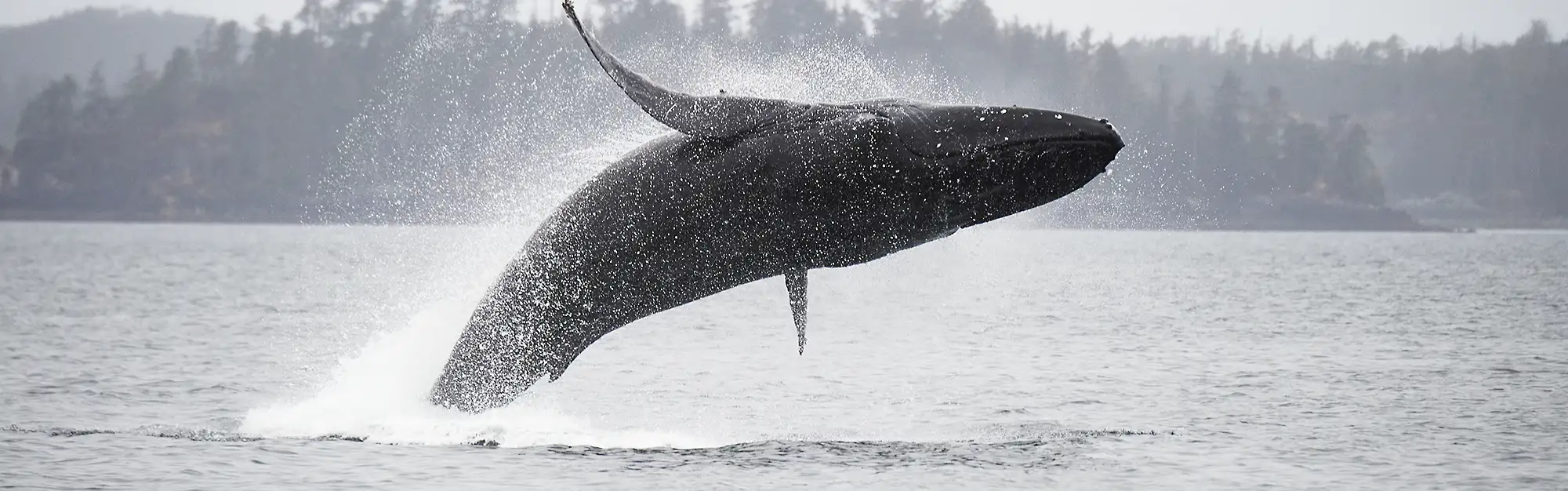
You’ll get plenty of chances. Five days is a lot of water time. Shoot the action, but between events, put the camera in your lap and just be present for a minute. And if you’re lucky, you’ll get to catch a humpback whale breach.
What Else Shows Up
The whales are the main event, but you’ll point your camera at a lot of other things too.
Bald eagles are constant. On one trip we found a sea otter carcass that had been killed by eagles, and there were 25 bald eagles feeding on it at the same time. That’s not a scene I’d read about in any field guide. You stumble onto things out here.
Harbor seals, Steller sea lions, sea otters. Otters floating on their backs with pups on their bellies is a guaranteed crowd-pleaser if you’ve got the reach for it. Harbor porpoise pop up around the boat with some regularity.
Last spring we followed a pod of Bigg’s (transient) orca for two hours, including two calves. Orca aren’t a sure thing. Maybe 10% of trips. But when it happens, nothing else matters for a while.
The birding is excellent too if you care about that sort of thing. Harlequin ducks, long-tailed ducks, rhinoceros auklets, marbled murrelets, various mergansers, cormorants, grebes. Between whale encounters, there’s no shortage of subjects.
The Right Setup for This
A lot of whale-watching operations run in Alaska during summer. Big boats, lots of passengers, a few hours on the water. That’s fine for seeing whales. It’s not ideal for photographing them.
Our Hungry Whales Photo Tour is a small group, six people max, on a dedicated charter with Gary. He’s lived in Sitka his whole life and knows these waters the way you know your neighborhood. We go where the feeding is, stay as long as the light and the action warrant, and position the boat for photography rather than sightseeing. Late March timing puts us in the peak of the herring spawn and the heaviest bubble-net feeding of the year, well before the summer tourist traffic shows up.
Small boat. Good captain. Right season. Patience. That’s the formula.