
Intro
NB: Here’s a guest post from a photographer and writer who came up a few years back and had a great time photographing the aurora. Kim Merritt is an awesome person, great writer and a treat to spend a week with. Thanks Kim.
The first time I saw the aurora borealis was in Iceland back in 2013. In hopes of capturing some epic shots, I was equipped with a Canon Rebel T1i, its factory lens, and the kind of bubbly optimism that only comes from having no idea what you’re doing.
It started the way it does for most first-timers: our guide pointing out something that looked a lot like a cloud, and me thinking that’s it? But then it grew. Slowly at first, until bright green ribbons made their way across the sky, with color growing more intense and vibrant by the minute. The greens turned to reds and purples, all visible to the naked eye, swirling above a farm house that framed up the perfect shot.
Just as the aurora was coming to life I heard, “Alright, time to go!”
Hearing this pulled my eyes off the sky for the first time that night, only to realize everyone else on the “best aurora tour in Iceland” was already in the car. Yet here I was, standing in a field in thermals, snowboarding gear, and enough excitement to keep my internal temperature up for days, fully prepared to stay out until sunrise. But alas, our arbitrary curfew hit at barely midnight.
We drove back towards Reykjavik as I watched the glow of city lights increase and the aurora continue to strengthen and overpower them from my window seat. I knew then I’d be back. Maybe not to that exact place, and definitely not with the same guide, but back to the arctic north to chase the lights. With someone whose objective is to photograph them for as long as they’re willing to put on a show, not just check a box and go back to the hotel.
WHY I CHOSE ALASKA
It took me over a decade to return to the aurora.
By then, a few things had changed. I’d upgraded both my skills and my gear—I was now shooting the night sky with a Canon R5, a 24-70mm f/2.8L, a 17-40mm f/1.8, and a slightly more informed sense of what I was doing behind a camera, at least in daytime conditions.
What hadn’t changed were the nerves around finding a guide as dedicated as I was hoping for, and the uncertainty of not knowing whether I would even get to see them. Part of me was reluctant to invest in a photography-specific trip that had no guarantees I would walk away with the shots I was hoping for. But as an adventure-loving optimist, I took a calculated risk.
To ease my anxieties and set myself up for success, I was determined to find a trip built around the singular goal of shooting the aurora. And to maximize my chances, I needed to choose a location that would give me the best odds of seeing it every night I was there.
Educated entirely by Instagram FOMO, I also debated between Iceland, Norway, and parts of Canada before eventually landing on Fairbanks. It sits directly under the auroral oval, making it optimally positioned for the highest likelihood of seeing the aurora on any given night during the winter season. Since it’s more inland than coastal destinations like Norway and Iceland, that typically means fewer clouds, aka more likelihood of seeing the lights when they do appear. I figured if the Geophysical Institute of The University of Alaska Fairbanks chose to set up shop there to provide data and research to official aurora monitoring models, that was good enough for me.
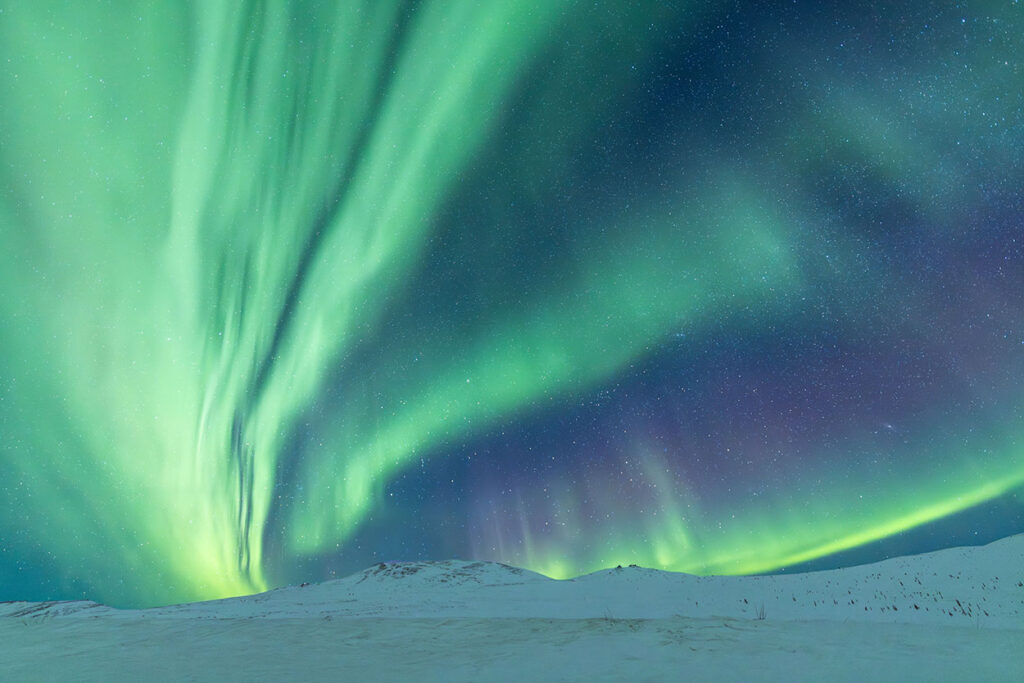
Practically speaking, it was also the easiest flight path from my home in Ohio. Less travel time meant more time in the field, and less money spent on flights meant more cash available for a guide. All of those calculations paid off, because we ended up seeing the lights every night on the trip—we were treated to full-on explosive, sky-consuming displays on five nights, and a soft, beautiful glow on the sixth.
WHY I DIDN’T DIY THE TRIP
For most of my photography trips, I tend to hit the road solo, following a loose route of pinned locations with plenty of room to deviate wherever something catches my eye. But as a solo woman in an unfamiliar place, driving alone at night in winter, chasing a moving target I knew very little about across hundreds of miles of wilderness, that all felt a little overwhelming. Maybe even a bit stupid, like there were too many things that required extra precautions I didn’t feel like handling. All I wanted to do was be able to pull over and snap photos without crashing out of sheer excitement.
I wanted someone else to handle all of the logistics and planning so I could focus solely on getting out of the car and operating my camera. And perhaps more importantly, I wanted to spend my nights shooting and my days sleeping, not burning hours scouting locations.
But I know that joining groups can be a gamble. If I’ve learned anything over a decade of traveling with my camera, it’s that if you want good photos, you have to travel like a photographer. That means structuring your days around light, not being rushed, and not standing next to someone who casually turns on their headlamp or car lights in the middle of a 25-second exposure. If photos are the goal, it’s best to travel with a photography-specific group who just gets it.
WHY I CHOSE EXPEDITIONS ALASKA
The aurora photography trip with Expeditions Alaska felt like it was built with that exact mindset.
Small group. Photography-first. Flexible nights dictated by aurora activity and conditions, not a clock. Most importantly, it didn’t feel like a tour, it felt like going out with a passionate photographer friend who already knew exactly where to be, and when. There was also the draw of traveling with Carl himself, which I knew meant hands-on support when my settings felt off, or my tripod inevitably malfunctioned (because for some reason, nothing works quite the same in the dark).
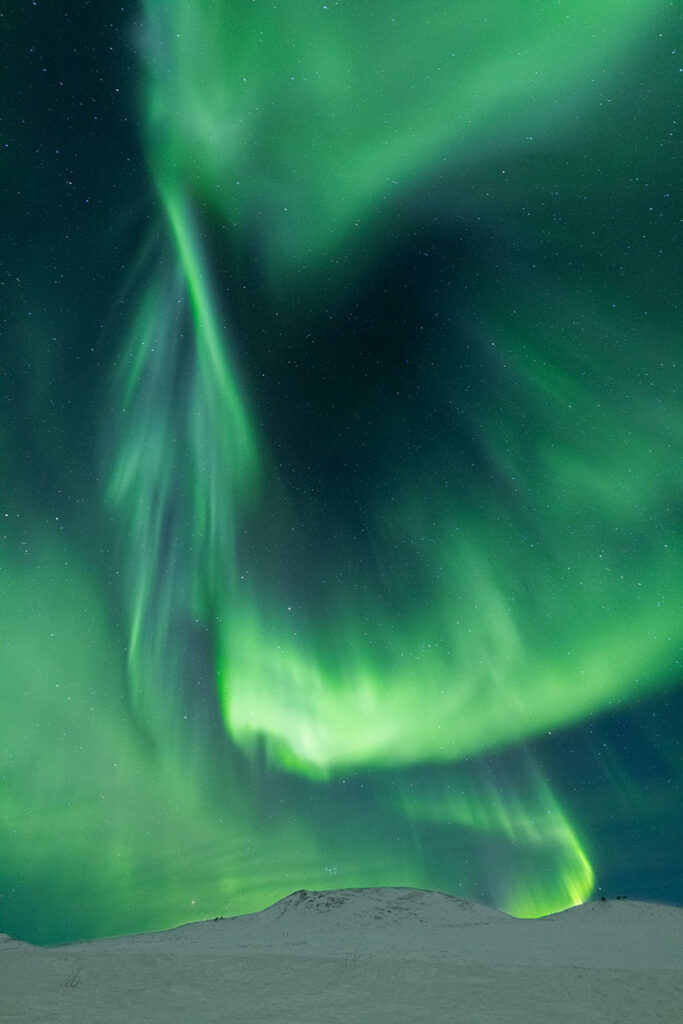
HOW THE TRIP PLAYED OUT
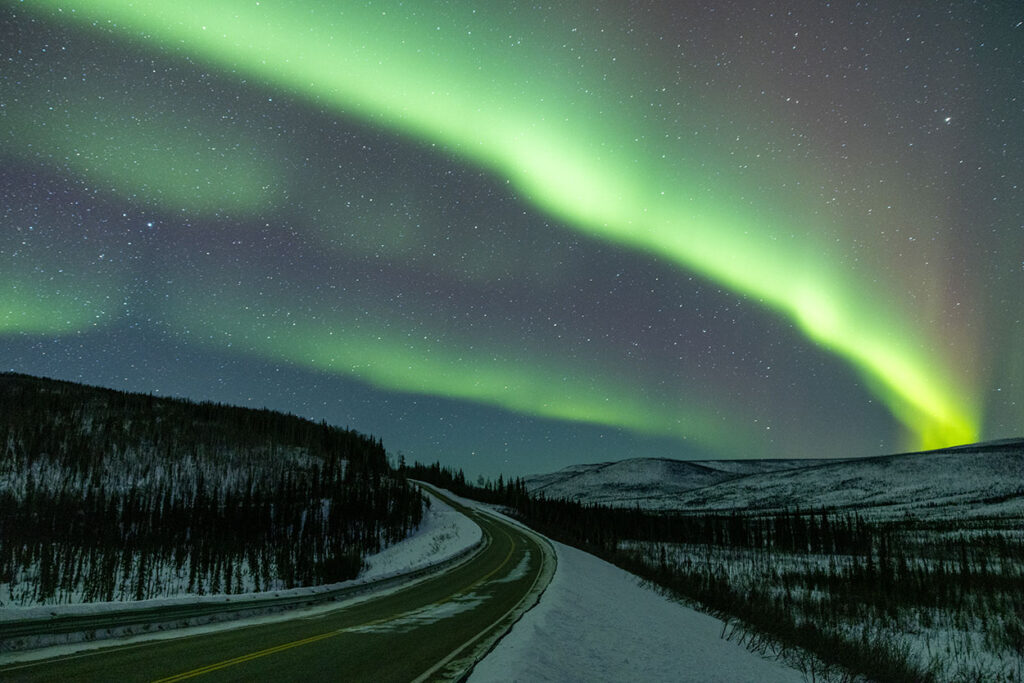
Each night started the same way: dinner, then driving. Our lodging gave us a centralized base from which Carl would drive us up to two hours in any direction based on weather, cloud cover, and aurora activity.
It felt effortless from where I was standing, but it became clear pretty quickly that we weren’t just winging it. Carl had pre-scouted locations that were compositionally strong, facing the right direction, and free from light pollution, making sure we were ready for whatever the sky decided to do. He was constantly in contact with people across the state gathering reports and making real-time calls on where we’d go next. And every night, he delivered.
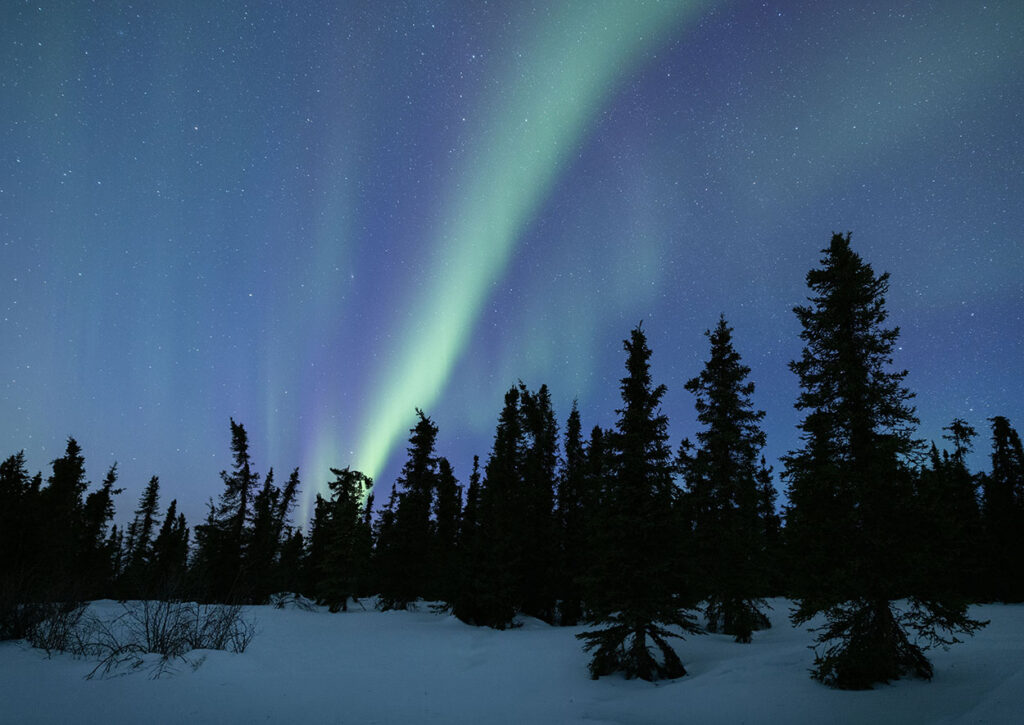
Each night was different from the last, giving me a genuine range of compositions and conditions to work with. I fumbled a few of those for sure, but overall I walked away with at least a dozen photos I was super proud of. Not once did our evenings feel rushed, like we were chasing blindly—or like we had to call it quits before the aurora did. And somehow, we seemed to arrive at the perfect viewing location just minutes before the sky lit up, every single night.
Thanks to the super helpful guide Carl had shared beforehand, it only took me a few shots to dial in my settings—managing noise, white balance, shutter speed, and ensuring the stars stayed super crisp. Ten minutes into the first night, I couldn’t believe my back-of-camera view, and how my very first shots were already some of my favorite photos I’d ever taken in my life. And we’d only just begun.
The small group size meant I could quickly get support the second something went sideways, which is more valuable than it sounds because things change fast with the aurora. Losing two minutes to a stubborn tripod or confusing setting is two minutes of the show you don’t get back. Plus when my eye wasn’t glued to the camera, I had moments to step away alone and experience the beauty and awe of this phenomenon, which is an entirely different experience in itself than being tethered to a large, loud crowd.
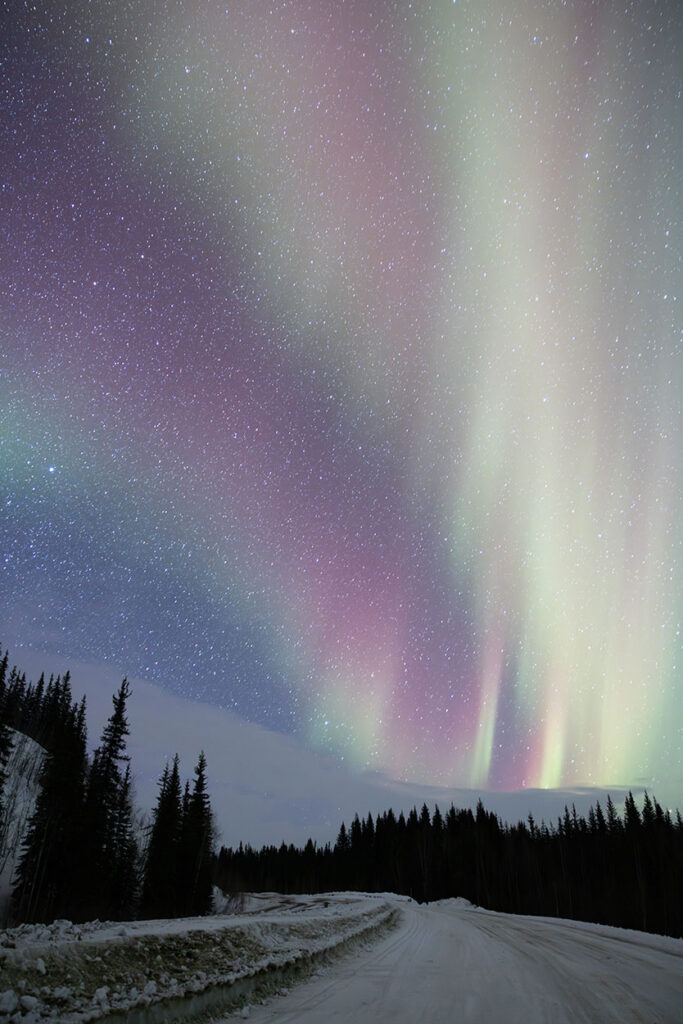
Carl’s expertise behind the scenes did what every good guide should do: made the whole trip feel effortless and flawless from my side. His combination of Alaskan backcountry knowledge, photography expertise, and real-time aurora and weather monitoring for perfect shooting locations really made it feel like all I had to do was show up.
MY TAKEAWAY
Before this trip, I assumed aurora photography was mostly dumb luck—you either get a show, or you don’t. And yes, it’s true that you can’t control the night sky, but you can absolutely control how ready you are when it decides to show up.
On this trip, I learned how to adjust exposure quickly before the brightness intensified, how to choose a lens based on movement rather than just composition, and to keep double-checking to make sure the stars stayed in focus. I learned how to read subtle changes in the sky before things intensified, how to anticipate when a quiet glow was about to explode or fizzle out, and to always look up, because you never know what kind of burst is happening overhead.
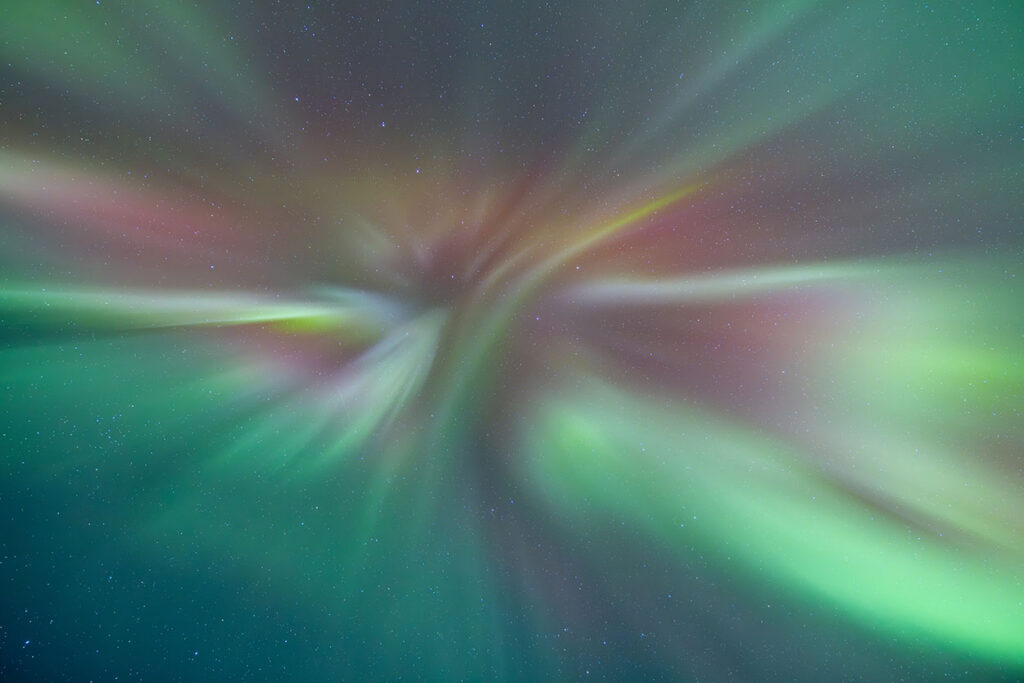
I left with a handful of portfolio shots I was genuinely proud of. Not just photos to share online and say “I saw the northern lights,” but images I was able to print and make my first sales with.
More than that, this trip became the foundation for my aurora photography. I now chase the lights regularly, having followed them to Lofoten, Norway, and the random occurrences closer to home in Ohio and Michigan. I’ve even been able to coach others in the field, and surprisingly, in the dark. As an avid overthinker, I still hear Carl’s helpful voice, excitedly shouting “Shoot! Shoot! Shoot!” as a reminder for me to stop waiting for the perfect moment and start capturing the ever-changing organic flow unfolding right in front of me before it’s gone.
That trip turned something that used to feel like luck into something I could chase, over and over again.
LEVEL-SETTING EXPECTATIONS
If you’re considering an aurora trip with Expeditions Alaska, there might be a few things worth knowing up front. Though, if you’re a seasoned photographer, none of this will surprise you.
Your schedule will revolve around the aurora, which means you’ll likely sleep during the day and shoot at night, so come prepared to flip your internal clock and be less rigid in your routines. You should also arrive with a working baseline understanding of your camera. This isn’t a beginner workshop, and you won’t have enough time to learn your camera in the field, especially in the dark.
What I can say without hesitation is that traveling with Carl is as good as it gets. He’s personable, knowledgeable, and a genuinely good time to hang out with—which, as a solo female traveler, is not something I say lightly. It’s clear to see the level of care he has for his clients and for what he does. And he is 100% the reason I came home with the number of beautiful shots I did, and an even stronger desire for chasing more.
I went into this trip with uncertainty, hoping I’d have a lucky few days. But I left feeling like the entire experience had been created for success. Not guaranteed obviously, but definitely stacked in our favor. The difference wasn’t just choosing Alaska as a destination. It was choosing a guide who knew where to go, when to move, and how to put us in exactly the right place at exactly the right time, night after night. And then stepping back to let me do my thing. Personally, I can’t wait to return to Alaska and photograph grizzlies with Carl someday!
Thanks Kim .. too kind. Was a treat to travel with you.
Cheers
Carl