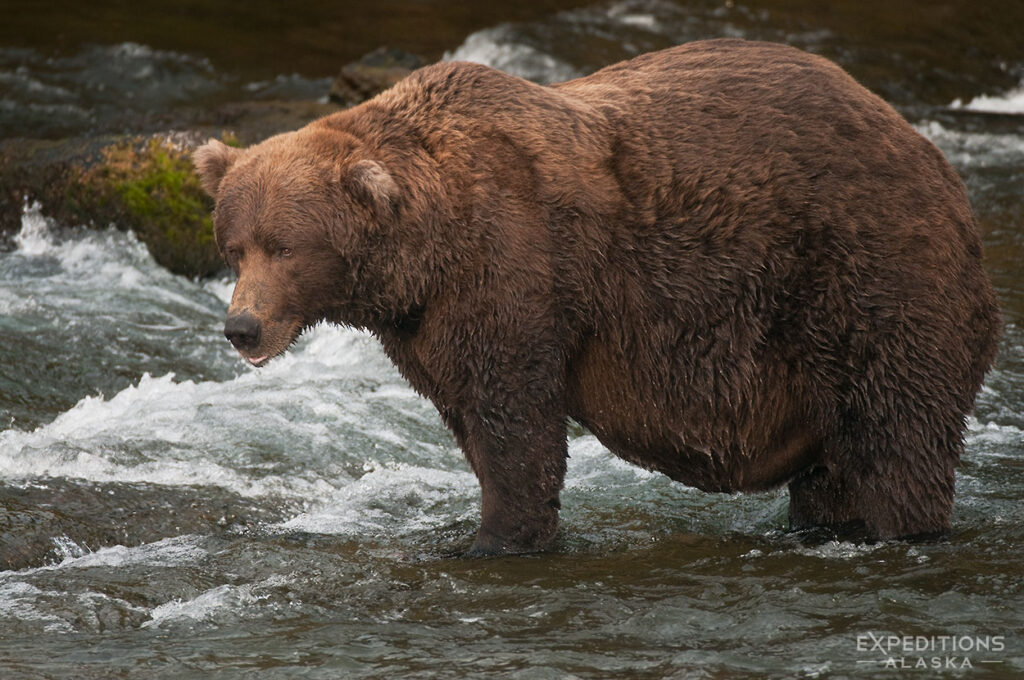
Alaska brown bears are so big because they eat salmon. A coastal boar in Katmai can eat over 90 pounds of salmon a day during the summer run and put on more than half his body weight before hibernation. That’s why the biggest bears in the world live along the salmon coast of Alaska. The same species inland, without salmon, stays much smaller.
The salmon math
A healthy adult male brown bear in Katmai National Park during the height of the salmon run may eat 90 pounds of salmon a day. Not for a week. Every day, for weeks, through the entire run. That’s an intake most large mammals can’t touch. Salmon is essentially calorie-dense protein and fat, arriving on a predictable seasonal schedule at exactly the time bears need to prepare for hibernation.
Bears in Katmai have been recorded putting on more than half their own body weight in a single summer. A bear that walks out of the den in April at 700 pounds can be at 1,100 pounds by late September. The math on that is simple. The consequence is bears that finish the summer looking like small buses.
What that looks like in the field
I’ve watched a small female grizzly on the north slope of arctic Alaska that weighed under 200 pounds. Same species, walking through the same latitude range at roughly the same time of year, a boar brown bear at Katmai may weigh over 1,500 pounds before he enters his den. That’s an eight-fold difference within a single species. Very few animals on earth show that kind of size variation without a taxonomic split behind it.
The Katmai bears I photograph in late September and early October are staggeringly huge. Bellies close to the ground. Walking slowly because they’re carrying more weight than any land carnivore has any business carrying. That’s what a summer of salmon does to them.
Why the coast produces the biggest bears
The salmon runs of Bristol Bay are the largest wild sockeye runs left on earth. Chum, king, and silver salmon show up in the same watersheds. When five species of salmon converge on a small number of rivers over a compressed season, the bears that live along those rivers eat like nothing else in North America.
The interior bears in the Brooks Range and ANWR don’t have that. Their food base is ground squirrels, berries, the occasional caribou calf, and whatever they scavenge. There’s no salmon to sit on for two months. So the same species, in a habitat that doesn’t offer the same calories, produces a much smaller bear.
Same species, different size
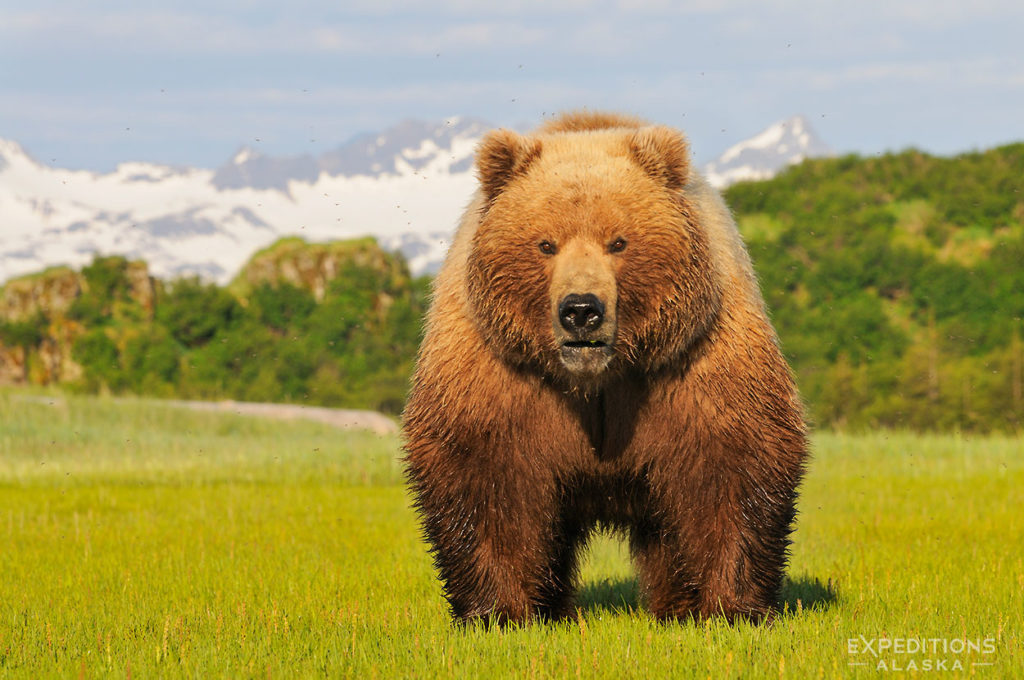
Every brown bear and grizzly in North America is Ursus arctos. Taxonomists split the species into various subspecies (some argue for many, some for just a couple), but the underlying animal is the same. What varies is diet, habitat, and the number of summer weeks that food is available in bulk. That’s the mechanism behind the size differences, not genetics or subspecies.
Kodiak bears (Ursus arctos middendorffi) are the largest recognized subspecies, isolated on the Kodiak Archipelago and living on their own salmon runs. They’re big for the same reason Katmai bears are big.
What it means for the population
Rich food doesn’t just make individual bears bigger. It also lets a lot more bears live in a small area. Katmai supports one of the densest brown bear populations anywhere in the world for the same reason. Home ranges shrink to as little as 30 square miles when the salmon is that concentrated. In ANWR, where a grizzly may need a home range of a few thousand square miles to find enough food, the population is much thinner.
Salmon is the whole story. Take it away, and you don’t just lose the biggest bears. You lose the density of bears the coastal ecosystem is built around.