
Yes, if you have the time to get there. Wrangell-St. Elias rewards visitors with three things you can’t easily find elsewhere: a near-intact early-twentieth-century industrial mining town (Kennicott), drive-up access to a major active glacier (Root Glacier), and views of mountains that rank among the highest and most rugged in North America. It isn’t the right park if your trip is built around quick photo stops or loop-road sightseeing. The drive in is long and the visitor infrastructure is concentrated in one small area.
What most visitors actually do
The vast majority of trips to Wrangell-St. Elias are based out of McCarthy and Kennicott, two adjacent communities at the end of the McCarthy Road on the south side of the park. McCarthy is the working town, with a footbridge crossing, a few restaurants, lodging, and around 40 year-round residents. Kennicott, half a mile away on a hillside, is the historic copper mining town, now a National Historic Landmark managed by the Park Service.
A typical visit involves: walking the historic Kennicott district with a Park Service ranger tour, hiking up to Bonanza Mine high above town, getting onto Root Glacier with crampons (either on your own or with a local guide service), and taking a scenic flight over the surrounding peaks. Most people stay two to three nights and find that’s enough.
Why the historic angle matters
Kennicott isn’t a reconstructed tourist site. It’s the actual mining operation that ran from 1911 to 1938, abandoned mid-shift when the high-grade ore ran out, and stabilized rather than restored. You can walk through the fourteen-story mill, see the machine shop, the assay office, and the bunkhouses. Few places in the United States preserve this much intact industrial heritage from that era.
Why the natural angle matters
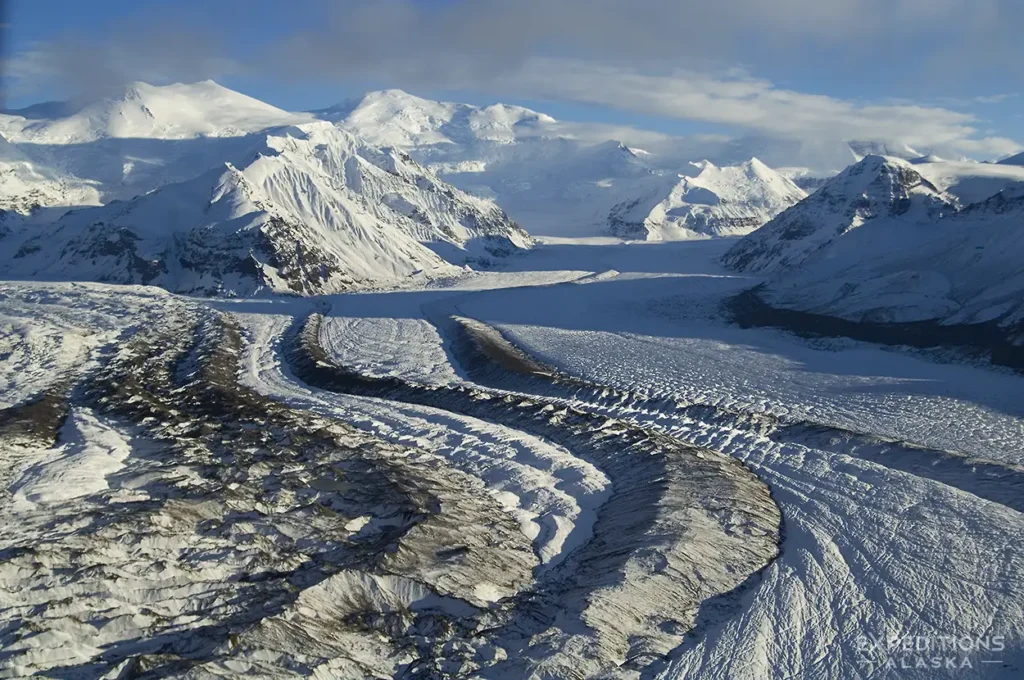
The park covers 13.2 million acres, the largest national park unit in the country, and contains some of the most extensive glacier and ice field systems on Earth.
Even without leaving the road system, you can walk on Root Glacier the same day you arrive. Flightseeing reveals country you’ll never see from the ground: the Bagley Icefield, the upper drainages of the Wrangell volcanoes, and Mt. Blackburn’s 14,000-foot west face from the air.
The Nabesna side
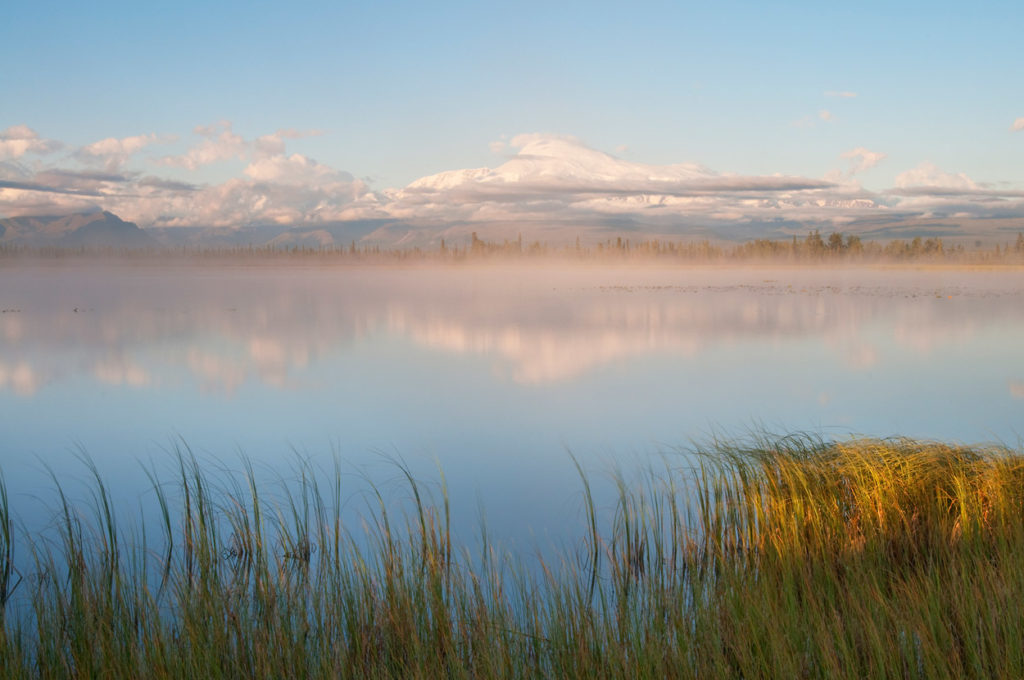
A second, quieter access point exists on the north side of the park: the 42-mile Nabesna Road off the Tok Cutoff near Slana. This side has a fraction of the visitors, more wildlife sightings from the road, and a different kind of country (open tundra, big river valleys). Worth considering if you want a less-crowded experience or are connecting to a Yukon trip.
Who probably shouldn’t bother
If you have only one or two days in the area, or you’re hoping to drive up to a viewpoint and then move on, this park doesn’t really work that way. The McCarthy Road alone takes most of a day each way, and the experience asks for some commitment. A drive-by isn’t going to capture much.
The honest answer
If you’re already routing through Alaska’s interior and have three or four days you can dedicate to it, yes, it’s worth visiting. If you’re trying to fit it into a tight Alaska itinerary on top of Denali, the coast, and Anchorage, it might be a stretch. Either way, plan around the drive time and the limited services, not around expectations of standard national park infrastructure.
If you’re looking for a guided backpacking tour in Wrangell-St. Elias National Park, check out our offerings here.