
Understanding Bear Behavior
Not all bears are the same. The species matters. The situation matters. Reading context is critical.
Grizzly Bears (Brown Bears)
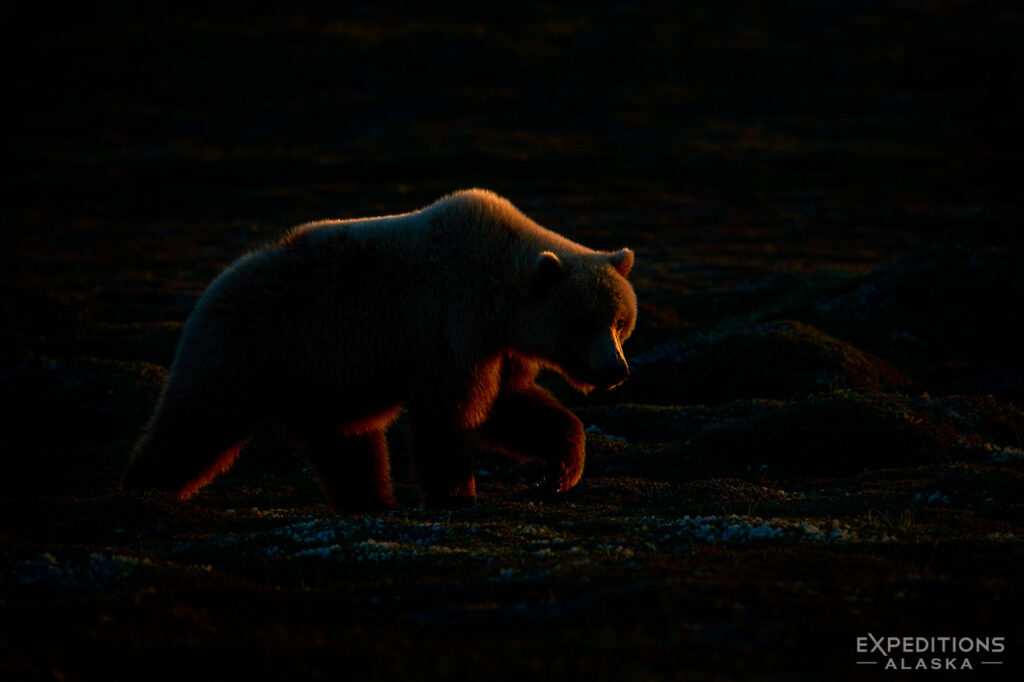
Most grizzly-human conflicts in Alaska are defensive, not predatory. Someone surprised a bear, or showed up near its food source, or it has cubs. The bear feels threatened and reacts.
Our encounters with grizzly bears in the Alaska backcountry have almost always resulted in the bear leaving the area as soon as they became aware of our presence. They’re usually more fearFUL and then fearLESS.
Black Bears
Black bears in Alaska are less aggressive than grizzlies, but when they do attack, it might likely be predatory. A black bear that approaches you calmly and deliberately, without huffing or agitation, may see you as prey.
It’s also been common for us to encounter black bears that simply ignore us; neither frightened nor aggressive. Nonchalant better fits many of those bear responses.
Predatory behavior by bears (even polar bears) towards humans is rare. It requires a different response.
are typically recognizable.
- Huffing, jaw-popping, clacking teeth
- Bluff charges (bear charges partway, often just a step or 2, more of a stomping of the ground, then the bear stops or veers off)
- Agitation, pacing, head-swinging
- Bear seems as surprised as you are
The bear is scared. It doesn’t want to eat you. It wants you gone.
You still need to be wary and keep your distance.
Recognizing Predatory Behavior (Any Species)
Predatory behavior looks different.
- Calm, stalking approach
- Direct stare, focused attention on you
- No huffing, no agitation. Just intention
- Silence
This is the bear you want to avoid, or defend yourself from.
If You Encounter a Bear
There’s no one-size-fits-all protocol. Every encounter is different. Read the situation and respond accordingly.
Initial Response
Running triggers a chase response. You can’t outrun a bear. Don’t try.
If you’re with others, move together. Slowly. Don’t scatter. A tight group looks bigger and more intimidating than individuals.
Stop moving. Stay calm. Assess what’s happening.
Use a low, calm voice. “Hey bear. We’re just passing through. We’re leaving.” The point is to identify yourself as human. Your voice will help do that. You’re not trying to shout or challenge.
Read the Context
If it hasn’t seen or smelled you yet, and you’re far enough away, you might be able to move quietly out of the area without ever getting its attention. Sometimes the best option is to enjoy the moment, and leave unnoticed.
Surprised bears are defensive. They’re reacting to a perceived threat (you). Give them space and an escape route. Don’t corner them.
Mother bears with cubs are extremely defensive. If you see a cub, the mother is close. Back away slowly and carefully. Do not get between a mother and her cub.
A bear on a carcass or a salmon stream is defending resources. It doesn’t want to share. Give it a wide berth.
This is the one that’s concerning. If a bear is coming toward you without agitation, without huffing, just focused and intent. That’s predatory behavior.
If/Then
If the Bear Charges
Many grizzly charges are bluffs. The bear runs at you, then stops or veers off. It’s trying to scare you away.
Don’t run. Don’t scream. Hold your position. The bear will likely stop.
If the bear keeps coming and makes contact:
- Pepper spray
- Protect your neck and head with your hands
- Lie flat on your stomach or curl into a ball
- Play dead
- Stay still even after the bear leaves. It may come back to check.
Go to the ground
- Pepper spray
- Fight back
- Use anything you have: rocks, sticks, trekking poles
- Go for the eyes and nose
- Be aggressive
- Do not play dead
- Fight back
- Black bears are more likely to be predatory
- Do not play dead for a black bear
If the Bear Doesn’t Charge
- Speak calmly
- Back away slowly
- Keep your eyes on the bear, but don’t stare it down
- Give it space and an escape route
- Don’t turn your back until you’re well clear
- Let it go
- Wait until it’s out of sight
- Leave the area
- Take a different route if possible.
Bear Spray
A Tool, Not a Solution
Bear spray is effective, but it’s a last resort, not a primary defense. It’s also a tool that requires good judgment to use safely.
20-30 feet. That’s it. If a bear is farther than 30 feet, you’re wasting spray and creating a cloud you might walk through. If it’s closer than 20 feet and charging, you should already be (s)praying.
- Remove the safety clip (thumb in front of curved tip, pull back toward you)
- When bear is 20-30 feet away, aim slightly downward in front of the bear’s head
- One to two second blast
- Cone-shaped fog fills the space in front of you
- If the bear keeps coming, spray again
That’s it. You can’t hold the trigger down and hope. Short, controlled bursts. Make them count.
Try to spray downwind if you can. The force of the spray can overcome light wind, but even a small amount of blowback will affect you. Getting sprayed yourself makes it hard to function, see, or breathe.
If it retreats, great. Leave the area immediately. If it stops advancing but doesn’t retreat, back away slowly, keeping the spray ready.
Bear Spray Reality
Bear spray is often viewed as a “necessary liability.” It works. But it also carries significant risk to your group if mishandled.
An accidental discharge in a tent, in a plane, or in your pack can incapacitate everyone nearby. If someone accidentally triggers a canister, everyone in the area suffers.
- Don’t store above 120°F. Pressure builds and the canister can explode
- Don’t store below -7°F. Pressure decreases and it won’t spray properly
- Keep accessible at night when camping
- Carry in a holster on your body (not in your pack)
Buy an inert practice canister and rehearse deploying it. Know how to remove the safety quickly. Know what the trigger feels like.
Don’t bring them. Dispose of them or use them for training only.
Commercial airlines will not transport bear spray. If you’re flying into the backcountry on a bush plane, inform the pilot before departure. They may allow it in a float or external compartment.
Should We Carry a Firearm?
Our View
In short, no.
Our company and our guides have operated safely in bear country for nearly 30 years. Knock on wood.
We have never carried a gun on any of our trips. We have had a few close encounters, but they have been very very rare. We’ve dealt all of those situations with bear spray, our best judgement, and as is always required in the natural world, some good fortune.
Here are our reasons why guns introduce bigger problems.
- I don’t know of a single peer-reviewed study that suggests a firearms provides a greater likelihood of protection than bear spray might.
- Bear spray can be used effectively without nearly the same degree of expertise required of a firearm. A charging bear, at close quarters is probably not a target you’re going to nail with a firearm.
- Even a simple, short training session with bear spray is adequate for most people. For firearms, unless you’re an experienced, excellent marksman/woman, a firearm is a bigger liability than bear spray is. A guide can give a guest a quick 5 minute lesson on the operation of safely carrying and using a can of bear spray. Firearms not so well.
- We’ve seen accidents in the field. I (Carl) have been sprayed directly in the face by a trigger-happy guest with a can of bear spray while a bear wandered the tundra a hundred yards away. I’ve seen guests on another photographer’s tour accidentally discharge an entire can of bear spray and multiple people needed medical attention. We’ve all seen numerous near misses and incidents because someone didn’t quite put the safety cap back on a can of a Counter Assault properly. I’d much rather deal with those consequences (water and some dawn detergent) than had someone been mishandling a firearm in any of those situations.
- Nobody ever accidentally killed another person with bear spray.
- I’ve listened to many conversations amongst experienced firearms experts on what is the best firearm for a backpacking trip in bear country. Even the wisest disagree vehemently. I’ve never heard backpackers argue and disagree on exactly which can of bear spray they should use in which situation.
- The speed and the stress of these situations is not something you can train for easily. Just because you can aim a gun, doesn’t mean you can do so in an event that contains the amount of stress and adrenaline that a negative bear encounter does
- Bear spray is more versatile in different contexts
- Bear spray is more easily shared among a group of people
- The odds you’ll need either are extremely low.
The other side of this many-sided coin
And there are always other sides of a coin. Any coin.
It’s quite possible an encounter involves more than one bear. A sow and 2 two ear old cubs is a handful for a person or small group with a can of bear spray.
For our trips we have to provide safety to ourselves, and to each of our guests. We ask people to not bring a firearm on their trip.
For personal trips, you do you. You may well be a superduper experienced firearms expert and by all means, your best choice will be different to ours. I wouldn’t surmise to tell you what’s best for you.
When the Guide Decides
In a bear encounter, the guide makes the decisions. Not the group. Not by consensus. The guide.
No questions. No debates. No arguments.
You do what the guide says. Immediately. The guide is reading the situation, assessing behavior, and making calls based on experience. There’s no time to discuss or explain. You follow instructions.
After the encounter is over, in a safe place, you can ask why a particular decision was made. Not during.
Pop Quiz
e.g.,
You’re set up for the evening, enjoying dinner, and a bear is spotted approaching camp. Your guide says “pack up all your food immediately.”
Your response is?
a) pack up all your food immediately?
b) put your food down and go get your camera?
c) enjoy the show while you continue to eat your pizza?
d) carry your pizza and your camera with you while you approach the bear for a better photo?
The correct answer is NOT b, c or d.
This information is based on standard bear safety protocols and the operating procedures used by Expeditions Alaska. For more detail on bear behavior and safety, consult Alaska Department of Fish and Game resources.