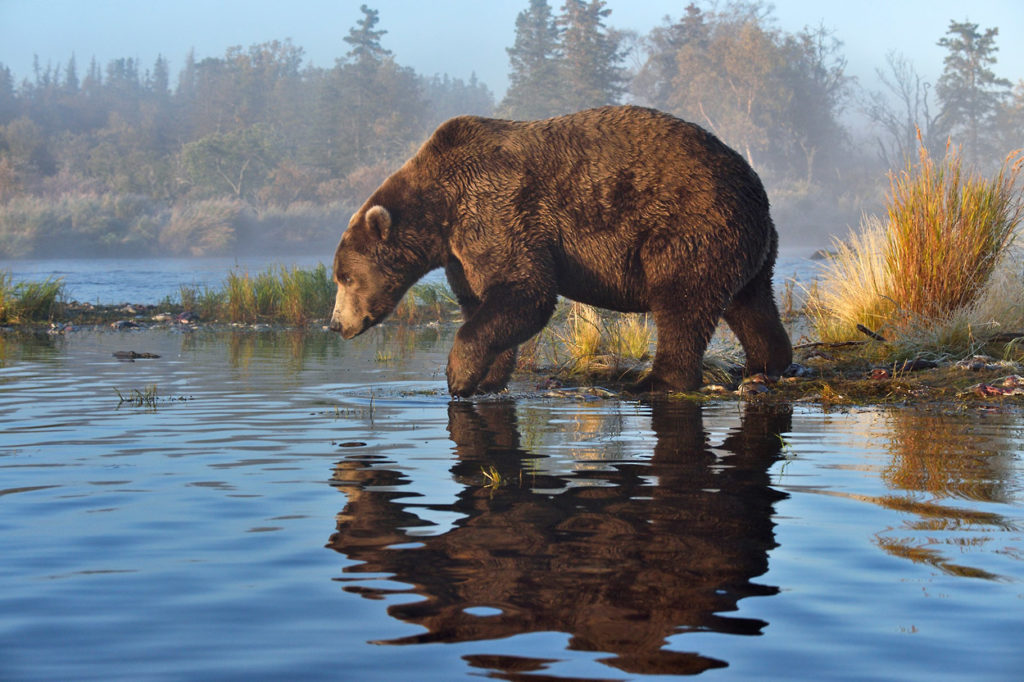
No, Alaska brown bears and grizzly bears are the same species, Ursus arctos. The naming convention splits by habitat, not by biology. Coastal populations with salmon access get called brown bears and grow massive. Interior populations without salmon get called grizzlies and stay smaller. Same animal, different diet, different habitat. Kodiak is a subspecies of that same species.
What the science says
Every brown bear, grizzly bear, and Kodiak bear in North America is Ursus arctos. The taxonomy debate about how many subspecies to recognize has been going on for a long time and shows no sign of settling. Some biologists demarcate multiple North American subspecies. Others argue for two or three. The Kodiak bear (Ursus arctos middendorffi), isolated on the Kodiak Archipelago for around 12,000 years, is the one subspecies almost everyone agrees on.
The rest of the naming convention isn’t really biology. It’s language. “Brown bear” typically refers to coastal populations in Alaska and Kamchatka. “Grizzly” refers to interior populations across Alaska, western Canada, and the northern Rockies. Both names describe the same animal.
My take after 25+ years
For me, they’re all grizzly bears. Some are big, some are small, some are fat, some are dark colored almost black, some are so blond they’re almost white. All of them are the same species doing what the same species does, adapted to whatever’s in front of them.
Calling the Katmai coastal boars “brown bears” and the ANWR arctic females “grizzlies” makes sense as shorthand, but it can be misleading. It implies two different animals. It’s really one animal, wearing very different diets.
The real drivers of the difference
Three variables explain almost every difference you’ll see between an “Alaska brown bear” at Hallo Bay and a “grizzly” on the Sagavanirktok River.
Diet is the first. Coastal bears eat salmon, and a lot of it. Interior bears don’t. That single fact accounts for most of the size difference. A healthy adult male in Katmai during the salmon run may put down 90 pounds of salmon in a day. His interior counterpart is working ground squirrels out of the tundra.
Season length is the second. The salmon run in Katmai lasts weeks. It arrives on schedule, in bulk, at exactly the right time to fatten a bear for hibernation. The interior food base is thinner and more spread out through the year.
Latitude and climate is the third. ANWR bears live above the Arctic Circle. Their active season is shorter. Their den period is longer. Everything about their annual budget compresses.
In practice
On a Katmai trip you’re standing next to bears that push 1,000 pounds regularly and can top 1,500 in the biggest fall boars. Same species, on a coastal river with salmon. On an ANWR trip you might see a female bear that weighs 200 pounds. Same species, on the tundra, in a food-thin latitude.
Every trip we run through both habitats reinforces the same lesson. The bears aren’t really different animals. The countries they live in are. What the country produces, the bears become.