Yes, grizzly bears live throughout Gates of the Arctic National Park, on both the south and north sides of the Brooks Range. Black bears are present too, mostly on the forested south side. The population density is low because food is scarce this far north and home ranges are large, but the population is stable. Sightings are uncommon but not rare on backcountry trips.
Where you see them
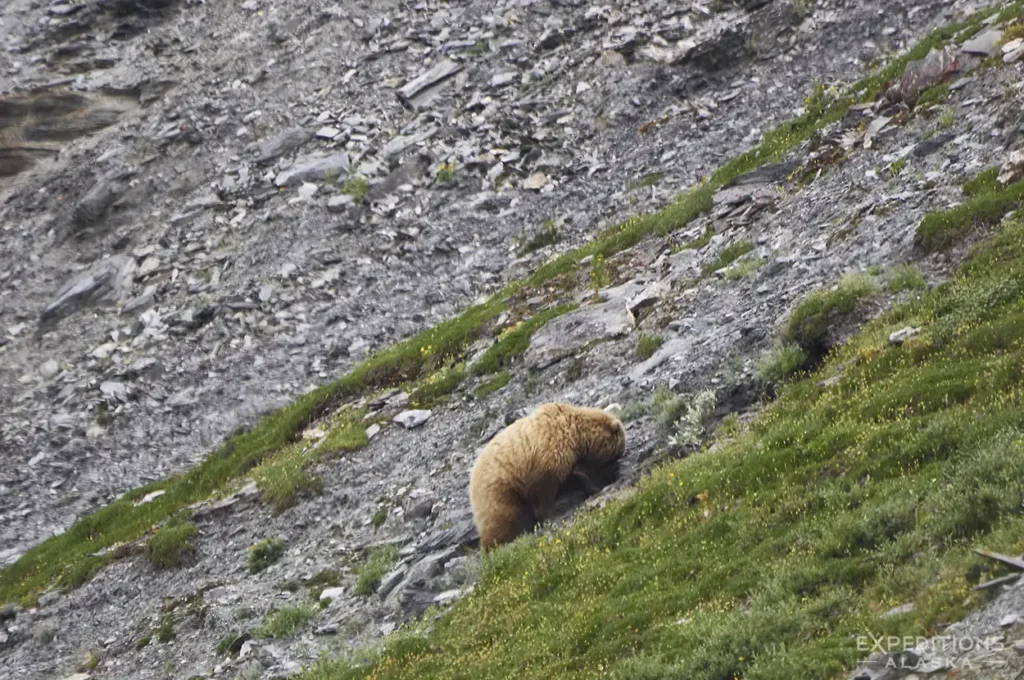
We see grizzlies in three main settings in Gates. The forested valleys on the south side, where they push through alder and willow along salmon-bearing streams. The high alpine passes and tundra benches in the heart of the range, where they dig for ground squirrels and graze on emerging berries. And out on the open tundra, rolling plains, and muskeg of the North Slope, where you can sometimes see one half a mile off across the country.
A North Slope grizzly looks different from a south-side grizzly. Less bulk, longer-legged, lighter colored on average. They’re working with a much shorter season and a much thinner food supply than the salmon-fed bears further south.
Population context
Grizzlies in the Brooks Range have some of the largest home ranges of any North American grizzly population. Individual bears may use territories of several hundred square miles. The food base is limited to ground squirrels, berries, the occasional caribou or moose calf, and whatever they can scavenge. They’re not fat bears. They work hard.
Arctic grizzlies are also notably smaller than grizzly bears further south. The bears in Katmai or Lake Clark eat salmon for months of the year and look like they did. The bears here don’t have that food source. A North Slope grizzly is more wiry, longer-legged, lighter colored, and meaningfully smaller than its southern cousin. They also tend to be more wary of people, because they get hunted in this country and their southern relatives in the major bear-viewing parks largely don’t.
Black bears are restricted to the south side of the range, in the boreal forest along drainages like the Koyukuk and the Alatna. You won’t see a black bear north of the divide.
What this means for visitors
If you’re backpacking in Gates, plan for bear country. Carry bear spray, store food properly, make noise in dense brush, and don’t camp on game trails or in obvious bear travel corridors. Encounters happen. Most are at distance and end with the bear leaving. The NPS bear safety guidance for Gates of the Arctic covers the practical specifics.
What encounters actually look like
In 2011 we were packrafting the Alatna River. Got off the water for camp on a long gravel bar, set the cook tent at the north end and the sleeping tents at the other end. I came out of the kitchen and a grizzly was walking right between the two camps. The bear saw me, ignored me, kept going, walked off into the woods.
It was raining, so we went back in the cook tent. The packrafts were deflated outside the kitchen, paddles and river gear stacked next to them. We heard something, yelled, and opened the tent door. The bear was running back across our gear. Paddles went everywhere. A couple of the packrafts needed patching from claw holes the next morning.
That’s a typical Gates grizzly encounter. The first pass was incidental. The second was expensive but nobody got hurt and the bear didn’t stick around. Most encounters here go that way. The bears aren’t aggressive toward people. They’re sometimes interested in food or curious about gear, which is a problem you solve by storing things properly, not by being afraid.