
Hey Folks,
There is no generic answer to this most-frequently asked question for Alaska backpacking trips. Obviously your fitness, your pack weight, your group, etc, all heavily impact the distance you’ll cover each day. More than that, the terrain itself will determine how far and how fast you travel.
Not just the gradient and uphill/downhill stuff. Those things clearly are important. However, here in Alaska, hiking in places Denali National Park, or Gates of the Arctic or Wrangell-St. Elias National Park or even the Arctic National Wildlife Refuge, the most common determinant, and most profound one, is the terrain itself.
It’s The Terrain, Folks
The footing. What are you walking over? What are you walking ? Heavy, dense alder will slow you down way, way way more than you imagine. Add thickets of Devil’s Club inside that and you’ll be moving very slowly. You might make 3/4mile an hour. Maybe. Even on flat terrain.
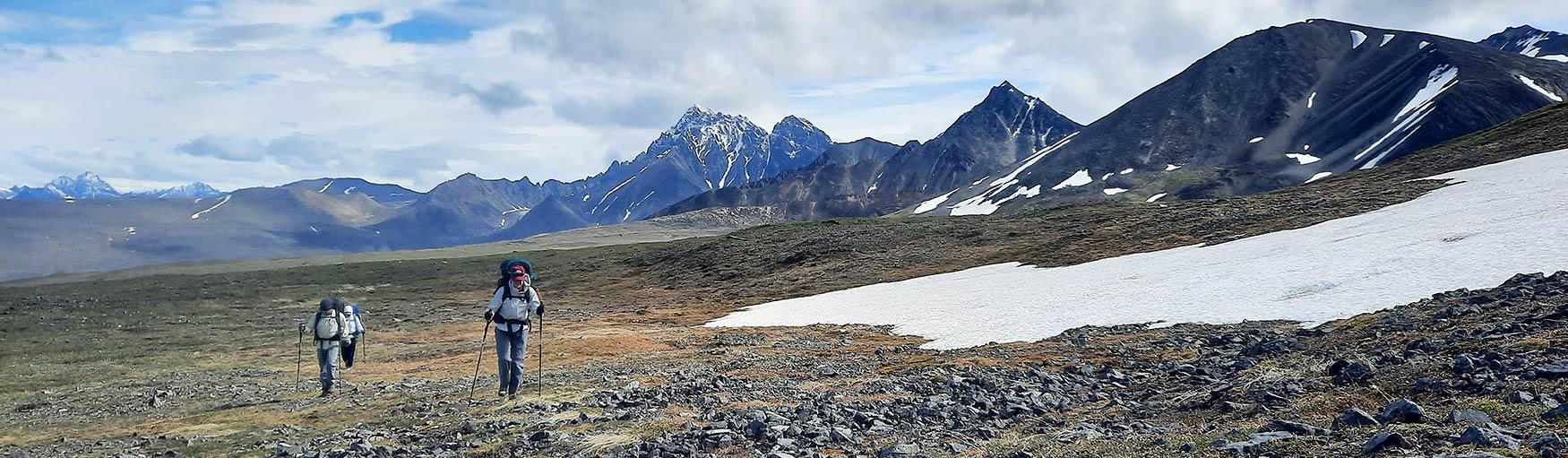
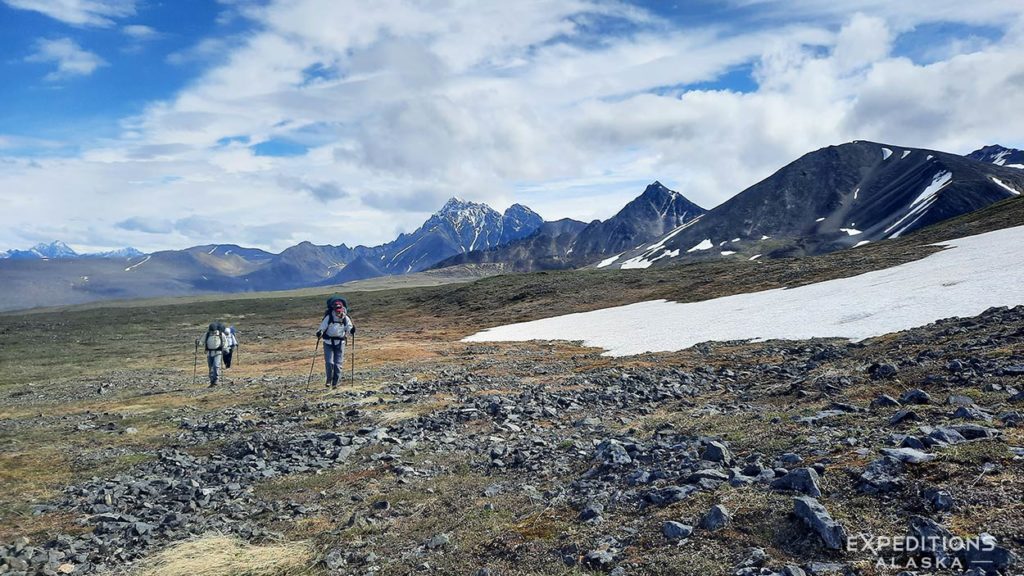
Another terrain challenge we see a lot is rocks. lots of rocks. Glacial moraine can be super slow going. Huge boulder fields can cause some people endless balance concerns, and the result is a slow progress forward. Talus and scree slopes can do that same. For some tips on hiking over rocks and boulders, read this.
Not all people experience this stuff the same way. Some people move through alder, or over rocks, much more fluidly and comfortable than others. My nemesis is mud. LOL There are a few trips where I prefer to add a good bit of distance to my route and avoid a swampy wet sloppy mess underfoot. Other folks don’t mind it at all.
The point of this post is that you shouldn’t concern yourself with mileage. As clearly as I can state, it’s meaningless. Beyond meaningless. The mileage of an off-trail route tells you about how challenging a trip might be, or if that trek is a good fit for you. Nothing at all.
In short, you might make 10 miles today, over good terrain, with no real elevation loss or gain. Nice walking. Tomorrow you might make 2 or 3 miles because you spent a few hours crossing a boulder field or a river or picking your way through alder thickets or sidehilling a talus field. And that day may be the most difficult hiking day you’ve ever had in your life. So don’t fall for the idea of mileage being some useful metric for your trip. It really isn’t. At all. Pay it no heed.
Don’t bother pondering it. Instead, practice carrying a 35lb pack over a boulder field for a couple hours. You’ll be glad you did.
Cheers
Carl
Frequently Asked Questions About Alaska Backpacking Mileage
What’s a good daily mileage for an Alaska backpacking trip?
There is no generic answer – mileage is essentially meaningless for Alaska backpacking. Terrain determines difficulty, not distance. You might make 10 miles in a day over good terrain, but only 2-3 miles the next day through boulder fields, alder thickets, or talus slopes. That shorter day may be the most difficult hiking you’ve ever experienced.
Why is mileage meaningless for Alaska backpacking trips?
Alaska backpacking is almost entirely off-trail in places like Denali, Gates of the Arctic, Wrangell-St. Elias, and ANWR. The terrain itself – what you’re walking over and through – determines difficulty far more than distance. Dense alder, Devil’s Club thickets, glacial moraine, boulder fields, talus slopes, and sidehills create challenges unrelated to mileage covered.
What terrain challenges slow down Alaska backpacking?
Heavy dense alder can slow you to 0.75 miles per hour even on flat terrain. Devil’s Club thickets make it worse. Glacial moraine and boulder fields require careful balance. Talus and scree slopes are slow going. River crossings take time. Sidehilling steep slopes is exhausting. Different hikers handle different terrain challenges differently – some move fluidly through rocks, others through brush, while mud stops others entirely.
How should I prepare for Alaska backpacking if mileage doesn’t matter?
Instead of focusing on mileage, practice carrying a 35-40 lb pack over boulder fields for a couple hours. Train on uneven terrain, not just trails. Work on balance and stability. Understand that terrain difficulty varies dramatically – what seems like easy flat ground on a map may be impassable alder or ankle-rolling tussocks.
How far can I expect to hike per day in Alaska wilderness?
Daily distance varies wildly based on terrain. On good terrain with minimal elevation change, you might cover 10 miles. Through challenging terrain like boulder fields, alder thickets, or steep sidehills, 2-3 miles might take all day. Most Alaska backpackers are surprised by how little distance they cover compared to Lower 48 trail hiking.
What’s the difference between Alaska backpacking and Lower 48 trail hiking?
Alaska wilderness backpacking in national parks like Denali, Gates of the Arctic, Wrangell-St. Elias, and ANWR is almost entirely off-trail. There are no maintained trails in most areas. You’re navigating through brush, over boulders, across rivers, and up steep terrain without paths. The challenge is terrain difficulty, not distance covered.
What Trip is Right For Me?
Not sure which trip you might want to look at? Check out our Explore Our Trips page and filter by location, duration and difficulty. Give it a try →
For More Backpacking Tips & Info
"*" indicates required fields