
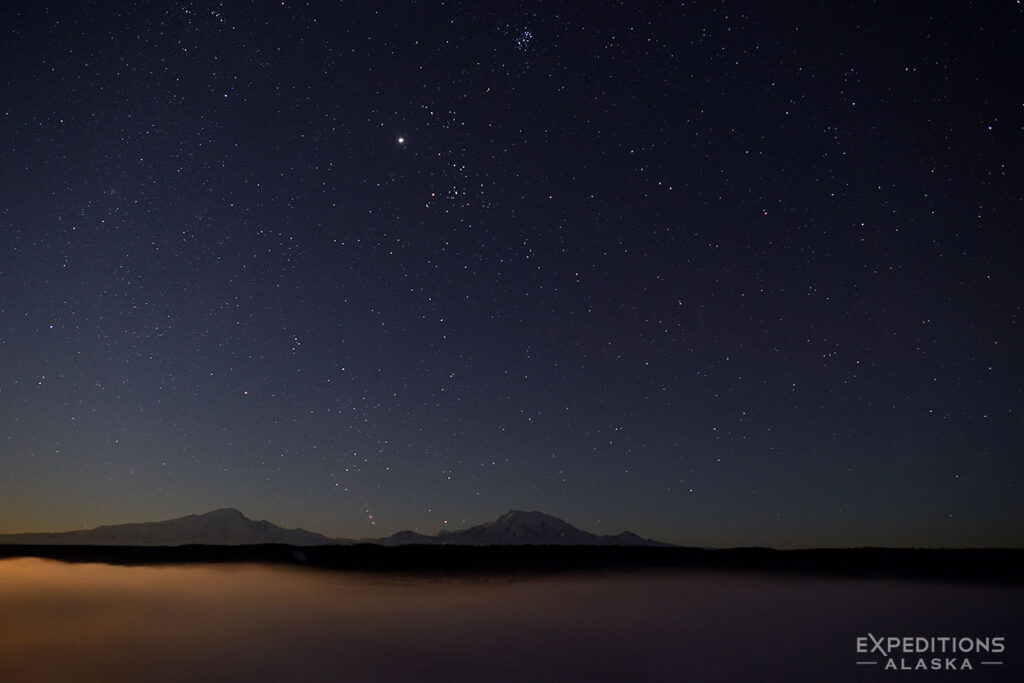
Hey Folks,
With a host of people heading north this winter/spring to photograph the aurora, I thought it might be of some interest to talk a little about the process of shooting photography at night. I know a lot of people have little experience with that, and it really can be a challenge at times. Particularly on a cold frozen night in Alaska when the northern lights start going crazy overhead. We run a couple of Photo Tours for the northern lights, you can check them out here.
So, the first thing I’d suggest, if you haven’t already, is read over my 3 part article on shooting the northern lights. There’s a downloadable PDF at the end of that article you can keep for future reference.
Why Test Shots Matter for Alaska Night Photography
So now that you’re prepared, consider the moment.
It’s dark. It’s cold, maybe minus 20 degrees F; cold enough that your hands start to really feel it after a few minutes. But you’re well-dressed for the cold because you read this article.
It’s dark. You have a headlamp on, and that gives you a little bit of vision out to maybe 30-50 yards or so. After that, you can’t see too much at all.
The aurora starts to fire up, and you want to shoot it.
You can’t see your foreground and composition. It’s dark. You don’t even know if the foreground is worth shooting. It’s dark. You can’t walk around all over and use your headlamp to see, because (a) there isn’t time, (b) there are other people trying to shoot, (c) you don’t want to track up all the snow by stomping around in it.
So setup your test shots. This is probably the most important part of the process.
Set up and do your test shots.
Setting Up Your Test Shots
Increase Your ISO Dramatically
Increase your ISO. I feel pretty good using either my D700 or my D600 at ISO 1600 for northern lights photography. That’s a pretty good ballpark to start with. So, for my test shot, I jack the ISO up all the way; whatever it goes up to; ISO 6400? ISO h1, h2 h3? On my D600, it’s HO2.0 – 4 stops higher than 1600. I turn Noise Reduction off.
I am now using the Nikon Z9 and Z8. Extraordinary cameras. But I don’t shoot with ISO much higher than what I used to with these older cameras above. ISO 1600 is a good target for the lights. My process for the test shot remains exactly as described above.
UPDATE #2; I’ve also now started a Photography tips channel here on the site. Follow along for more info.
Overexpose Deliberately
And I crank my shutter speed; if the correct exposure is, say, 1/15th second at HO2.0, I’ll add maybe 2-3 stops. So let’s just say 1/2 second. That’s way over what the correct exposure should be.
But … the brighter image that results helps me review the LCD more closely for the test shot.
I’ll take a shot.
The Systematic Test Shot Process
Step 1: Review the Scene
I use the test shot method to discern whether a location is even worth shooting.
Driving down the road at night, the aurora kicks on, and I pull over at the first available location to shoot it. I do a test shot or 3 to review whether the scene works or not. I don’t worry about fine tuning focus here.
My first priority is ‘does this scene work for me?’
If not, I’ll take one more shot to make sure; can I turn around and shoot further to the left, right, etc? No? Then back in the vehicle and move on.
(unless the aurora is so absolutely mind numbingly amazing right then and there that I have to shoot it anyway, of course).
So I drive down the road and find a nicer location; maybe with some nice spruce trees in the foreground, or a cool mountain ridge beneath the sky. Stop, test shoot, and review the scene.
Step 2: Check Focus (Most Critical)
Is it sharp? No? .
I don’t care how crooked my horizon is if my photo is out of focus. So I fix my focus (read the article linked above, closely, for info on focusing at night time). Shoot another test shot. Is it sharp? No? Then Repeat. When I’m confident my focus is on, I move to the next step
Step 3: Level Your Horizon
I’ll check things like the horizon. Is it level? No? . Shoot another test shot. Is it level? Yes? Awesome.
Step 4: Compose Carefully
Now I fine tune the composition. Is the composition something I like? No? .
Don’t fix it, change it.
More than likely, it’s not right. So adjust it. Get rid of that weird branch coming in from the side, the footprints in the snow in the foreground, the dead tree sticking up into the frame. Remember moving my location will mean I have to check my horizon again, and possibly my focus as well.
But take the time to get it right. Don’t stay in one place and shoot simply because that’s where you stopped and set up.
Step 5: Dial In Correct Exposure
Now, my image is sharp, level, well composed? Awesome. I’ll start figuring the correct exposure. I’ll bring my ISO back to the ballpark I want it to be in (approx. 1600, usually). Adjust my shutter speed and fire another test shot; review the histograms.
“Histograms? Plural?”
Yes .. the RGB histogram, Red Green and Blue. Don’t waste your time looking at the single luminosity histogram; y.
Do I need to touch it up? Probably. Tweak it, test shot again. Get that histogram correct.
Step 6: Noise Reduction Decision
Now that I have this epic histogram, I know my exposure is where I need it to be. Do I need to turn (long exposure) Noise Reduction (NR) on? Well, maybe. Some folks I know say no. Some say yes. A general rule of thumb is exposures over 4 seconds might require NR turned on.
The problem can be that it effectively doubles your exposure time between shots, turning a 4 second exposure into an 8 second shot, and so on. If you’re taking 30 second exposures, that means one minute between shots. That can mean not shooting an awful lot of photos.
On the other hand, some folks say that temperatures in the vicinity of 0 degrees F and colder, NR really isn’t an issue, because the sensor doesn’t heat up enough to yield noise anyway. This is somewhat camera dependent, so do some tests on your gear, if you can. I generally leave NR off when shooting at night, unless my exposure is over 30 seconds.
Now, take my final test shot. This photo should be right on it. Focused, well composed, level, correct exposure; I’ll review it closely to make sure I got it right. Good? Yes. So I leave everything as is, and shoot and watch the sky. I’ll review things as I shoot them, but be careful not to move anything, or adjust any settings, etc. Even bumping the tripod can mess up the horizon.
When to Repeat the Test Shot Process
Now, I want to switch to a vertical shot? Move a little to my left? I go through the entire process again. Always, always, always.
Remember – it’s dark. What you see with your eye won’t be what your camera records.
Common Mistakes to Avoid
Don’t waste your time trying to capture what you can’t see. Use your camera and shoot the scene to get a view of what’s in front of you. Shoot those test shots. You’ll be glad you did.
Common Problems
What goes wrong when you skip test shots?
You come home with a bunch of images that you don’t want.
Trust me.
Power lines are in your photo. The horizon is irretrievably askew. The exposure is wrong. The composition is lame. (Most commonly) you’re out of focus.
These things are almost always caught in the test shot process and can (usually) be corrected for. But they can’t be corrected when you get home.
Test. Test. Test.
Equipment Checklist
What to bring for night shooting?
Photography gear matters. Don’t listen to anybody telling you it doesn’t.
- A fast f1.4 lens beats a 4.5 aperture for nighttime shooting every day (or night) of the week.
- A full frame body that handles high ISO well is a big win. You can make do with a DX body, but my recommendation for night time photography is always a full frame or FX slr/mirrorless camera.
- A tripod. Your shutter speed will be too slow to hand hold.
- I don’t use a cable release, or a timer.
- Don’t use a filter.
Common FAQs
Can I use my Smartphone?
For the less advanced (or interested) photographer, modern smartphones do well for night time photography. If all you want is some instagram or facebook post images, don’t hesitate to shoot with an iPhone 16 or higher. Or the Android equivalent. The software these modern phones employ is nothing short of magic.
How many test shots should I take?
There’s no simple standardized answer here. Enough to get it .
But it also depends on what you’re missing while you’re testing. If the aurora is going off and you are worried about missing some action, shoot away.
Better still get there early, set up and control what you shoot. Take control of your photography.
Can I use this technique for other night photography?
Absolutely. You should.
What about focusing on stars vs moon?
The moon is tough to focus on and check that it’s sharp. Stars or a planet are easier.
What if conditions change mid-shoot?
They likely will. Especially if you’re shooting the northern lights. Check, and re-check and re-check your exposure and focus. Don’t make the mistake that all the rest of us have so often made where we didn’t check, and end up coming home with a bunch of images out of focus or poorly exposed or whatever because we bumped some setting or the light change or something.
Check your shots for sharpness and exposure often.
Every time you move or adjust the camera. Doublecheck you’re still where you want to be.
It’s all about practice and paying attention to what you’re doing; not the sky.
How do I find the northern lights?
Cheers
Carl