Trip Review: Bremner Mines to Tebay Lakes

September 3rd, 2008 by Carl D
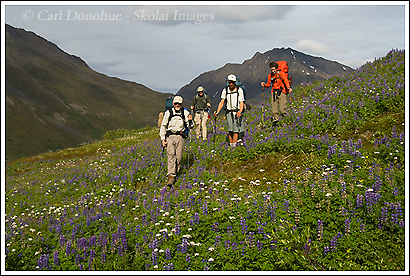
Backpackers hiking through field of wildflowers in the Chugach mountains, between Bremner Mines and Tebay Lakes, along the Klu River valley, Wrangell-St. Elias National Park, Alaska.
Hiking up the Flu Valley.

Klu River Valley Wildflowers

Hey Folks,

I finally get a chance to catch up quickly here – it’s been one trip after another, and though the weather’s not been the best, the trips have all been a ton of fun. I’m heading out in a few days for another basecamp/photo trip, which should be great, and then the season is over – it’s gone WAY too quickly!

One of the highlights this year was our Southern Traverse Backpacking Trip – the first ever commercial trip here, and one of the first groups of people to complete the route. We had an awesome group of experienced hikers, adventurous all, and we had a blast. The route was challenging at times, but enough long mellow stretches of easy hiking that we all enjoyed it.

Continue reading…

Mt Drum from the Sanford Plateau

August 6th, 2008 by Carl D
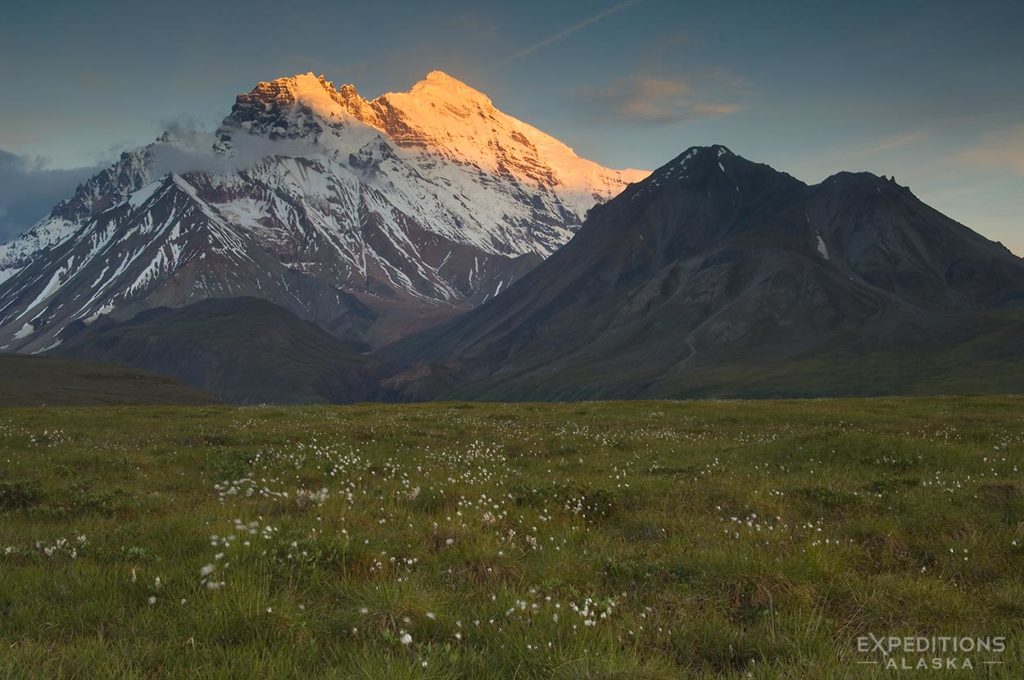
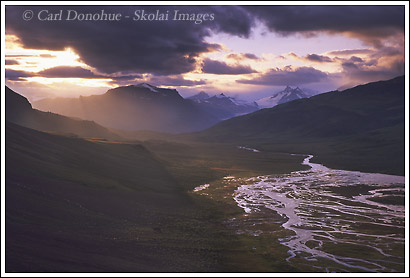
Mount Drum, Sanford Plateau, Wrangell St. Elias National Park, Alaska.
Dawn on Mt. Drum.

Hey Folks,

We just got through a great trip up on the Sanford Plateau, on the north side of Wrangell-St. Elias National Park. The hiking was great, the views sublime, and the group awesome. This image is from our campsite on the 2nd night, where we spent 2 full days enjoying the high alpine tundra and incredible views of the massive mountains nearby – Mt Sanford (over 16 000′), Mt Wrangell (over 14 000′) and Mt Drum (over 12 000′). This image is of early morning at Mt Drum.

The weather wasn’t too bad – a mix of rain, clouds, wind, and calm sunny weather as well – a welcome respite. Much better than the weather on the previous trip to Skolai Pass, where rain, sleet and even a little snow bound us up tight for much of the trip.

I’m excited to start doing more treks on the north side of the park and exploring this area further – we’ll definitely be back on the Sanford Plateau in 2009, and hopefully be able to do a few other trips in the area as well.

I’m off tomorrow for the 2 week trek from Bremner Mines to Tebay Lakes, which I’m very excited about, and hopefully we’ll get some good weather. We’ve a great group of hikers again, and this promises to be loads of fun.

I need to get to bed and get some rest, because tomorrow evening, we’ll be in the backcountry. I’ll try to put a trip report together when I get back on the 20th. Stay tuned!

Cheers

Carl


Sea Kayaking Icy Bay, Wrangell-St. Elias National Park, Alaska

June 24th, 2008 by Carl D
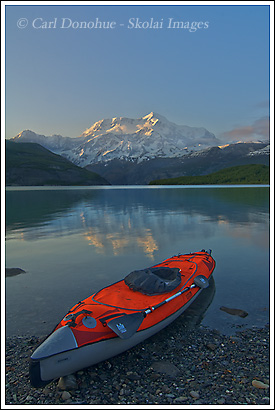
Sea kayaking Icy Bay with Mt. St. Elias in the background, Wrangell St. Elias National Park, Alaska.
Icy Bay and Mt. St. Elias.

Hey Folks,

I just got back from a sea kayak trip to Icy Bay, down on the southern edges of Wrangell-St. Elias National Park.

This will definitely be a trip for next year. It was my first time in this amazing place, and it really is cool. There’s SO much to see and explore in the area.

It’ll be a sea kayaking/hiking trip, a little of everything. the scenery is awesome, and the geology of the place is fascinating. 100 years ago it was a wall of glacial ice, now 3 glaciers have receded, and the valleys left in their wake filled with water, creating 4 deep cold fjords. The Taan fjord is the most navigable for paddling, the Tsaa fjord is almost covered with icebergs.

Here’s a shot from a camp site along the shores of the Taan fjord, Icy Bay, looking out over the bay towards Mt. St. Elias, as it catches the last rays of the sun for the day. Pretty sweet view, eh?

Continue reading…

Summer’s here! Wrangell-St. Elias National Park, Alaska

June 9th, 2008 by Carl D
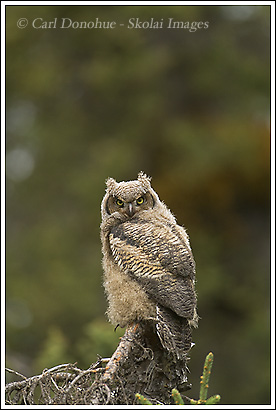
Great Horned Owl Chick, Wrangell-St. Elias National Park, Alaska.
A young Great-Horned Owl perched in Wrangell-St. Elias National Park

hey Folks,

Just a quick post before I disappear for a couple of weeks. The blog will slow down even more the next few months, as I’m too busy hiking and photographing to get much posting done, but I’ll try to update it from time to time.

Anyway, here’s a photo I took a few days ago, when I was lucky enough to find a few Great Horned Owl fledglings, just learning to fly, and not far from their nest. The light wasn’t so great, but these little guys were SO cute! I’ll probably not run into them again as they’ve gained their wings and are heading off on their own before too long. I’m about to head off for a trip for 2 weeks, then heading up to the Arctic National Wildlife Refuge for 2 weeks, which I can’t WAIT to do, so in the meantime, have fun, stay safe, and enjoy the mountains.

Cheers

Carl


First Aid in the Backcountry

May 7th, 2008 by Carl D
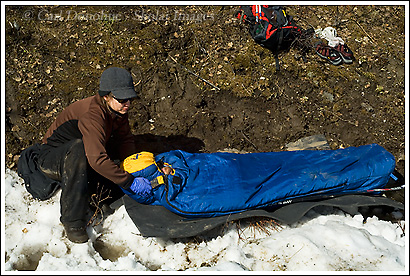
A wilderness First Responder course simulation has this rescuer stabilizing a patient

Hey Folks,

Introduction to Backcountry First Aid

  • Brief overview of the importance of first aid in the wilderness.

With the summer season just around the corner, a few tips on some basic First Aid might be helpful. In this simulation, you can see my friend and Wilderness First Responder, Lisa, stabilizing the patient’s (Jason) neck.

Spine Stabilization in Critical Care

Stabilizing a patients spine is super-important in critical care for all patients who have suffered major trauma, or where the mechanism of injury is unknown. In other words, when the rescuer doesn’t know what happened, and why the patient is suffering.

The best position for a patient whose may have a spine injury is flat on their back, with a rescuer holding their head in what’s called ‘anatomical position’ – basically, as straight as possible. Moving the head, or allowing the spine to flop around, can easily cause the spinal cord to be ruptured, or severed, causing permanent disabilities to the patient.

Continue reading…

Protected: Skolai Pass PhotoTour

March 28th, 2008 by Carl D

This content is password-protected. To view it, please enter the password below.


Bear Spray Effectiveness – How Effective is Bear Spray?

March 27th, 2008 by Carl D
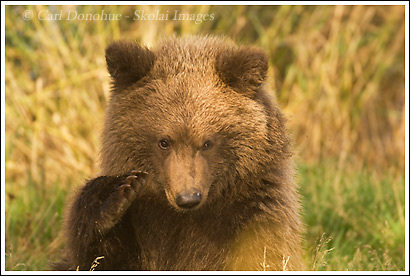
Grizzly bear cub photo, Katmai National Park, Alaska.
Would you spray this little guy? What about if his mom was running at you?

Introduction

A lot of people ask about bears and bear spray and guns and what we do for safety.

We don’t carry guns on our bear trips, and nor would I be comfortable with someone on the trip carrying a firearms, unless there were some very extenuating circumstances. I do carry bear spray, and we usually take 2 or 3 cans per trip, depending on the size of the group.

Bear Spray vs Firearms – What the Research Says

A recent Canadian study showed bear spray to be quite a bit more effective than firearms might be. The study looked at data from the last 20 years, and concluded bear spray is generally a safer option than firearms. “Despite persistent doubts among hikers and campers venturing into bear country, you’re better off with an eight-ounce can of bear spray than a gun, according to an analysis of 20 years of data.

Canadian and U.S. researchers announced that they found

  • Bear spray stopped aggressive bear behavior in 92% of cases.
  • Firearms were effective about 67% of the time.

Whether that behavior was an attack or merely rummaging for food the spray worked with nearly 100% efficacy. Guns were noticeably less effective.

Continue reading…

Winter Outdoor Gear for Alaska?

March 23rd, 2008 by Carl D
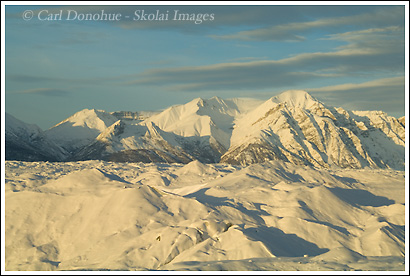
The Kennecott Glacier and moraine covered in snow one early winter morning and Chugach Mountains in Winter, Wrangell-St. Elias National Park, Alaska.

Hey Folks,

Common Questions About Winter Gear

I hear most frequently; what do you do in the winter?

Well, as winter just wound to a close, I thought I’d post a short note about winter outdoor gear.

Alaska Guide’s Winter Outdoor Gear

All in all, what’s the best outdoor hiking and backpacking gear I bought this winter? What piece of gear really rocked my world?

Down Booties

A $40.00 pair of Sierra Designs Down Booties! These things rock! Kept my feet warm and happy during the coldest of days – not quite 50 below zero! I was really impressed with them. Sierra Designs make some good gear, but these are the best buy of the season. Comfortable, light, durable, cheaply priced and stylish! Other candidates for good buys or just good winter gear were:

Insulated Hat

* My Lowe Alpine Mountain Cap. I don’t even know if this is still made – I’ve had mine for over 10 years, and it’s still good as new. It now officially counts as my oldest piece of 1st-tier gear.

Sleeping Bag

My North Face Firefox sleeping bag, which is no longer made, is just as old, but I don’t use it most of the time, after buying the Western Mountaineering Ultralite 18 months ago. Regarding the cap, I have the Triple Point Fabric version and they also have a Gore-Tex version. This hat is awesome, fleece-lined, and toasty! And it looks cool as well!

Cold Hands?

* A surprise contender, for me, is the REI fleece gloves I have .. they’re fingerless, but with a little extra fold-over mitten .. these are great, I can fold the mitten cover back, exposing my fingers for operating a camera, and quickly cover them back up as it gets cold. Unless it got REALLY cold, these gloves we re just fine this winter. Well-priced, and warmer than I thought they might be.

Snowshoes

* Atlas 1030 Snowshoes. Excellent shoes for getting around in the powdery snow in Wrangell-St. Elias National Park, good traction cleats, lightweight rugged construction, and easy to fix buckles. Great snowshoes for just about any snowshoeing trip, though not cheap either.

If you’re looking for something to spend your tax refund on, you won’t go wrong with any of the above gear, and it’s probably all marked down for end of season sales.

Cheers

Carl


Book Lists

March 21st, 2008 by Carl D
Sunset over Skolai pass, Wrangell-St. Elias National Park, Alaska.

Hey Folks,

Anyone out there looking for some good reading material? I thought I’d make a post that lists some books I’ve really enjoyed – I’ll add to it as I go, and would appreciate any visitors adding their favorites to the list. I’ll start with some great nature books:

  • Thoreau (of course): My favorite is “Walking”
  • Jack Turner: “The Abstract Wild”
  • Derrick Jensen: “Listening to the Land”
  • Paul Shepard: “Coming Home to the Pleistocene”
  • Jack London: “Call of the Wild” (I know, I know, it’s fiction, but wow, what great fiction!!!!)
  • Wendell Berry: “Another Turn of the Crank”
  • Doug Peacock: “The Grizzly Years”
  • Aldo Leopold: “A Sand County Almanac”
  • Bill McKibben: “The End of Nature”

That’s enough for starters – I’ll add more as they come to me!

Cheers

Carl


Canning River Rafting Trip, ANWR, Alaska

March 10th, 2008 by Carl D
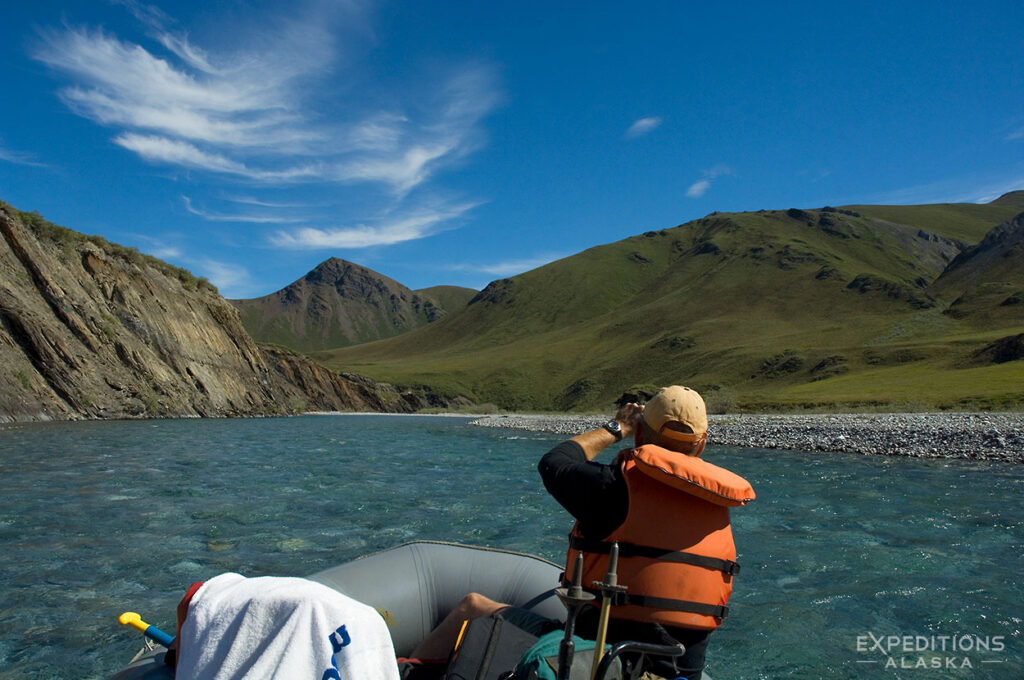
Rafting float trip, Canning River, Arctic National Wildlife Refuge, ANWR, Alaska.

Hey Folks,

Rafting Trip Announcement

The Canning River, ANWR

I’m super excited to announce the 2008 Canning River Rafting trip in the Arctic National Wildlife Refuge, or ANWR, this coming July.

We’ll be leaving Fairbanks on June 29, and don’t return until July 14. That’s 2 solid weeks of exploring and traveling in the arctic is hard to beat. Room is a premium on this trip, so it’s wise to get in early. 2 people are already booked, and we won’t have more than 5 people on this trip, plus 2 guides, so definitely start making preparations!

ANWR

The trip will include flying into ANWR, to the headwaters of the Marsh Fork, in the heart of the Brooks Range, just on the north side of the Continental Divide.

Marsh Fork & Canning River

The Upper Marsh Fork is pristine mountain terrain, and we’ll spend some time exploring and hiking the peaks and valleys to see more of this region as we make our way north. After a couple of days we join up with the Canning River, continuing through the Brooks Mountains – spectacular country.

We go through 2 very cool canyons; they’re short but really neat little canyons. Sometimes Dall sheep are in the area, and caribou, grizzly bear, wolves and wolverines too!

The Coastal Plain

Gradually, as we wind our way north, we reach the coastal plain, which is seemingly endless. The Canning and the Staine Rivers (pronounced Steen) lead us to the coast, where we’ll see the arctic ice pack, just off shore, the Beaufort Sea and Arctic Ocean.

We’ll visit the renowned Bird Camp, and hopefully get some great opportunities at photographing migratory birds that visit the area, including tundra swan, shorebirds, sea ducks, loons, and maybe even snowy owls. Arctic foxes and red foxes are in the area, and we’ll also see arctic terns as well. The Arctic National Wildlife Refuge is famous for 2 herds of caribou, the Porcupine Caribou Herd and the Central Arctic Herd, and we have a good chance of seeing either as they make their way along their migratory routes.

Trip Plan

We’re allowing plenty of time for this trip. We won’t be pushed for time, we’ll have lots of free time for hiking and photographing and exploring along the way. We’ll try to get around in the best hours for wildlife viewing and landscape photography, as the midnight sun allows 24 hour travel. A trip to ANWR is always a treat, and I can’t way for summer to roll around and to get back up to this incredible place.

Rafting is the way to travel in ANWR, we’ll cover lots of ground with little effort, there are very few rapids at all, it’s a great float down the river. We will do some hiking on both the coastal plain and in the mountains, but with the raft we can get ourselves and all our gear over 100 miles northward with far less effort than a regular backpacking trip would require. Campsites abound along the way, and we’re sure to have a blast. The weather in the high arctic is typically dry during the summer, so it’s a trip that’s hard to beat. Contact me at Expeditions Alaska for more information.

We also have an exceptional ANWR Backpacking trip you should check out.

Cheers

Carl


Expeditions Alaska
Visit the wild