Lake Clark National Park
Lake Clark National Park covers 4.1 million acres. Most of it is designated wilderness. The park averages fewer than 10,000 visitors in a typical year, making it one of the least visited national parks in the country. That’s the setting for this trip.
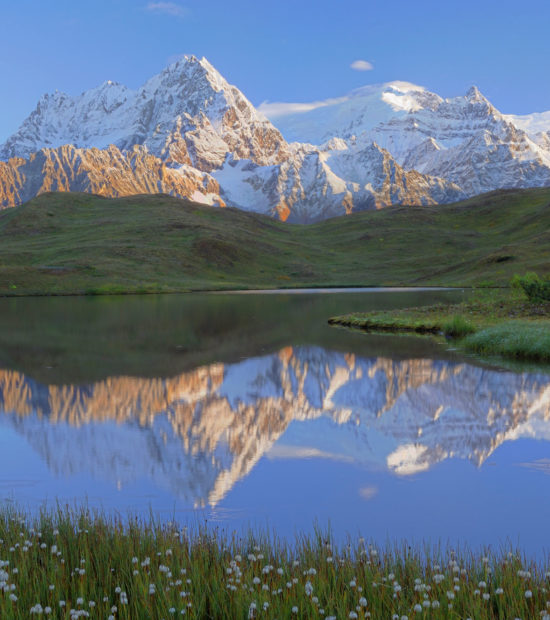
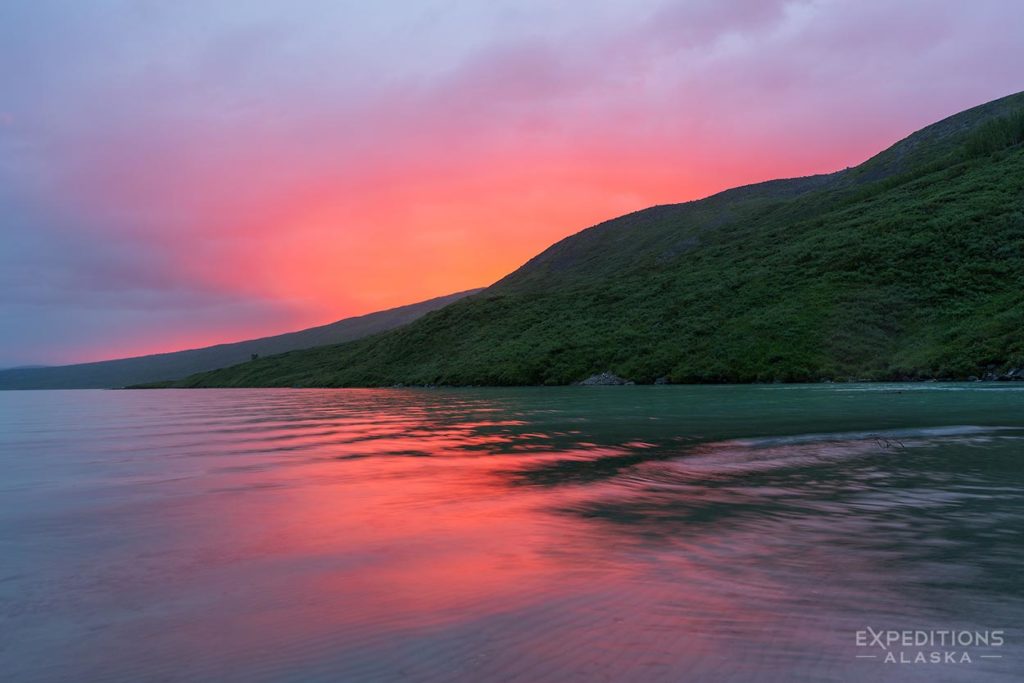
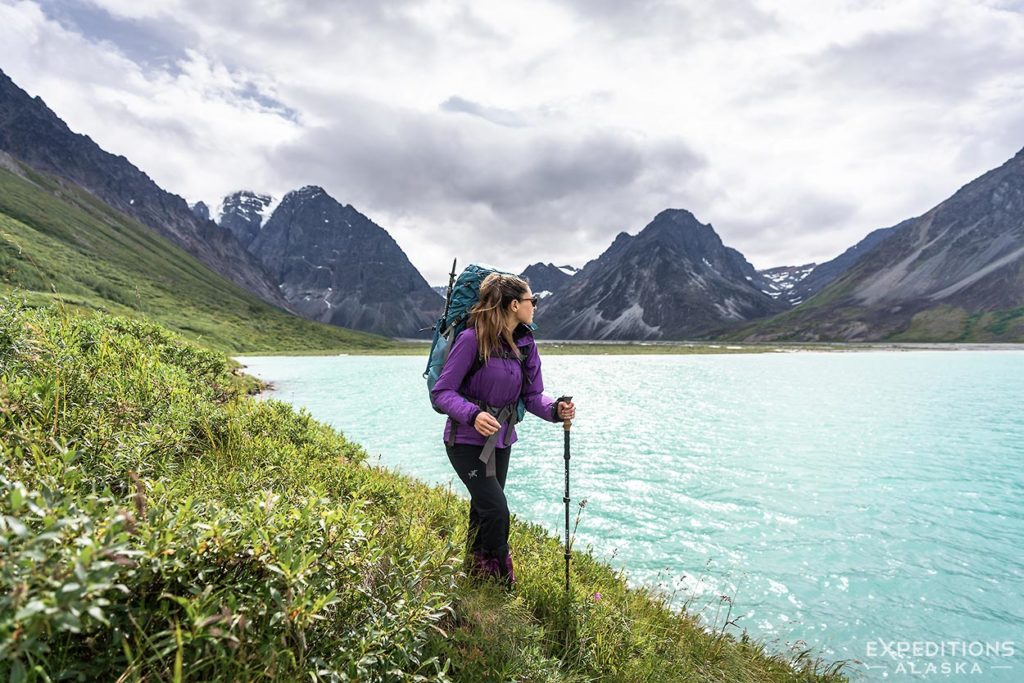
The route starts at Turquoise Lake, a glacial lake at the foot of the Chigmit Mountains in the southern Alaska Range. The water really is turquoise. Glacial flour suspended in the lake scatters light in a way that has to be seen to be believed. We usually spend our first day exploring the valleys near the lake before heading south.
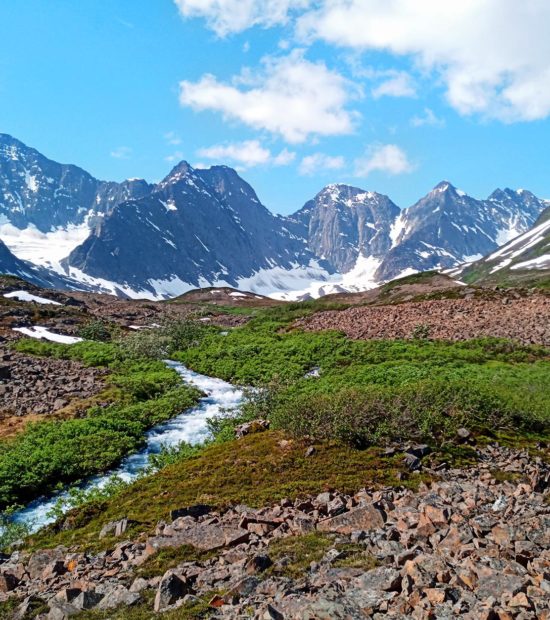
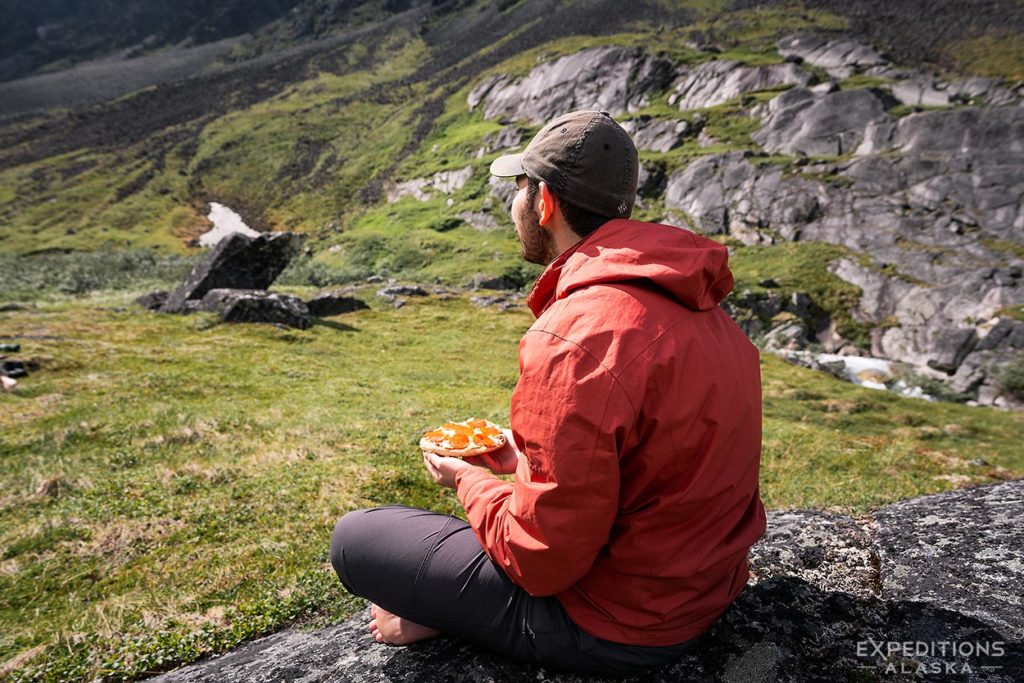
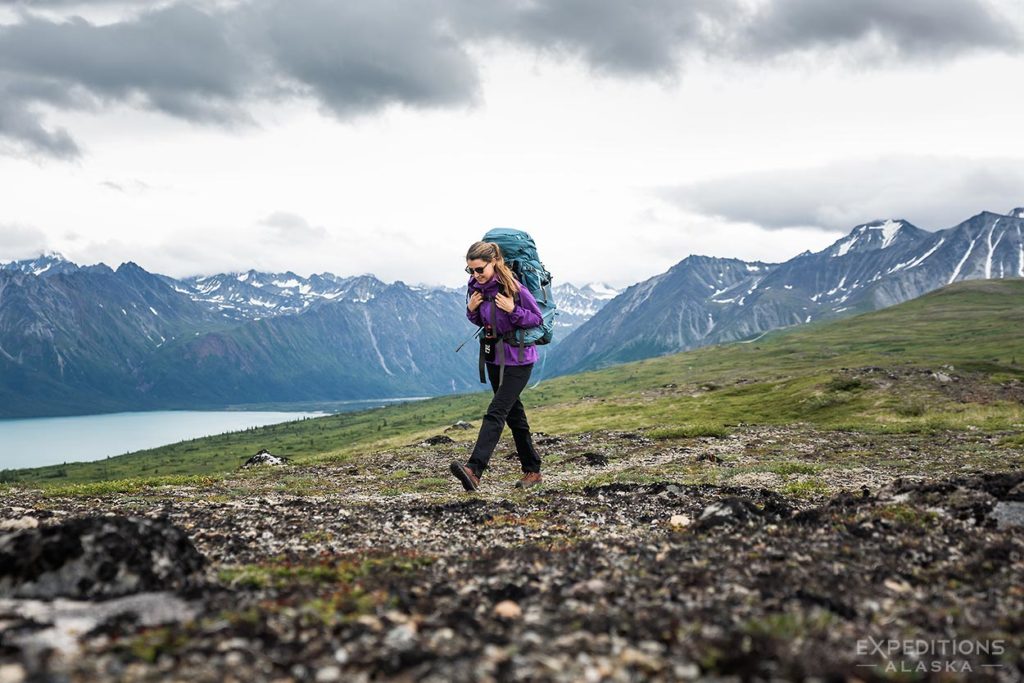
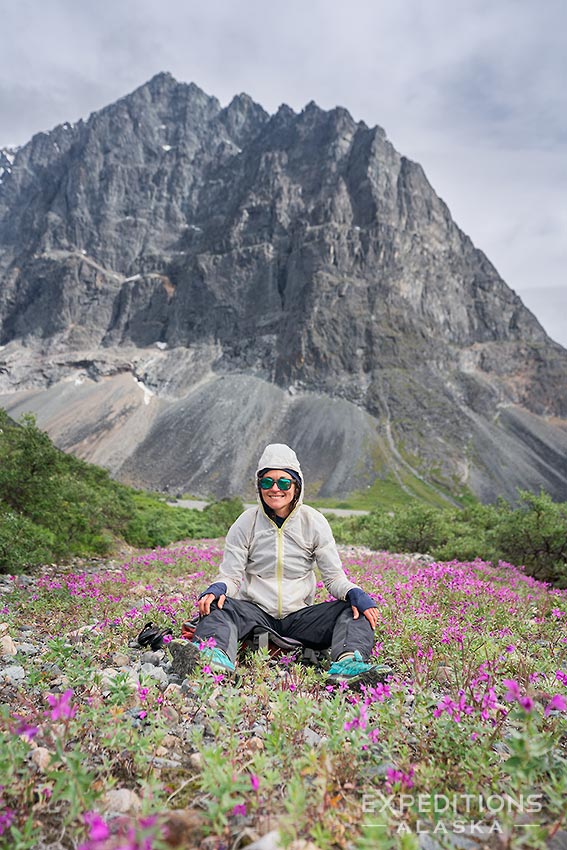
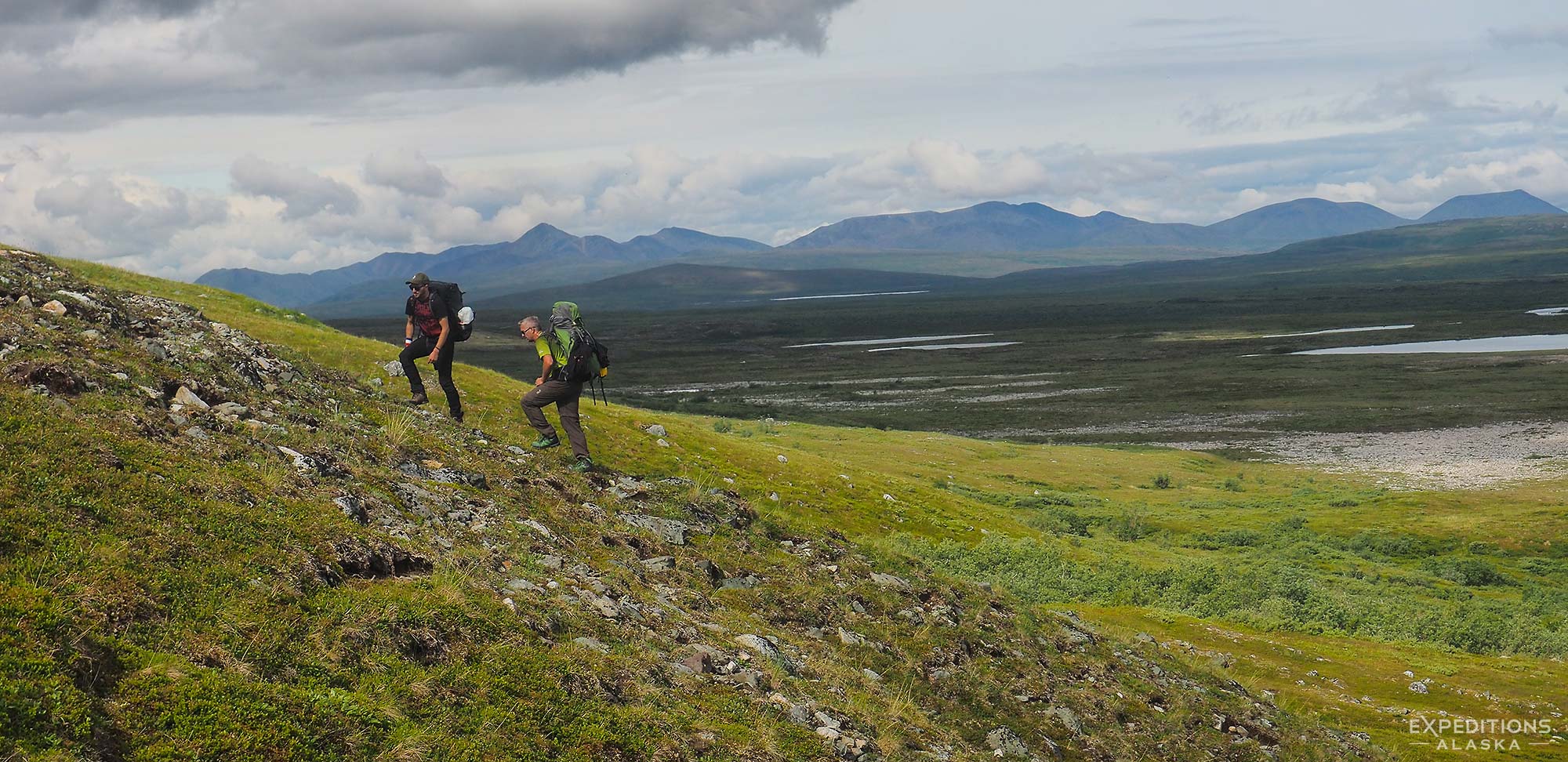
From Turquoise, we climb onto the tundra bench above the lake and head south through alpine country. The walking here is open, rolling tundra carpeted with wildflowers in early summer. No trail, but no need for one. You can see for miles in every direction: glaciated peaks, hanging valleys, the occasional cluster of alpine tarns. The terrain is honest. What you see is what you walk.
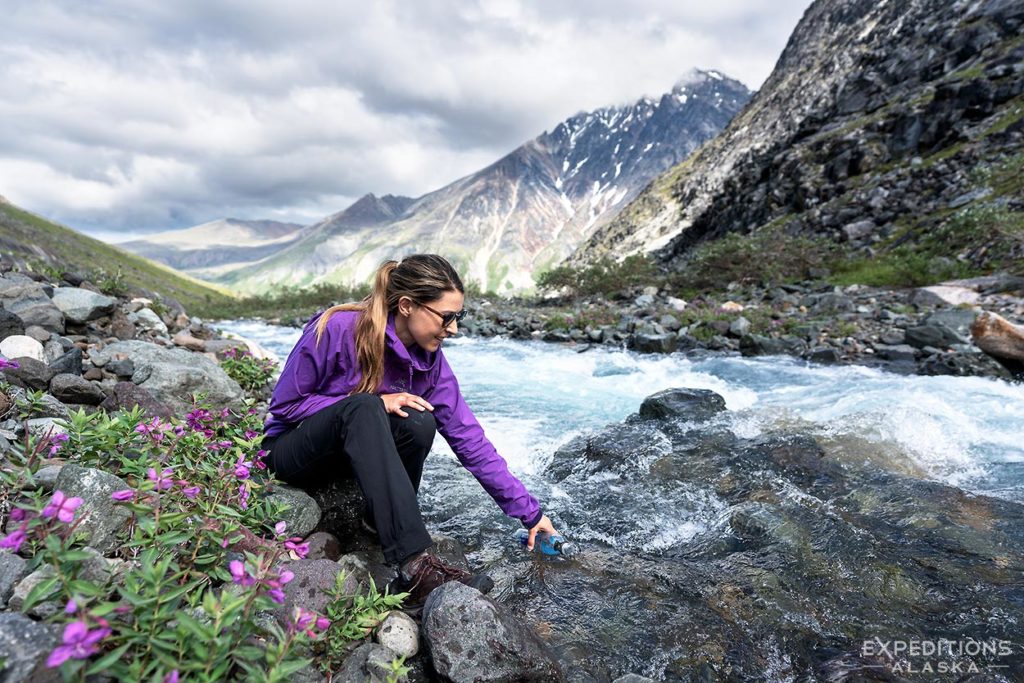
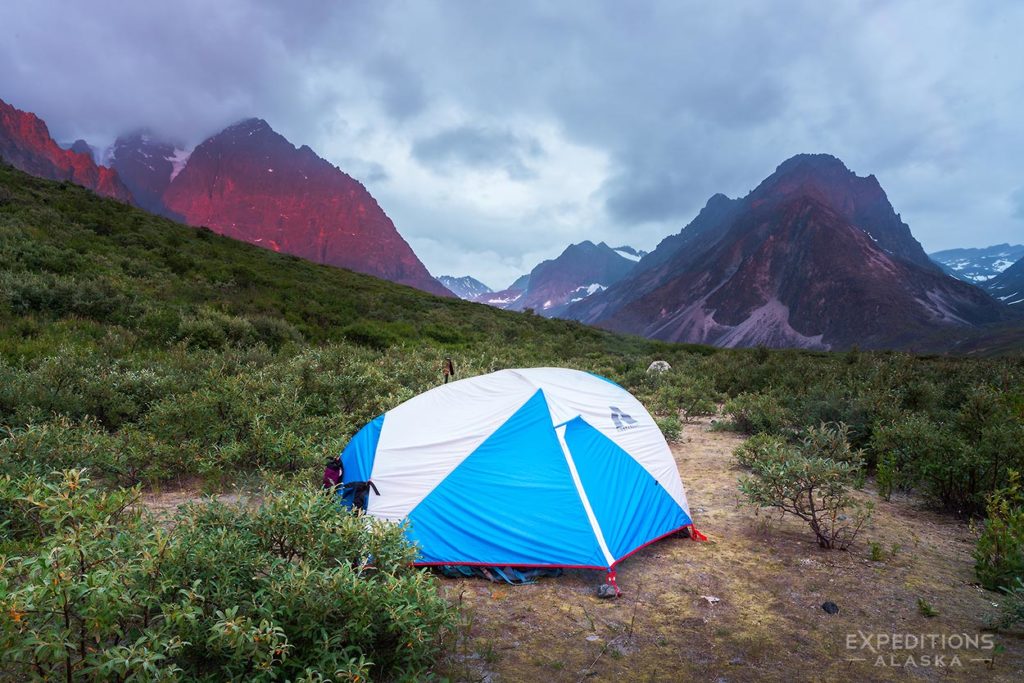
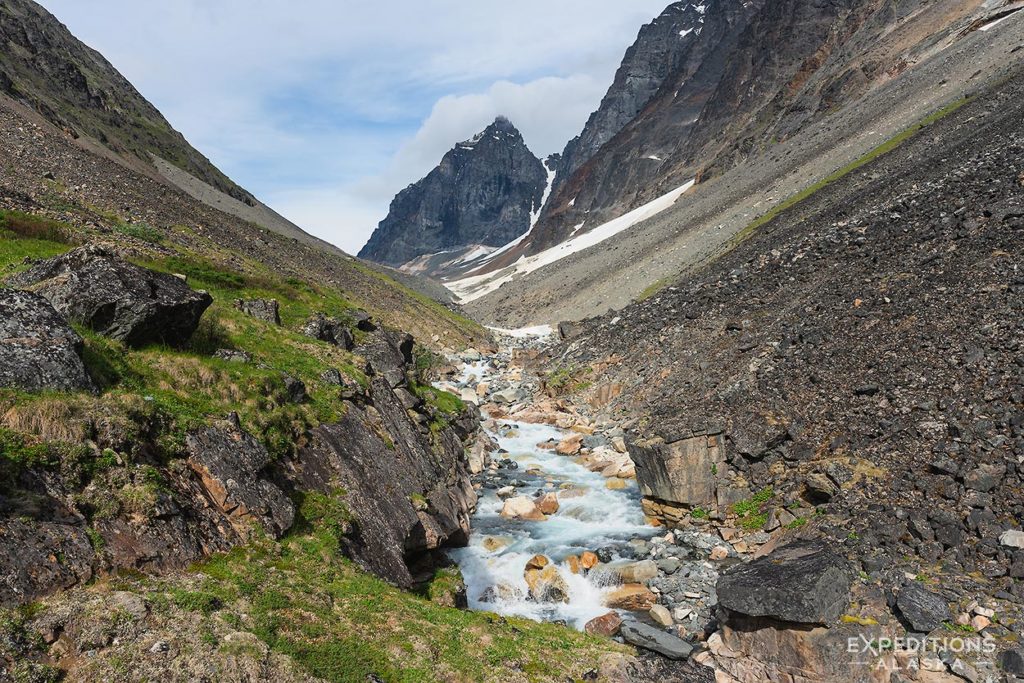
The middle section of the route takes us through the high country between the two lake systems. This is the heart of the trip. Alpine campsites with views that don’t quit. Clear streams for water. Room to wander and explore side valleys if the weather cooperates.
As we descend toward Twin Lakes, the landscape shifts from open tundra to scattered spruce forest. Twin Lakes sits lower and feels different from Turquoise. More boreal, more enclosed. This is where Dick Proenneke built his famous hand-hewn cabin in 1968 and lived alone for over 30 years. If the Chilikadrotna River is crossable, we walk to the cabin. If not, our pilot picks us up on the near shore. Either way, we end the trip with a floatplane ride back to Anchorage.
Wildlife
I always hesitate to promise wildlife sightings. Animals are wild. They do what they do, and they’re never quite as predictable as we’d like them to be.
That said, this is excellent wildlife country. Brown bears are common on this route and we see them on most trips. Dall sheep too, often visible on the higher ridgelines above the tundra. We’ve seen moose, red fox, and wolves here as well.
The birding is strong. Bald eagles and golden eagles patrol the valleys and mountain passes. Ptarmigan, Arctic terns, and a range of smaller birds round out the list. It changes trip to trip and season to season.
The terrain is open enough that you’re glassing the landscape constantly. It’s one of the things that makes this route so good for wildlife viewing. You’re not hemmed in by forest. You can see what’s moving across the tundra from a long way off.
Where Are We
A Match?
Who’s It For?
Among our Alaska backpacking trips, this one is on the easier end of the scale. We feel it’s a pretty good introductory Alaska trip for most people. backpackers with less experience, or not quite as fit as some others would find this a great trip; challenging and adventurous, but definitely manageable for most people
Experienced backpackers will certainly have a grand time with it, as the scenery and the hiking is superb, wildlife are common, and it’s a wonderful wilderness to spend some time.
Don’t ever think of a backpacking trip here in Alaska as “Easy”. As always, you have to be in decent shape and at least a little bit durable to endure what Alaska puts out there. But it’s always a treat.
If you are interested in seeing the area but without the adversity of a backpacking trip, inquire about a basecamp option.
Challenges
Don’t think, however, that makes it easy. Sure, it doesn’t seem that far. And it’s not terribly hard terrain. Mostly tundra and some bushwhacking to get you started.
There is some brush to wade through in the lower stretches of the area, but it’s not an awful lot and it’s not horrible brush (not all brush is the same). And you get out of the brush soon enough and the walking is much easier. We even end up with a rough social trail near the end that makes the final part of the hike more manageable.
The Chilikadrotna River can be a crossing, at higher water. We can (usually) avoid that by communicating with our pilot and getting picked up on the other side if the crossing is too sketchy.
As always, weather can be adversarial and tough. It can also be glorious. Hope for the latter and pack for the former.
FAQs
-
Can we visit Dick Proenneke's cabin?
We try to include a visit to Proenneke’s historic cabin on Twin Lakes, and we make it there on most trips.
The main obstacle is the Chilikadrotna River crossing near the west end of Lower Twin Lake. At higher water levels, particularly mid-summer, this crossing can be unsafe.
We stay in contact with our pilot and adjust the pickup location accordingly. If we can’t safely cross, we arrange pickup on the near side of the river. It’s one of those things we can’t guarantee, but we do everything we can to make it happen. -
How is this different from the Turquoise Lake Basecamp trip?
The Turquoise Lake Basecamp trip stays put at Turquoise Lake.
You fly in, set up camp, and explore the area through day hikes. No heavy pack, no point-to-point travel.
The Turquoise Twins backpack covers the full 23-mile traverse from Turquoise Lake to Twin Lakes, carrying everything with you.
If you want the scenery without the pack weight, the basecamp is the way to go. If you want the full traverse, this is the trip.
-
What time of years is best for the Turquoise to Twin backpacking trip?
June through September all work. Early season (June) brings longer daylight, wildflowers, and potentially some lingering snow in the higher passes.
Mid-summer (July-August) means warmer temperatures and the best conditions for river crossings.
September brings fall colors and fewer bugs but shorter days and colder nights.
Each window has its own character.
-
Do we fly from Anchorage or Port Alsworth?
We charter a direct flight from Anchorage to the backcountry and back. No connecting flights through Port Alsworth. This saves a travel day in each direction and means fewer moving pieces. You arrive in Anchorage, we fly to Turquoise Lake. When we’re done, we fly back to Anchorage.
-
These trips really don’t seem that far?
In Alaska, as with most off-trail hiking, route mileages are deceptive and often somewhat useless information. People often have a tough time hiking here simply because they don’t understand different it can be.
A 30 mile route may sound like a nice 4 day walk but in reality 30 miles of off-trail Alaska backpacking is probably a 6 day walk for most hikers.
Hiking off-trail often involves moraine and scree slopes, steep sidehill traverse, route finding and bushwhacking, stream and river crossings, etc. Suffice it to say that maintaining an average speed of 3 miles per hour is pretty tough going here for any real length of time. A 5-7 mile day will in most likely be a tough day for most hikers.
Most people think in terms of distance and elevation gain/loss, and that’s really not typically the main factor here in Alaska. The type of terrain you’re hiking on is typically the biggest factor. And that terrain can change drastically in a short distance. You might get an easy mile of walking over open, rolling tundra, then hit a glacial moraine and that WILL slow you down.
So don’t think of these trips in terms of the mileage. At best it’s an estimate and more often than not completely irrelevant information. I put it on the website only because it’s what many people want to know. It’s gives a rough ballpark about a hike but it’s really NOT a sound gauge of what a trip entails.
-
How are the difficulty ratings defined?
Well, “defined” probably isn’t the right word. This is Alaska after all. But this an important question to consider.
One boot equals easiest and five boots the most challenging option. Thanks.
We’ve just added a new rating.
🥾🥾🥾🥾🥾🥾🥾🥾🥾🥾🥾
It’s one louder. Reserved for trips that seem like good ideas until you’re actually doing them. 😏
As a general rule I’d suggest rating everything here one notch than what you might be used to (assuming you haven’t hiked in Alaska before). If you consider yourself up for an intermediate level hike, assume that a trip rated intermediate here will probably be a bit tougher than you’re expecting. Not impossible, but harder than you think.
As I mentioned above, terrain is the biggest factor here and it’s extremely subjective as to what is difficult terrain and what is not.
Some people really struggle walking over a boulder field and others don’t find it difficult at all. Some people find sidehilling more difficult. Or bushwhacking. Or muskeg, etc. Well, everybody finds sidehilling difficult. . Your balance is probably a more important consideration than how miles you run on a treadmill each day in the gym.
One of the best ways to lower a rating is simply give yourself an extra day or 2. Make a 5 day hike a 7 day hike and it’ll much more manageable. Conversely, if you want a challenge give yourself a little less time and you’ll find just about any trip here as challenging as you could want it to be.
Again: please carefully . It’s the boot icon in the sidebar of the trip page.
Thanks.
-
Backpacking Gear Check List
Here’s a very simple gear check list. Email me if you have any specific gear/food questions. Try not to overpack but don’t short change yourself on essential items like rain gear, tent, backpack, boots, sleeping bag, etc. Temperatures can be below freezing with rainy and even snowy weather.
Once we leave Anchorage (or Fairbanks), there are usually NO options for purchasing gear, supplies, food, etc. Anchorage has a great REI and several other gear stores, groceries, etc. The best option is to bring as much as you can with and only use Anchorage for forgotten and last minute items.
Expeditions Alaska will supply bear resistant food canisters, fuel (white gas/coleman fuel, or isobutane mix) and water filter system, First Aid Kit and maps. I highly recommend bringing your own “boo boo kit” – a basic first aid supplies, like sunscreen, blister kit, bandaids, ibuprofen/aleve, etc). We can, if you need, provide tents and food as well. Let me know if you have any specific gear requirements. We’re always glad to work to accommodate them.
I also recommend you see this post for my gear list for more information.
Our Recommended Backpacking Gear List
Food
Tent, w/ groundcloth
Sleeping Bag (20degF min)
Backpack – w/ rain cover
Trekking poles – (Provided if necessary, highly recommended*)
Sleeping pad
Lighter/matches
Plastic garbage bags
Eating utensils
bowl, mug
Water bottlesStove (check with Carl)
Cook set (check with Carl)
Fuel bottle (check with Carl)
A couple of gallon sized zip lock bags
Flashlight/headlamp (if before mid-Aug)
CompassLong underwear (wicking, top & bottom)
Long sleeve nylon shirt
Nylon Pants
Fleece Jacket
Additional thermal layer
Rain shell – Pants and Jacket
Wool or fleece gloves
Hat – Cap and 1 Fleece
Wool socks & liners
Backpacking Boots
Stuff Sacks
Sandals/Camp Shoes
Head Net/mosquito Repellent
Toiletry items – Toothbrush, toothpaste, Floss,
Toilet paper
Biodegradable soap, etcBlister stuff (mole foam second skin, etc)
Ibuprofen tablets
Bandaids
Sunscreen
Sunglasses
Lip balmSmall bath towel (2′ long)
Book/Reading material
Camera & Film/memory cards
Brush/comb20˚F, or lower, sleeping bag
Waterproof-breathable rain jacket and pants
Pack rain cover
Fleece jacket (min. 200 wt) or (even better) down/synthetic fill jacket
Sleeping pad
Do NOT Bring
Poncho
Trash bag as rain gear or pack cover
Flip flops for river shoes
35˚F or higher rated sleeping bag -
What’s A Fully Outfitted Trip Involve?
That is trip dependent.
For backpacking trips, a fully outfitted option includes your tent (one or two person tent), all your kitchenware, food and cooking by Expeditions Alaska. A typical trip, up to 12 days long, costs an additional $450.00 per person for the fully outfitted option ($350 for 4 day trips or shorter).
Available “á la carte” options are (per person)
Tent $50.00/tent
Food/cooking $325.00 (up to 4 day trip duration)
Food/cooking $425 (any trip 5 days or longer)For personal items such as a backpack, or sleeping pad, talk to me prior to your trip and we’ll see if we can possibly arrange something. If you need a pack I recommend you rent a backpack from a reputable local outfitter. They can find and fit a pack to you rather than “making do” with one of mine that may or may not be a good fit for you.
Items such as BRFC, bear spray, fuel, hiking poles are included gratis with Expeditions Alaska trips. See What’s Included? for more info.
-
What’s Included/Not Included (Lake Clark Trips)
All trips and trip prices include the following.
* Professional Guide Service: Experience is paramount, as is a friendly, flexible atmosphere for your trip, and Expeditions Alaska go out of our way to bring that to the backcountry. I know the routes, the natural history and the place as well as anyone, and all the best campsites! Backcountry camping in Alaska can be intimidating for a novice and even for some intermediate and experienced hikers. A qualified guide service can go a long way to minimizing problems that may come up. Customers returning for
seveneightnineten consecutive hiking trips with Expeditions Alaska speaks volumes for the value of a good guide.* Travel: For our Lake Clark trips, we charter a return flight right from Anchorage to the park. This saves travel time and is a better logistical choice for our guests than flying down to Port Alsworth and then connecting a flight in and out of the park. Fewer moving pieces make life a little easier for everyone.
* Gear: We can provide all cookware, fuel, etc for the trip. Feel free to let us know if you’d like to bring your own. We can get the fuel you need as it’s not possible for you to fly with any fuel in your luggage. If you would prefer a fully outfitted trip we can accommodate that. You’ll need to bring your personal gear, such as sleeping bag and backpack. We’ll also provide bear-resistant food canisters and bear spray for the trip. Expeditions Alaska trips will also provide a cook tent for the trip. We also provide hiking poles for you if you don’t have your own.
* Safety: Any professional guide service puts safety first. This means caution, it means responsibility and it means an excellent knowledge of the area: the terrain, wildlife and travel, backcountry camping and safety. Fully qualified Wilderness First Aid certification. A satellite phone available for emergency backcountry service if necessary and a backup emergency messaging device such as Delorme inReach or PLB. We bring a GPS, map and compass on every route we do. This is an owner-operated business and all participants can feel confident knowing they’re not getting an intern or inexperienced guide for their trip.
* Storage: Extra travel items that won’t be needed while we’re in the backcountry.
What’s Not Included?
Expeditions Alaska do not provide the following unless otherwise specified.
a) food and camping gear — Expeditions Alaska will outfit your trip if you would like us to. For a minimal addition in cost, I’m glad to supply food and camping gear (you will need your own personal gear, such as sleeping bag, pad, clothes, pack, etc). Any specific items you may need help with, just send me an email or call me and I’ll work it out for you.
b) travel arrangements to Anchorage from outside Alaska.
c) trip insurance. I urge you to purchase trip insurance. Call Travelex and talk to them. Tell them we sent you.
d) travel meals. Any hotel or lodge meals we eat in the front country are not included in your price. So if we stop to eat along the road, for example, we do not pick up the tab for that.
d) guide gratuities.
Extra Info
Because of the nature of backcountry adventure, trips vary year to year. Each of the trips is also available for longer or shorter durations, and trip prices vary accordingly. Similarly, group bookings (3 or more participants) can usually receive discounts (depending on flight arrangements).
For more information, contact us using the Contact Form here.
All clients complete the backcountry waiver before departing for any of our trips.
-
Cancellation policy
Reserving your place on a trip requires a 50% deposit. Deposits are non-refundable. All trips be paid in full 45 days prior to the scheduled departure date.
If the client cancels on a trip paid in full, 80% of the price can be deferred and applied to another trip that is scheduled to occur within the next 12 months, provided that all three of the following occurs:
i) Expeditions Alaska, LLC is able to fill the cancelled spot,
ii) Expeditions Alaska LLC is able to fill the the trip that the client cancelled on, and
iii) 30 days (or more) notice is given.If a client cancels a trip and Expeditions Alaska is not able to completely fill that trip, regardless of the number of original participants in that trip, Expeditions Alaska will not defer or refund any portion of the cancelling client’s payment.
Expeditions Alaska, LLC cannot guarantee that a spot will be available on a scheduled trip in the next 12 months. If no spot is available and you cannot use your deposit in those 12 months, the deposit is forfeited and non-refundable.
If cancellation is within 30 days of the trip, only 50% of the fee can be carried over to a future trip. The remainder is forfeited and non-refundable.
No refunds, credit, or other reimbursements are given for cancellations within 14 days of the trip departure.
Expeditions Alaska, LLC reserves the right to cancel and/or modify the itinerary of a trip for any reason. If Expeditions Alaska cancels a trip you will be refunded your payment in full, minus a $250 administrative fees plus any unrecoverable deposits Expeditions Alaska, LLC made to organize the trip. If Expeditions Alaska cancels changes the date of a trip and you can no longer attend, you will be refunded your payment, minus a $250 administrative fees plus any unrecoverable deposits Expeditions Alaska, LLC made to organize the trip.
If weather or other factors delay or impede your trip, there will be no refund of fees. Expeditions Alaska, LLC is not responsible for any other costs incurred by the client as a result of the cancellation, delay, or modification of a trip.
Additional costs incurred through weather delays and itinerary changes are the responsibility of the client.
Additional costs incurred by the client, such as changes to flights or additional costs, etc, are the sole responsibility of the client.
-
I Have More Questions
I know you do. I do as well.
I recommend starting with the General Trip FAQ page
More questions? Email me or call me and we’ll go through them.
Upon your reservation I’ll also send out a comprehensive trip information packet that covers just about everything and more you might imagine about your trip.
Your Backpacking Trip
The Mountains
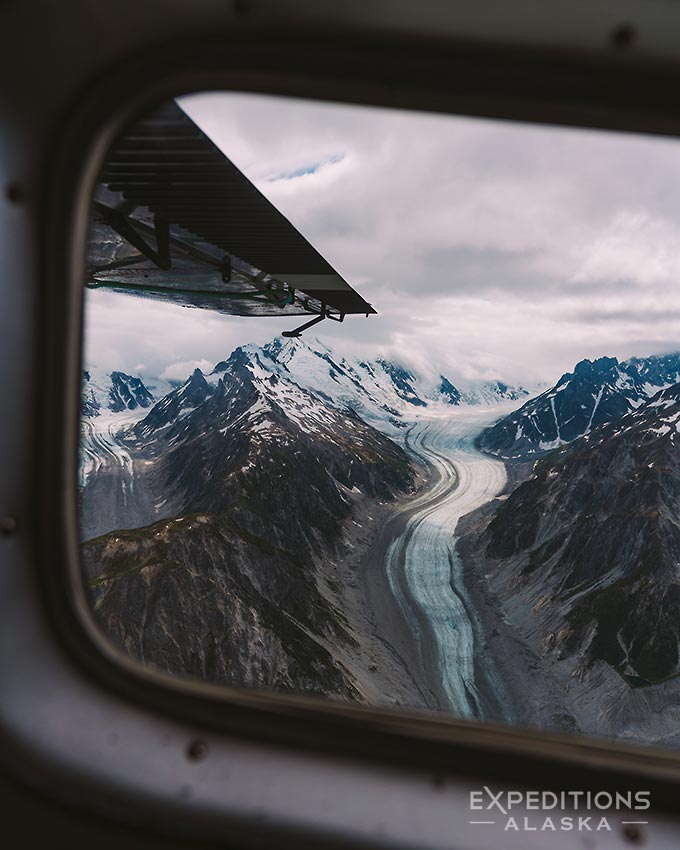
These mountains really are a spectacular experience. More than one of the volcanoes in the area are still active, both Redoubt and Iliamna vent gases routinely.
Because we’re taking this as an easier trip, we don’t traverse the steeper, more jagged and burly peaks of the higher route. But we do end up the high pass with some gorgeous views and stunning scenery.
The higher parts of this trek are 4500-5000′ ASL. Well above treeline and up in the alpine. Wilderness at its best.
We’ll have time allotted on this backpacking trip to do some exploratory hikes up in to the nearby peaks.
The Gear
Hiking poles are a must here. They’ll help you enormously on the hillsides and upper reaches of the backpacking trip when you hit the steeper sections. They’re also critical for any stream crossings we have.
Rain gear is necessary, as with all our trips.
We don’t need microspikes or any equipment for glacier travel.
Your backpack should weigh approx 30-40lbs, all included. don’t set that in stone. But it’s a good ballpark.
Logistics
This backpacking trip is a little less fiddly than some of the other excursions we make. In a nutshell, it’s a few simple things.
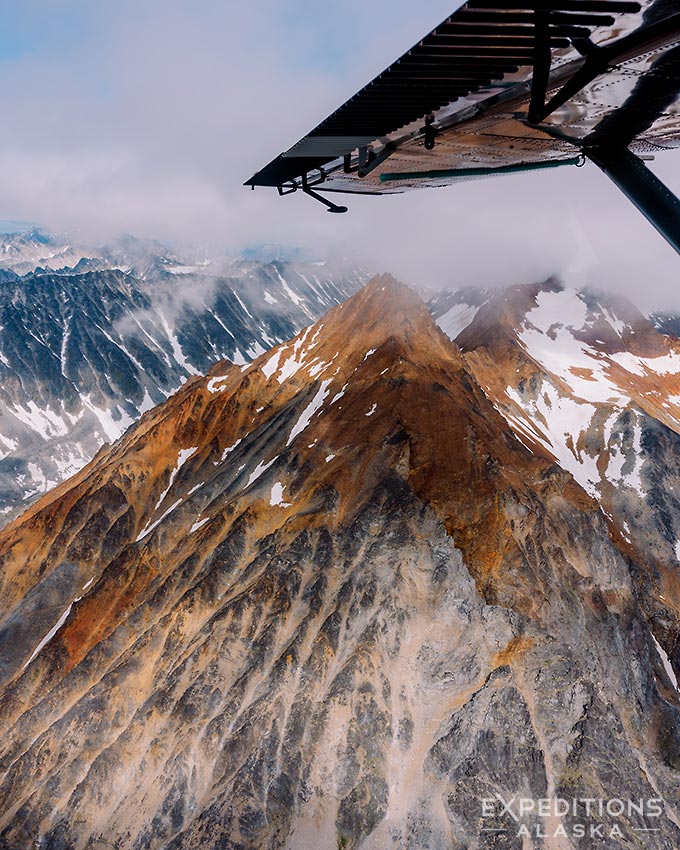
You arrive in Anchorage, and overnight (not included). In the morning we meet and fly in together to the park and begin your backcountry adventure. We have 5 nights in the backcountry, making our way toward our destination.
On the final day, we wait for the bush plane to come, pick us up and return to Anchorage.
“She did a great job of balancing the different speeds and experience levels of the four of us. … She was always positive even when some folks in the group weren’t necessarily so and kept us well-informed about what the game plan was each day. Her enthusiasm for Alaska is also pretty infectious. Overall, A+. And it didn’t hurt that the food was great.”
Itinerary
Like all the trips we run, the itinerary is somewhat fluid. Weather, hiker experience and many other factors determine the actual trip. For simplicity sake, let’s assume the trip dates are Aug 1 – Aug 6. Realize everything here is simply an example.
Trip participants should arrive in Anchorage no later than the evening before our schedule trip departure date. For our example, the Trip would require all participants arrive in Anchorage sometime on July 31. I highly recommend you try to arrive even a day earlier is at all possible, to allow for flight delays resulting from weather. Expeditions Alaska does not provide, but can recommend, accommodation in Anchorage.
Day 1
Meet us at our air taxi (details will be provided after your reservation) in Anchorage, 40 minutes before flight time. We’ll check in, do a last minute double check for gear and sundries, weigh up, load the plane and off we go.
You May Also Like