

Hey Folks,
Why Alaska Demands Trekking Poles
I’ve written on the topic of trekking poles in the past. Every year I receive a lot of questions about the use of trekking poles in Alaska. Nothing’s changed. Use them.
Use Hiking Poles
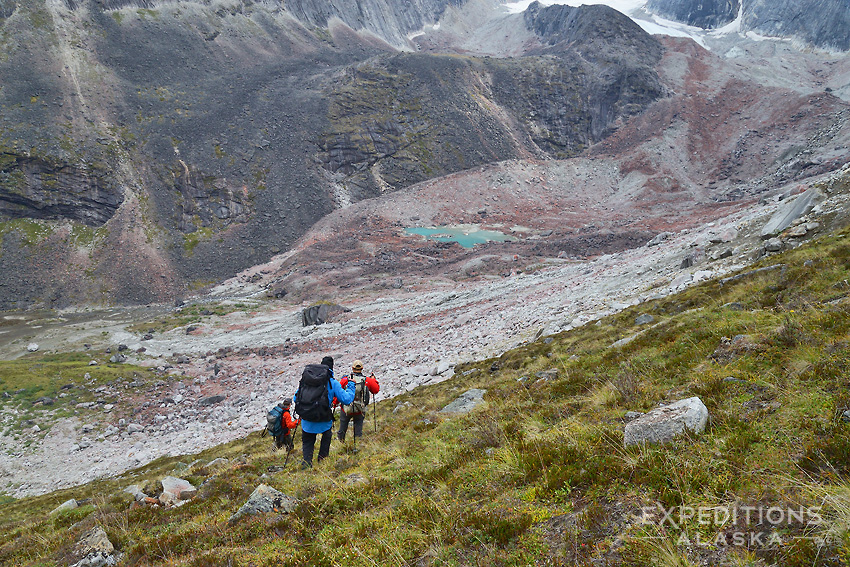
The image above illustrates how useful they can be. Backpacking up or down steep terrain like this, often on very little or no trail, with a heavy pack on your back is challenging. Surprisingly, harder still, for most folks, is hiking across the side of a hill like this. Having that pole on your side to lean in to the hill is a big help.
A lot of folks hiking in the lower 48 don’t use them, and I understand that, for sure. The trail systems there are (generally) so good that I don’t think trekking poles hold quite the same benefit there, even though still useful.
Up here, however, it’s a different matter (so I now provide trekking poles for all our Alaska backcountry trips if you don’t have them or don’t want to deal with packing yours up here).
Terrain That Requires Poles
We hike across boulder fields, glacier moraines or talus that may well be a mile or more across. We traverse steep terrain that an be slippery, wet, brushy, rocky, or all the above and then some. Hiking across snow fields and glaciers hiking poles are great, as well. I recommend a hiking pole over an ice axe for a lot of alpine travel in fact. Ice axes, particularly for folks not used to using them, are way more likely to cause the hiker an injury than hiking poles are.
Beyond Trail Support: Other Uses
Trekking poles also double as a tent pole for a cooking tent or teepee. A lot of the ultralight backpacking tents use trekking poles for their structural support as well.
The downside to this system is those poles are then not available for use while you’re on a dayhike. I like a free-standing tent so I can use my hiking poles for hiking, and my tent poles for my tent. Everyone has their own system.
I like the cork handled poles. They feel better in my hand. I also prefer one pole over two, but that’s simply personal preference.
One hiking pole just feels better to me. I know most folks prefer two. Honestly I think it’s just (like most things) what we get used to. For me, one trekking pole works great.
Travel and Brush Considerations
I started out using trekking poles the first time I ever had to fly to get to my backpacking destination. The poles shorten down and are then compact and great for travel, unlike a sapling. I could drop them into a duffel, or pack, and fly with them easy-peezee.
That’s also a handy feature when you’re backpacking through dense brush here. In those cases, the shorter poles strap tightly to the side or back of your backpack and carry them by hand; travel through alder and willow is easier without a trekking pole than with one (or two) in your hands. The poles catch everything when you’re hiking (especially if they have the little snow basket on them). Strapping them on to your pack leaves your hands free to deal with the brush.
So vote on trekking poles. 🙂
Cheers
Carl
