
Yes, musk ox live in Arctic Alaska, including the Arctic National Wildlife Refuge. They were reintroduced to the refuge in the late 1960s and 1970s after being hunted out of the region in the late 1800s. Today they’re doing well across the Arctic coastal plain and the foothills of the Brooks Range. The Canning, Hulahula, and Ribdon River drainages are reliable areas for sightings. They’re a primordial-looking animal, unlike anything else alive today.
Where to find them
The Canning River drainage on the western edge of the refuge is one of the longer-established musk ox areas. Herds work the river bottoms and the surrounding tundra, particularly in summer.
The Ribdon River, also on the western side of the refuge, has a population that’s done well in recent years. We saw musk ox there on a backpacking trip in 2022.
The Hulahula River drainage and the country around it on the north slope is another reliable area.
Across the broader North Slope and Arctic foothills, herds shift from year to year. Local knowledge from bush operators or USFWS biologists is the best current source on where animals are concentrated in any given season.
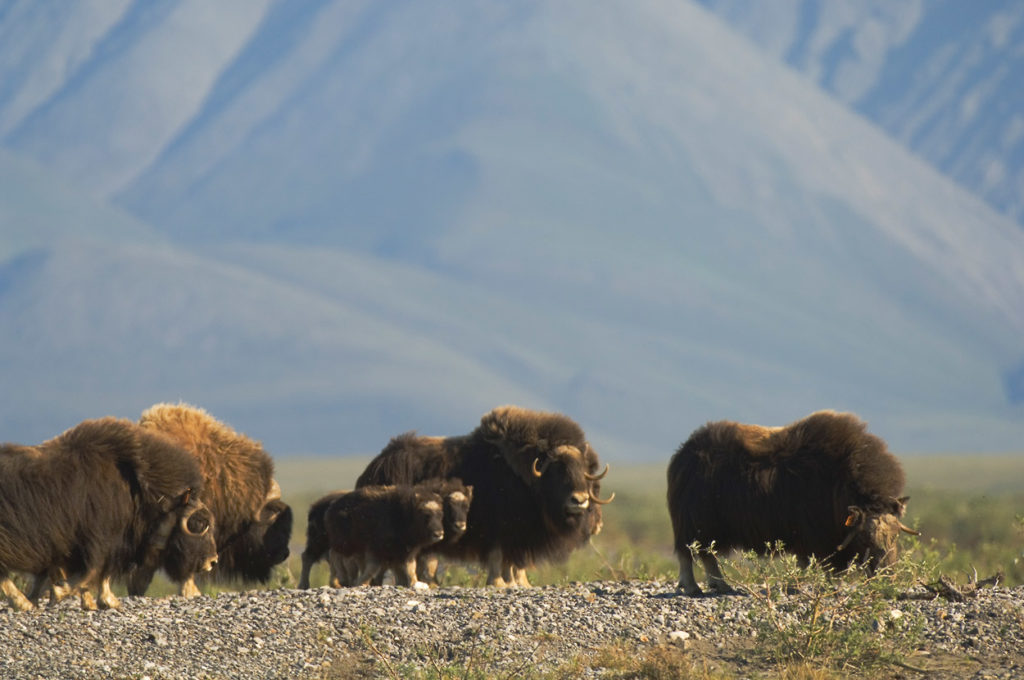
What musk ox actually look like
Musk ox are unlike anything else alive today. Squat, heavily-built, draped in long shaggy hair (called the qiviut underneath, the longest hair on the outside), with curving black horns that meet in a heavy boss across the forehead in adult bulls. They look like something that walked out of the Pleistocene because they essentially did. The species coexisted with mammoths and survived the megafauna extinction.
The first time I went down the Canning River, more than 20 years ago, we saw a herd of musk ox along the shore. We smelled them quite a while before we saw them.
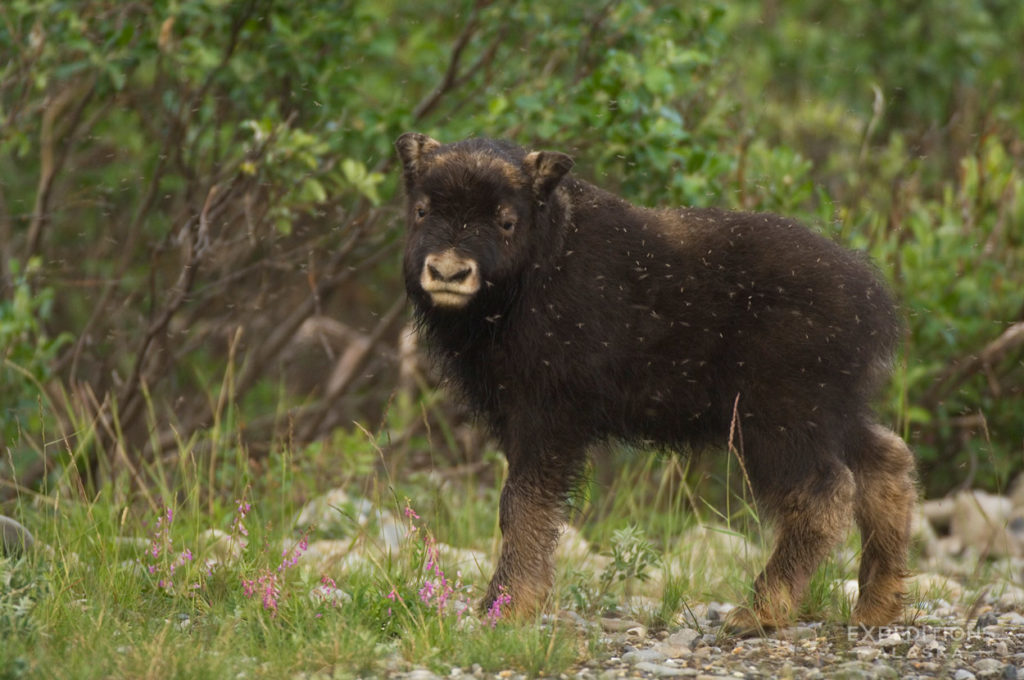
Baby musk ox
A baby musk ox is one of the cutest animals on the planet. Compact, all soft hair, short stubby legs, dark eyes. Hard to reconcile with the primal-looking adults they grow into. The first time I saw one was on that same Canning trip. I’ll find a photo of one for the Skolai Images musk ox gallery if there isn’t one there already.
Behavior
Musk ox don’t run from threats. They form a defensive ring or wedge with adults outside, calves inside, and stand their ground. This works against wolves. It works less well against humans with rifles, which is why they were hunted out of Alaska in the 1800s.
For visitors, give them serious distance. They look slow but they aren’t, and a defensive bull can move quickly. 100 yards is a reasonable starting distance. Use binoculars and a long lens. Don’t approach for a closer look.
Population history
Musk ox were eliminated from Alaska by the late 1800s through commercial and subsistence hunting. They were reintroduced from Greenland stock starting in 1930, with subsequent releases including the introduction to the Arctic National Wildlife Refuge area in 1969-1970. The population has grown since and is now established across multiple parts of Arctic Alaska. The Alaska Department of Fish and Game musk ox page has the official population and biology data.
A bull on the aufeis
We were backpacking down the headwaters of the Ribdon River when we spotted a lone bull musk ox out on the aufeis. Musk ox often park themselves on ice or near aufeis in the warm months. The cool air off the ice cuts the bug load down, and the bull knew what he was doing.
We dropped packs. One of the guests and I worked toward him slowly, off-axis, stopping every time he turned our way. He let us inside fifty yards and stayed there. We photographed him for the next half hour from a gravel rise above the river ice.
Up close, the primordial quality of a musk ox doesn’t quite translate to a photograph. The boss, the heavy guard hair, the bulk on those short legs. He stood on his patch of ice and watched us. The valley was empty in both directions. Nothing else was moving.