
The best place in Alaska to see polar bears is Kaktovik on Barter Island, on the Beaufort Sea coast at the northern edge of the Arctic National Wildlife Refuge. Bears gather along the barrier islands and around the village in September and October, drawn by sea ice forming in the intertidal zone and by the remains of the community’s traditional bowhead whale harvest. Boat-based viewing from local Iñupiat operators puts you within yards of bears in most years.
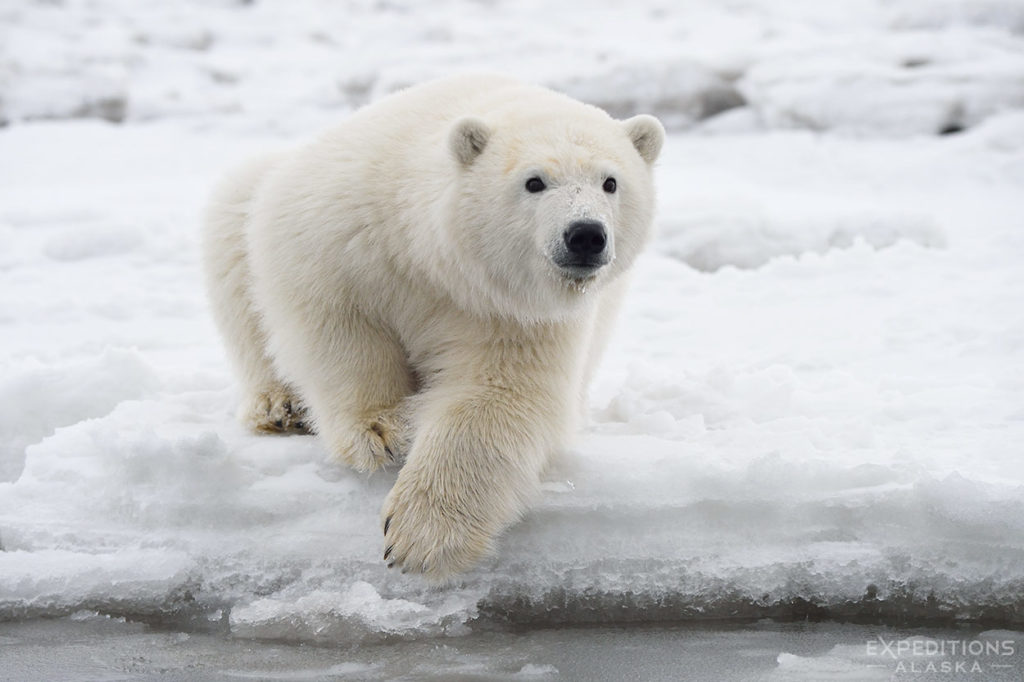
Why Kaktovik
Two things make Kaktovik the standout. First, the geography. The Beaufort Sea ice begins reforming each fall in the brackish intertidal zone where freshwater rivers meet the ocean. Polar bears, drawn back to the coast as summer ends, wait at the ice edge for the pack to set up so they can return to seal hunting. The barrier islands around Kaktovik concentrate that activity.
Second, the bowhead whale harvest. Kaktovik holds traditional rights to take bowhead whales each fall (currently three per year under federal subsistence regulations). The harvested carcasses are processed in the village and the remains placed on a spit east of town. Polar bears find that food source and gather there. The combination of waiting at the ice edge and feeding on whale remains produces the most reliable polar bear viewing in Alaska.
Other Alaska polar bear locations
Polar bears live elsewhere along the Alaska Arctic coast and on the sea ice, but reliable visitor access is essentially Kaktovik.
Utqiagvik (Barrow): Polar bears occur and are sometimes seen, particularly in winter. Tourism infrastructure for polar bear viewing is much more limited than at Kaktovik.
Point Lay: Bears occasionally come ashore, particularly when walrus haul out on nearby beaches. Not a standard tourism destination.
The 1002 area and broader ANWR coastal plain: Bears travel through but visitor viewing is not concentrated.
For practical purposes, Kaktovik is the answer.
What to expect at Kaktovik
The standard trip pattern is fly Fairbanks to Deadhorse to Kaktovik (small plane, weather-dependent), check into a local lodge, and head out by boat with a local operator. Boats run morning and evening, sometimes midday depending on weather and bear activity. The boats are small, the groups likewise. Bears can be very close.
Sightings aren’t guaranteed any single day, but across a multi-day trip in the right window, you’ll see bears. Most years, you see them well.
Land-based viewing from the village exists but produces fewer and more distant sightings than boat trips. The boats are how this works.
Photography considerations
Kaktovik in fall is dim. The Arctic sun is low even in midday and the days are short. Light is often diffuse from cloud cover, sometimes harsh under clear skies. Long lenses are useful but the bears can be close enough that mid-range zooms work well. Stabilization matters from a small boat. Salt spray is hard on gear.
Polar bear photography tours from Kaktovik cover the standard September-October window. The USGS Polar Bear Research Program is the strongest authority on the science behind the species and its current status.
A particular year
2013 was the best polar bear season we’ve had at Kaktovik. Heavy early snow that fall, which always helps the viewing. A lot of bears on the island that year, including a lot of young ones. One day on the water, one of the photographers on the trip took 5,000 frames. Bears playing with each other, walking out on the ice, wrestling in the snow, chasing each other. Often within 25 or 30 yards of the boat. Standing up to look at us, swimming where there was open water. About every behavior you’d want to capture, in one day. Most years are good. That year was something else.