
In the mid-2000s I spent four months living in Futaleufu, Chile, working with a rafting and kayaking company, guiding, and doing photography; eating a LOT of carne asada.
I spent a lot of time in the Andes backcountry around there. Never saw any pumas then. Not a track, not a kill, not a flash of tawny fur disappearing into the trees. That’s normal. Pumas are ghosts. You can live in their backyard for months and never know they’re there.
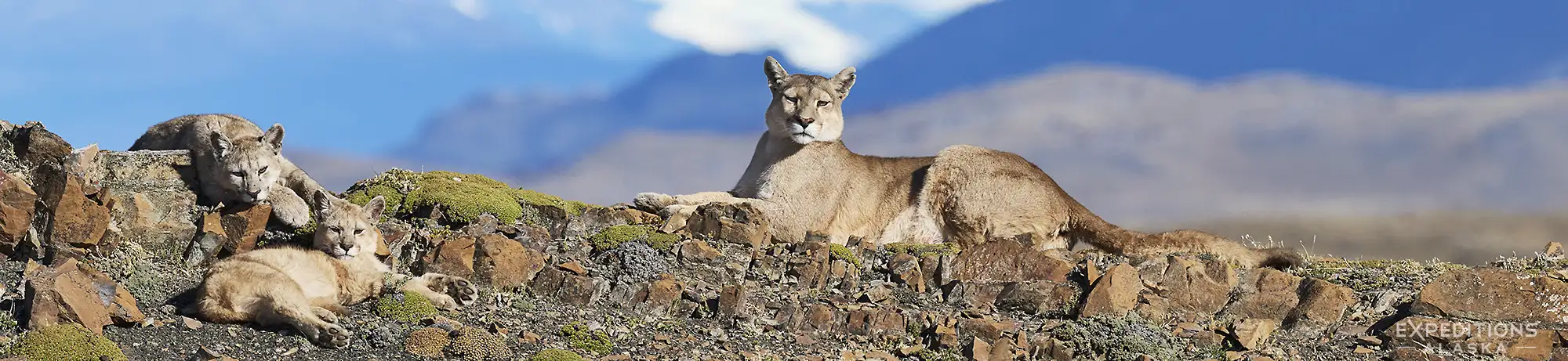
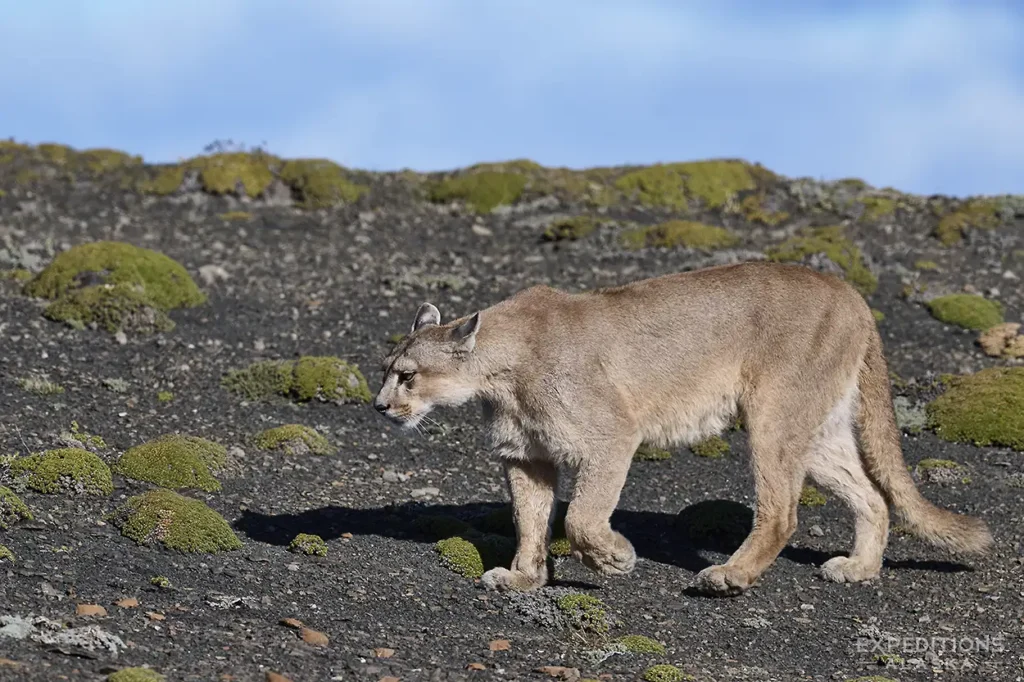
So when I started reading about what’s happening at Monte Leon National Park on Argentina’s Atlantic coast, it stopped me cold. Pumas aren’t just present there. They’re walking through a colony of 80,000 penguins in broad daylight, tolerating each other at close range, and hunting at the highest density ever recorded for the species anywhere on earth. These are not ghost cats. They’re something else entirely.
Three studies published between 2023 and February 2026 have documented a predator-prey interaction that didn’t exist a generation ago.
Three studies published between 2023 and February 2026 have documented a predator-prey interaction that didn’t exist a generation ago. Pumas at Monte Leon National Park on Argentina’s Atlantic coast are systematically hunting Magellanic penguins. Not scavenging. Not opportunistic snacking. Organized, sustained predation, with individual cats restructuring their entire lives around the penguin breeding season.
The numbers are staggering. Researchers from UC Berkeley, Rewilding Argentina, and CONICET GPS-collared 14 pumas and deployed 32 camera traps across the park between 2019 and 2023. They found the highest puma density ever recorded anywhere on earth: 13 cats per 100 square kilometers, more than double the previous global record. Nine of the 14 collared pumas hunted penguins. Five didn’t. The penguin-hunting cats interacted with each other five times more often than the ones that stuck to traditional prey. They shrank their territories when the birds were ashore, then nearly doubled their range when the penguins migrated back to sea.
A separate Oxford University study, published just this month, analyzed carcass counts from 2007 to 2010. Over four years, pumas killed more than 7,000 adult penguins at Monte Leon. Most of the carcasses were partially eaten or not eaten at all. That’s roughly 7.6% of the colony’s adult population of around 93,000 birds.
That’s a lot of dead penguins. But how we got here is the part that matters.
How Penguins Ended Up on the Beach
For most of their history, Magellanic penguins nested on offshore islands. The mainland coast of Argentina was puma country. Foxes, too. The beaches weren’t safe for a bird that waddles.
In the early 1900s, European sheep farmers arrived and solved that problem. They systematically poisoned pumas and hired professional puma hunters, called “lioneros”, to clear the land for livestock. They didn’t stop at big cats. Foxes, smaller predators, anything that might threaten sheep got eliminated.
With no land predators, penguins began colonizing the mainland. Dee Boersma, who has studied the Punta Tombo colony for decades, documented that bird surveys in 1876 found zero penguins at that site. By the 1920s, they were establishing colonies. By the 1940s, they were expanding rapidly. The massive mainland penguin populations that exist today, hundreds of thousands of breeding pairs across multiple sites, are essentially a 20th century phenomenon. The penguins we think of as “always having been there” arrived within living memory, filling a niche that human intervention created.
By the 1990s, sheep farming collapsed. The arid soil couldn’t sustain it. Wind erosion finished what overgrazing started. Farmers left.
In 2004, Tompkins Conservation donated 170,000 acres to create Monte Leon National Park. The penguins were already there, roughly 40,000 breeding pairs nesting along two kilometers of beach. They put penguins on the park logo.
Three years later, the pumas showed up.
What Happened in 2007
A female puma began killing penguins. Not a few. Thousands. Her cubs joined in. Most of the kills were surplus: carcasses left uneaten or barely touched. Javier Ciancio, a researcher with Argentina’s CONICET, described the situation bluntly: “A puma can kill hundreds of penguins while feeding on only a fraction of them”.
Park managers faced a choice nobody wanted. They killed the puma family to protect the colony.
More pumas came back anyway. Ciancio put it simply: “They finally decided to sacrifice these animals to protect penguins”. The culling was futile.
Bears on a Salmon Stream
Here’s where it gets interesting for anyone who has spent time watching brown bears in Alaska.
Pumas are solitary. That’s the textbook answer and it’s mostly true. They maintain large territories. They avoid each other. Encounters between adults are rare and often aggressive. That’s the animal we know.
But at Monte Leon, pumas that hunt penguins are tolerating each other at close range. Researchers documented 254 encounters between penguin-eating pumas during the study period. Between pumas that didn’t eat penguins? Four. Total.
Emiliano Donadio, the science director for Rewilding Argentina, called it directly: “We tend to think of pumas as extremely aggressive and intolerant. But when food is abundant and concentrated, there’s no need to defend it. They become more socially tolerant”.
If you’ve watched grizzlies at Brooks Falls or McNeil River, you know exactly what he’s describing. Bears that would never tolerate each other in the backcountry stand shoulder to shoulder when salmon are running. The food is abundant enough and concentrated enough that the cost of fighting exceeds the cost of sharing. Same principle. Different predator. Different continent.
Jim Williams, a biologist with Montana Fish, Wildlife & Parks and author of “Path of the Puma”, added another layer: “Unlike North America, there are no grizzly bears, black bears or wolves, so these cats are not sneaking around in the trees at night like they are up here”. The pumas at Monte Leon aren’t competing with other large predators. They own the system.
The Nutrient Bridge
There’s a secondary effect that I find almost as interesting as the predation itself.
When pumas kill penguins and leave the carcasses (which they do, often), they’re physically moving ocean nutrients onto land. Penguins eat fish. Pumas eat penguins. The leftovers decompose on coastal grassland. Donadio described it as pumas “linking the ocean and the land in a totally new way”. For part of the year, many of the park’s pumas are essentially running on marine energy. The uneaten remains fertilize terrestrial plants.
And there’s a ripple effect for other prey. When 80,000 penguins are sitting on the beach for six months, pumas focus on them. That means guanacos and lesser rheas, the traditional prey, get a seasonal break. Donadio’s preliminary data shows that other prey species face less predation pressure when the penguins are ashore. The penguins are absorbing the hunting pressure that would otherwise fall on everything else.
Will the Penguins Be OK?
Probably. That’s the most surprising part.
Despite 7,000 kills in four years, the colony at Monte Leon appears stable, possibly even growing. The Oxford WildCRU team that published the most recent study ran population models and found that puma predation alone is unlikely to drive the colony to extinction. The bigger threats are breeding success and juvenile survival, factors driven by ocean conditions, food supply, and climate. Extinction scenarios only emerged in models that combined very low juvenile survival with extremely poor reproduction and heavy predation simultaneously.
In other words, pumas are a real and significant pressure on this colony. But the penguins’ long-term future depends more on what’s happening in the ocean than what’s happening on the beach.
The Question Nobody Wants to Answer
Here’s where the conservation story gets uncomfortable.
The penguins are on the mainland because humans killed the pumas. The pumas are back because humans stopped killing them. Now they’re in conflict. Which iconic species do you protect?
Ciancio and his colleagues asked it directly in their research: “What should we do when human intervention, like the eradication of terrestrial predators, benefits charismatic species like penguins but comes at the expense of less charismatic natural resources, such as forage fish and related marine food webs?”
There’s an additional wrinkle. Ciancio’s team modeled penguin fish consumption and found that in their feeding areas, penguins likely consume more forage fish than the entire commercial fishing fleet. Protecting penguins at all costs has downstream effects on marine ecosystems that most people never consider.
There isn’t a clean answer. Restoring predators doesn’t rewind ecosystems to some baseline. It creates new ones. As Mitchell Serota, the lead researcher on the behavioral study, put it: “Restoring wildlife in today’s changed landscapes doesn’t simply rewind ecosystems to the past. It can create entirely new interactions that reshape animal behavior and populations in unexpected ways”.
Jake Goheen, a wildlife ecologist at Iowa State who reviewed the research for The New York Times, raised the question that nobody has a good answer for yet: “Will we see a situation in the future where the penguins go back to living mostly on oceanic islands?” In other words, will the pumas eventually undo what the sheep farmers made possible?
A Note on Where We Go
All of this research comes from Monte Leon National Park on Argentina’s Atlantic coast. Our Patagonia Puma Photography Tour operates in Torres del Paine, Chile. Same latitude, opposite sides of the Andes, about 170 miles apart. Different country, different ecosystem, different puma population entirely.
When I lived in Futaleufu, I was roughly halfway between these two sites. I spent months in the mountains and never saw a puma. At Torres del Paine, on private ranchland bordering the park, the cats are habituated to human presence and you can photograph them at close range. At Monte Leon, they’re walking through penguin colonies at the highest density ever recorded. Three very different places, three completely different relationships between the same animal and the landscape it lives in.
That’s pumas. More than 200 prey species across their range, from Canada to the southern tip of South America. As Donadio said: “But penguins? Seriously? Yes”.
It’s one animal doing completely different things depending on what’s available. That flexibility is part of what makes pumas so compelling to photograph and so difficult to manage. They don’t fit simple categories. The cat I couldn’t find in four months of living in the Chilean Andes is the same species that now crowds a beach in Argentina at 13 per 100 square kilometers. Same animal. Completely different rules.
We’re running a dedicated Patagonia Puma Photography Tour in November 2027. Five photographers, myself as the trip leader, three local guides, five days tracking wild pumas on private ranchland in Torres del Paine. Details and booking here.
Sources
Serota, M.W. et al. (2025). “A marine subsidy reshapes the ecology of a large terrestrial carnivore”. Proceedings of the Royal Society B. DOI: 10.1098/rspb.2025.2172
Lera, M. et al. (2026). “Shifting predator-prey dynamics at the land-sea interface: The case of Magellanic penguins and pumas”. Journal for Nature Conservation. DOI: 10.1016/j.jnc.2025.127208
Serota, M.W. et al. (2023). “Puma predation on Magellanic penguins: An unexpected terrestrial-marine linkage in Patagonia”. Food Webs.
Ciancio, J. et al. (2024). Journal for Nature Conservation. DOI: 10.1016/j.jnc.2024.126747
Researcher quotes sourced from coverage in The New York Times, Smithsonian Magazine, National Geographic, ABC News, Discover Wildlife/BBC Wildlife, Live Science, and ScienceDaily (Dec 2025 – Feb 2026).
Newsletter
Stay up to date with all the latest goings on as well as information and notes from the field with Expeditions Alaska. The magnificent newsletter "Ramblings" ~ It's like having Alaska land in your inbox.
"*" indicates required fields