Your Wrangell Plateau Trip
Trip At A Glance
We meet you in Anchorage and take care of you from there. We’ll travel to the park, into the backcountry, enjoy some mountain time, and travel back to Anchorage.
We fly through the Wrangell Mountains, past countless glaciers, and up onto the plateau. Our air taxi pilot lands on a dirt airstrip built by the National Park Service years ago.
The airstrip sits right on the plateau. Depending on your group and your preferences, we might camp near the airstrip or backpack a mile or two to a better spot near one of the small lakes.
From there? We hike. Dayhikes with light packs. No pressure. No agenda beyond exploring this remarkable landscape.
Far From Anyone
This area sees almost no traffic.
Most people visiting Wrangell-St. Elias National Park stay near McCarthy or fly into Skolai Pass or head south toward the Chugach Mountains. The Wrangell Plateau is off everyone’s radar.
We’ve done multiple trips here and have never seen another person on any of them.
It’s just you, your guide, and a whole lot of tundra.
The Walking is Good
Let me be clear about what “easy terrain” means in Alaska.
It doesn’t mean sidewalks. It doesn’t mean groomed trails. There are no trails up here.
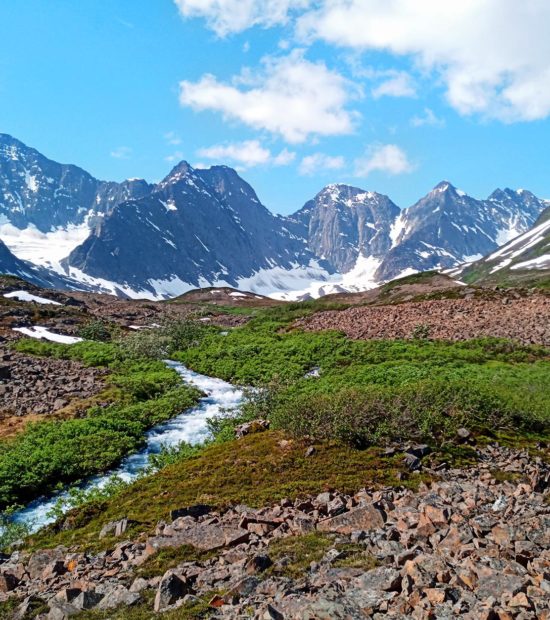
But the plateau is gentle. Rolling hills. Some rocky sections. A few steeper climbs if you want to get up on the higher ridges. Mostly, it’s just pleasant walking across open ground where you can see where you’re going.
Christie’s notes from her scouting trip: “Walking = great”.
That’s about as good as it gets in Alaska.
The plateau is exposed, so wind can be an issue. And there are cliffs on the edges, which means you need to pay attention. But in terms of terrain challenges, this is about as forgiving as we offer.
If you’ve never backpacked in Alaska before, this is a good place to start.
Basecamp or Basepack
We offer three variations of this trip, depending on your experience level and what kind of adventure you’re looking for.
- Some folks prefer a basecamp. Definitely the mildest choice.
- Basepack option, to combine some backpacking and basecamping, and
- A short backpacking trip.
Basecamp Option (Easiest)
Camp near the airstrip. Dayhike from there. You’ll still need to carry your backpack about a quarter-mile from the plane to camp, but that’s it. After that, you explore with a light daypack.
This works well for families with younger kids, for people who haven’t done much camping, or for anyone who wants wilderness without the full backpacking experience.
You’ll spend 2-3 nights here, depending on weather and how much hiking you want to do.
Basepack Option (Moderate)
Backpack a mile or two from the airstrip to a better campsite near one of the plateau’s small lakes. Set up camp. Explore from there. Then backpack back to the airstrip on your last day.
This gives you more flexibility and gets you into better camping spots with access to water. It’s still easier than most of our backpacking trips because you’re only moving camp once and the terrain is gentle.
This option works for people who can backpack but don’t want the daily grind of moving camp every single day.
Short Backpacking Loop (3-4 Days)
If you want a bit more adventure, we can do a loop. Backpack from the airstrip to camp one, spend a day or two exploring, move camp to a second location, then hike back to the strip.
This is still considered an easier backpacking trip compared to our other routes, but it requires carrying a full pack for several miles and being comfortable with that.
Who's It For?
- Families with kids (ages 8+)
- First-time Alaska visitors
- People who want wilderness without extreme difficulty
- Photographers looking for accessible alpine landscapes
- Anyone who’s always wanted to backpack in Alaska but wasn’t sure they could handle it
- Experienced backpackers who want a shorter, easier trip
- People recovering from injuries who still want adventure
- Older hikers who have the experience but not the desire to grind anymore
- People looking for extreme adventure (this isn’t that trip)
- Hikers who need trails and maintained paths
- Anyone expecting hotel-level comfort (it’s still camping)
“Best views for the least amount of effort. You land on this plateau and you’re immediately surrounded by world-class scenery. No suffering required.”
~ Christie, Lead Guide
Challenges
This is one of our easier trips, but it’s not without challenges.
. The plateau has a few small lakes and springs, but running water is hard to find. We’ll bring a water filter, and you’ll need to carry at least 2 liters of capacity. Plan on treating water at camp and carrying enough for your dayhikes.
. There’s nowhere to hide up here. No trees. No bushes. Just open tundra and sky. That means sun exposure, wind exposure, and weather exposure. If it rains, you’re in it. If it’s windy, you’re in it. Come prepared.
. The plateau drops off dramatically on several edges, especially overlooking the Cheshnina River valley. Pay attention. Don’t wander close to edges in fog. Kids are fine, just keep them close when you’re near drop-offs.
. This is Alaska. We’ve had sunny 60-degree days. We’ve also had fog and cold rain. Clouds can roll in and sit on the plateau for days. Be mentally prepared for weather that doesn’t cooperate.
. We’re camping around 4,500 feet. That’s not high by Colorado standards, but it’s higher than most places in Alaska. Some people feel it. Bring your fitness.
Hiking Options
Approx 8-mile loop with about 1,000 feet of elevation gain. This is the classic plateau hike.
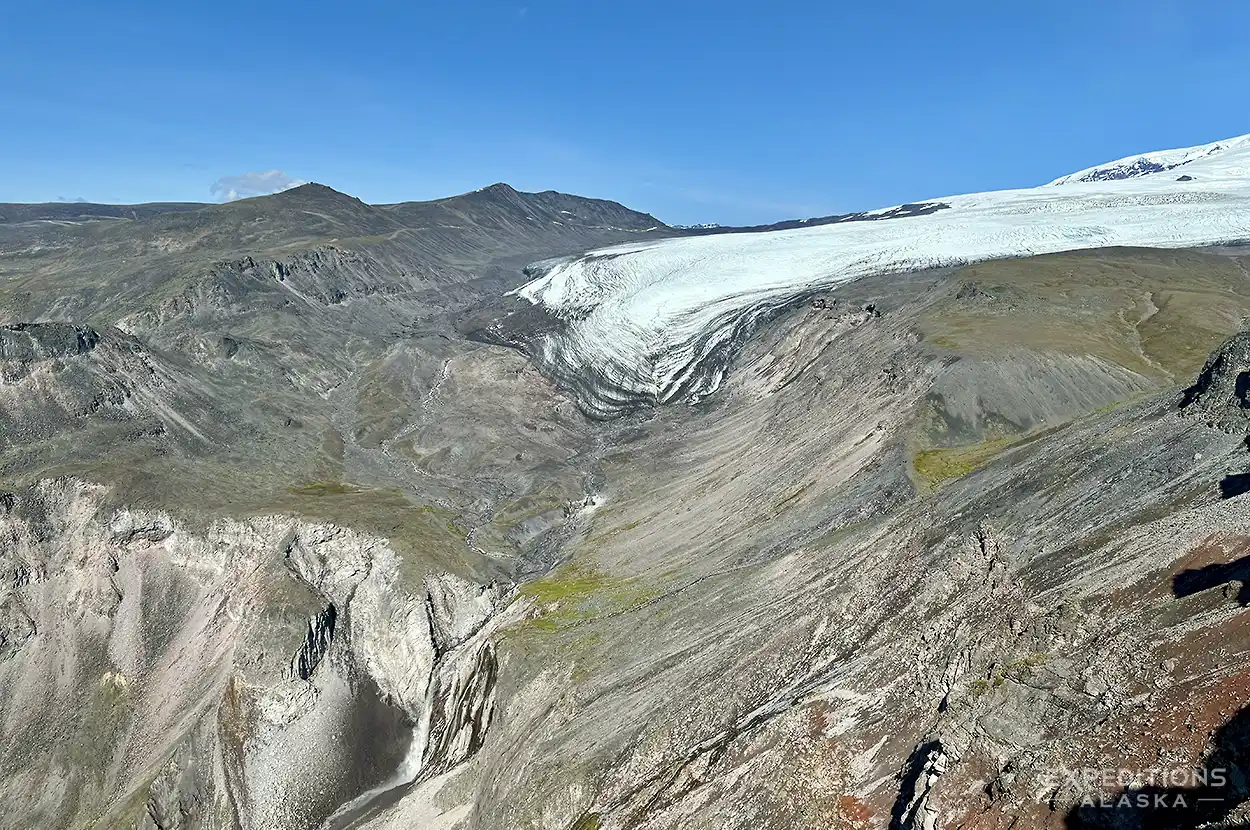
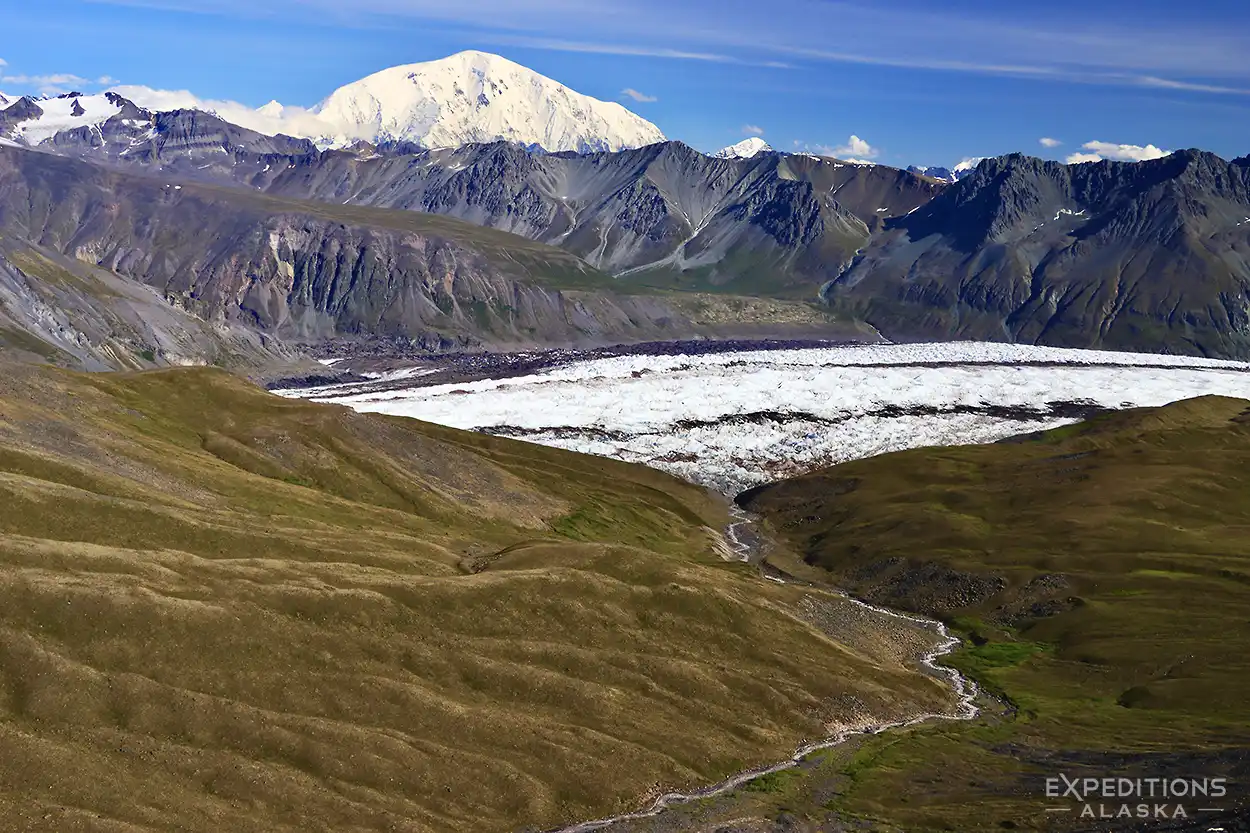
You’ll walk north toward the Cheshnina Glacier, climb up to the highest point on the ridge, and enjoy views of Mount Blackburn, the plateau, glaciers, and valleys stretching in every direction.
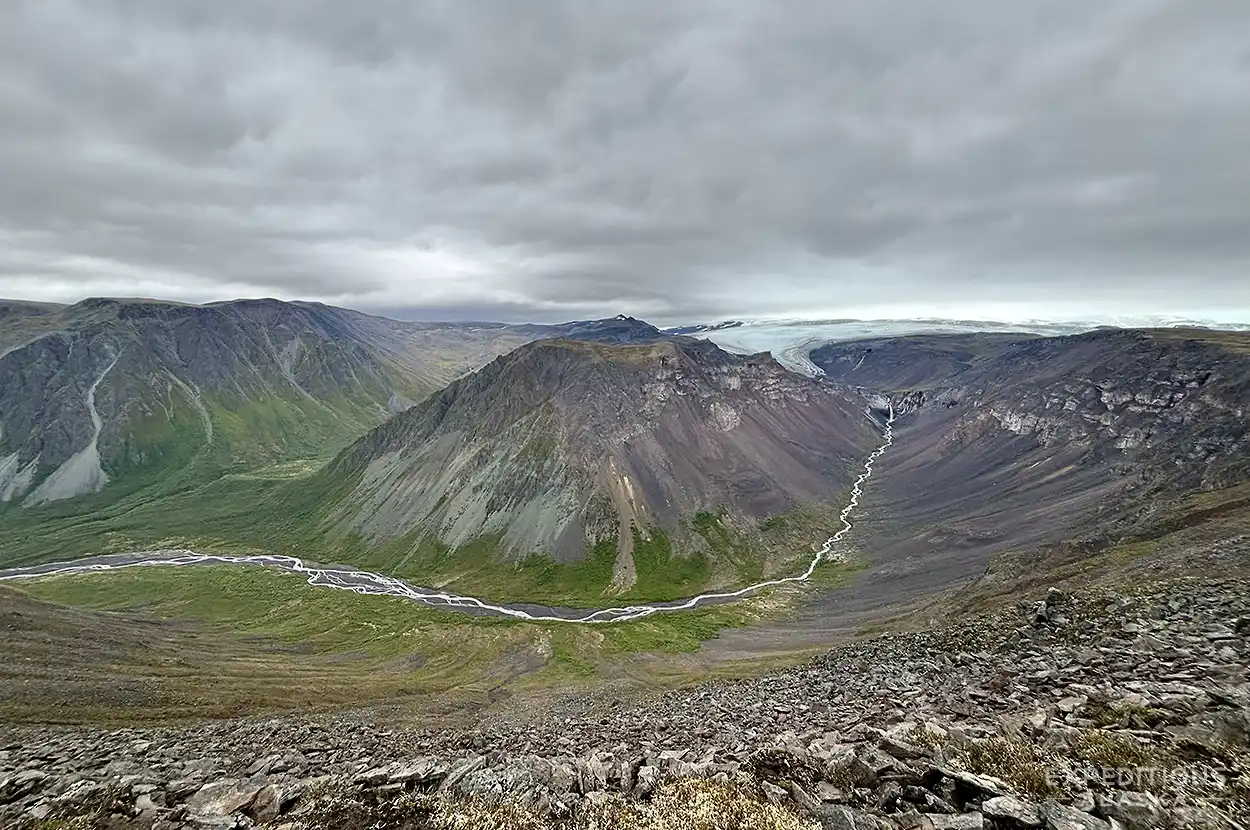
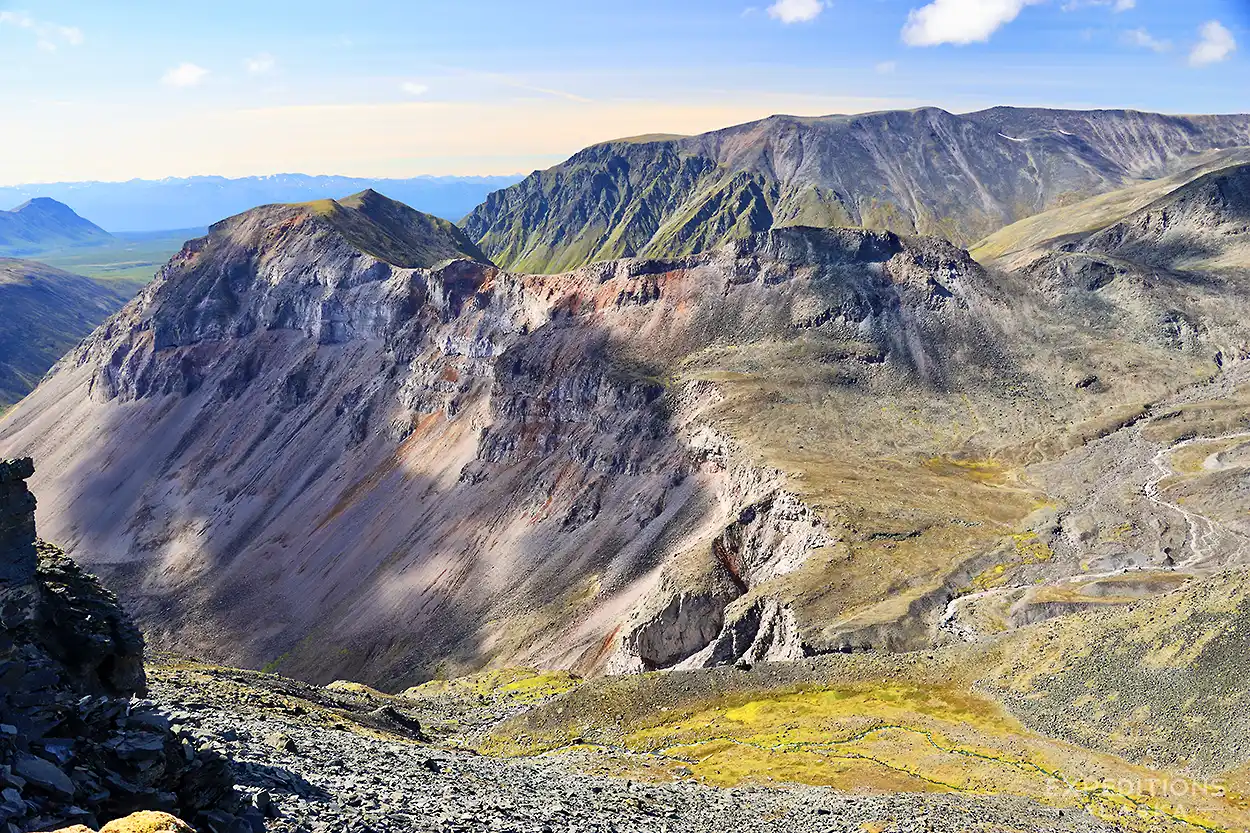
There’s a dramatic overlook where the cliffs curve and you can see the Cheshnina River valley dropping away below you. Count on 5-7 hours for this one.
A 3-6 mile out-and-back that drops down from the plateau via a sheep trail.
You’ll lose about 650 feet of elevation getting down there, which means you’ll gain it back on the return. The payoff is rolling grassy moraines with epic views of the glacier and valley.
Water can be scare on the plateau, so bring your water bottle!
A 4-mile out-and-back with about 650 feet of elevation gain.
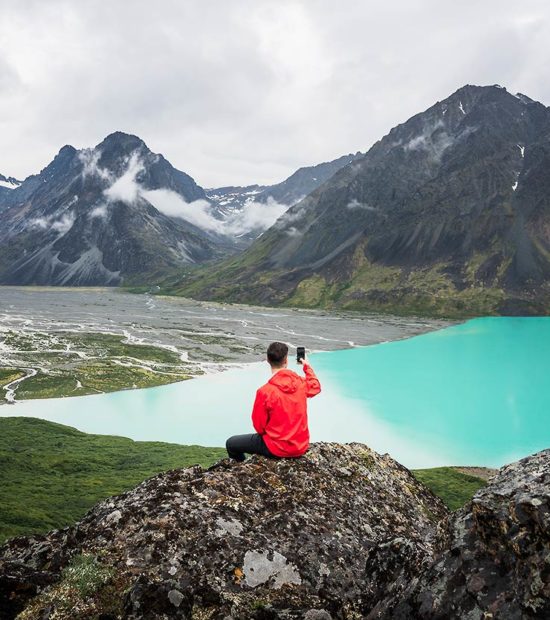
This takes you to a curve in the cliffs where you can see the Cheshnina River valley laid out below. The colors in the valley are gorgeous, and the photos are endless.
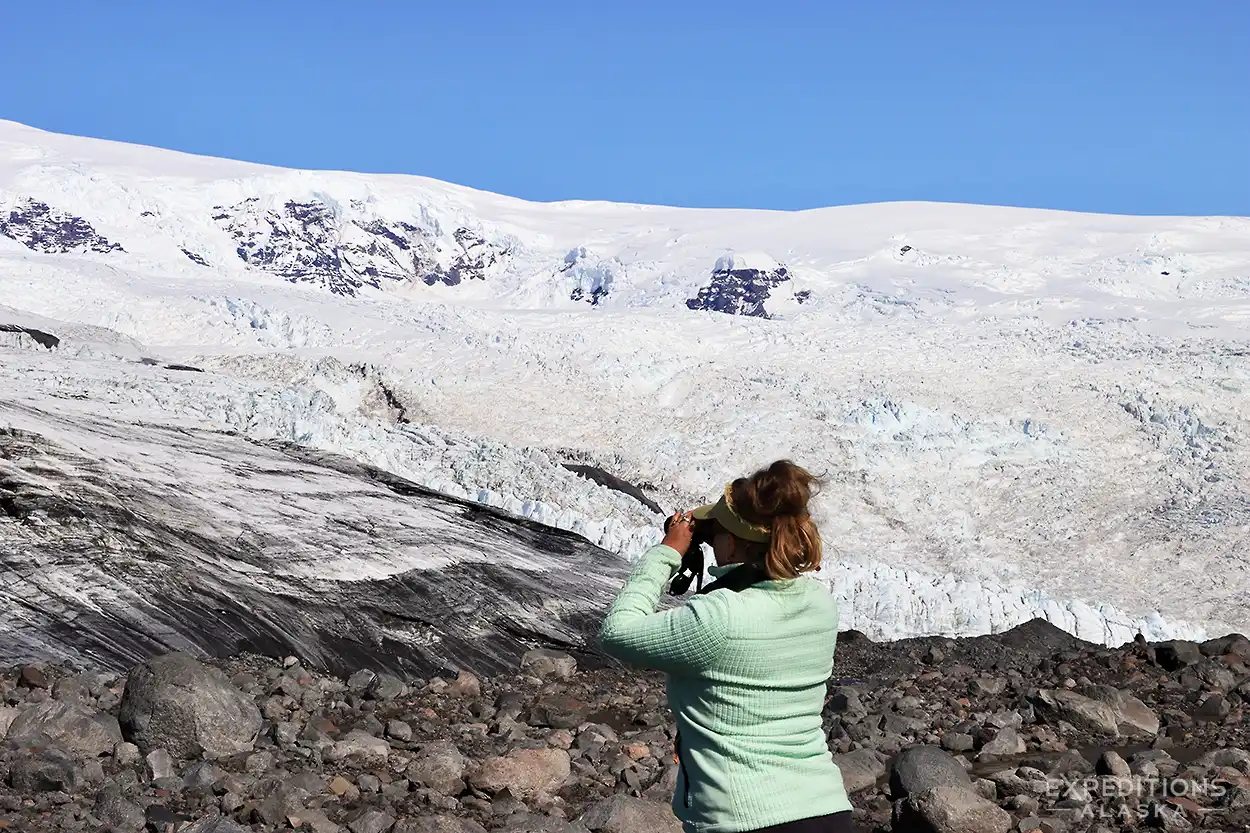
If conditions permit and the group is up for it, we can hike onto the Cheshnina Glacier.
It’s accessible from the plateau with a reasonable approach, and the glacier itself is relatively crevasse-free in the areas we go. We’ll bring crampons or microspikes depending on conditions. This is optional and weather-dependent.
You can also just wander. Pick a direction and walk. Explore the small lakes. Look for caribou sheds. Watch ptarmigan. Sit on rocks and stare at mountains.
That’s a perfectly valid way to spend a day up here.
Camping
Campsites on the plateau range from good to excellent.
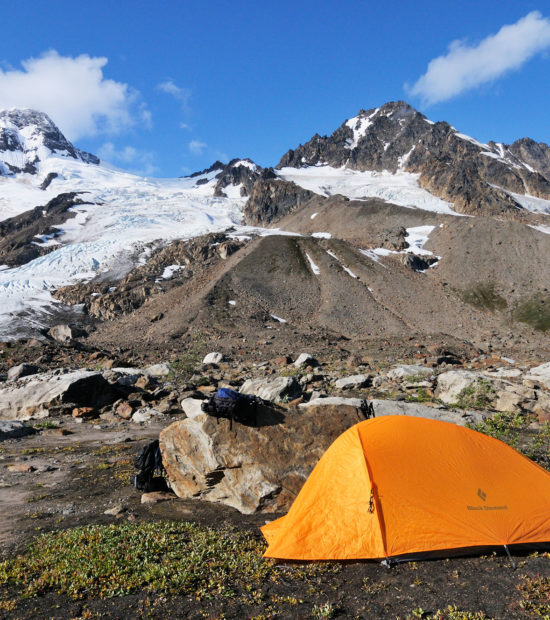
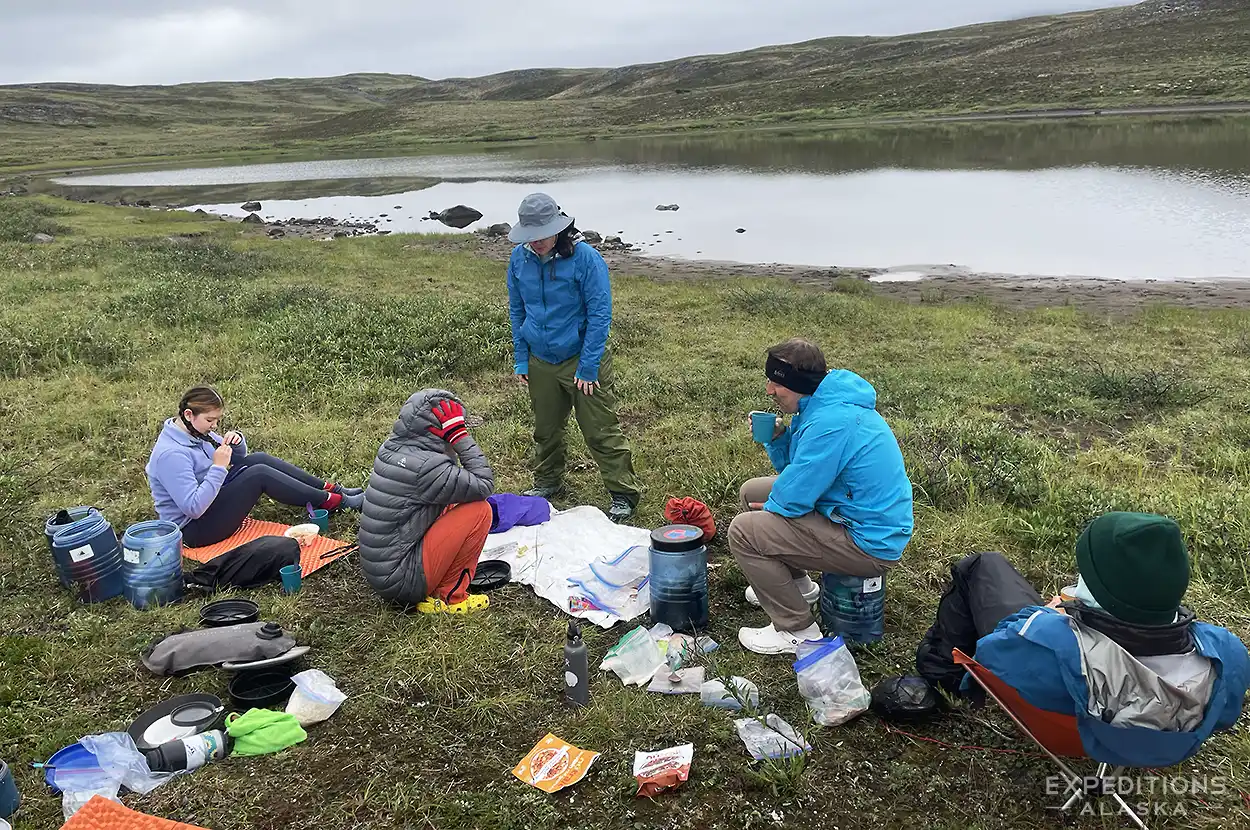
There are a few small lakes scattered across the area. Camping near them gives you access to water and some wind protection. The ground is mostly tundra; can be lumpy in spots but generally decent for tents.
Expect temperatures in the upper 40s to low 60s during the day, dropping into the 40s at night. It’s colder up here than down in the valleys, and the wind makes it feel colder still.
Our preferred camp is Lake Oasis, about 2.25 miles northeast of the airstrip. It sits in a bowl with a small hill providing wind protection. The south side is lumpy, but there are good flat spots around the rest of the lake.
We can also camp right near the airstrip if your group isn’t up for backpacking. There’s a small pond about 0.3 miles away. It’s more exposed to wind, but it works.
Wildlife
Grizzly bears are present. They’re usually roaming the plateau looking for ground squirrels or berries. We carry bear spray and follow our best practices for travel in bear country.
Arctic ground squirrels are everywhere. They’re the primary food source for most predators up here. You’ll hear them chirping constantly.
Ptarmigan (both willow and white-tailed) are common. Wolverine pass through occasionally. We’ve seen tracks but rarely the animals themselves.
Caribou don’t tend to stay on the plateau, but you may find shed antlers lying around.
This isn’t prime wildlife habitat compared to lower elevations, but there’s enough activity to keep things interesting.
Weather & Wind
The Wrangell Plateau sits at high elevation in an exposed location. Weather can come from multiple directions.
Sunny days are spectacular. Clear skies, good visibility, mountains out in every direction. We’ve had trips with perfect weather where people walked around in t-shirts.
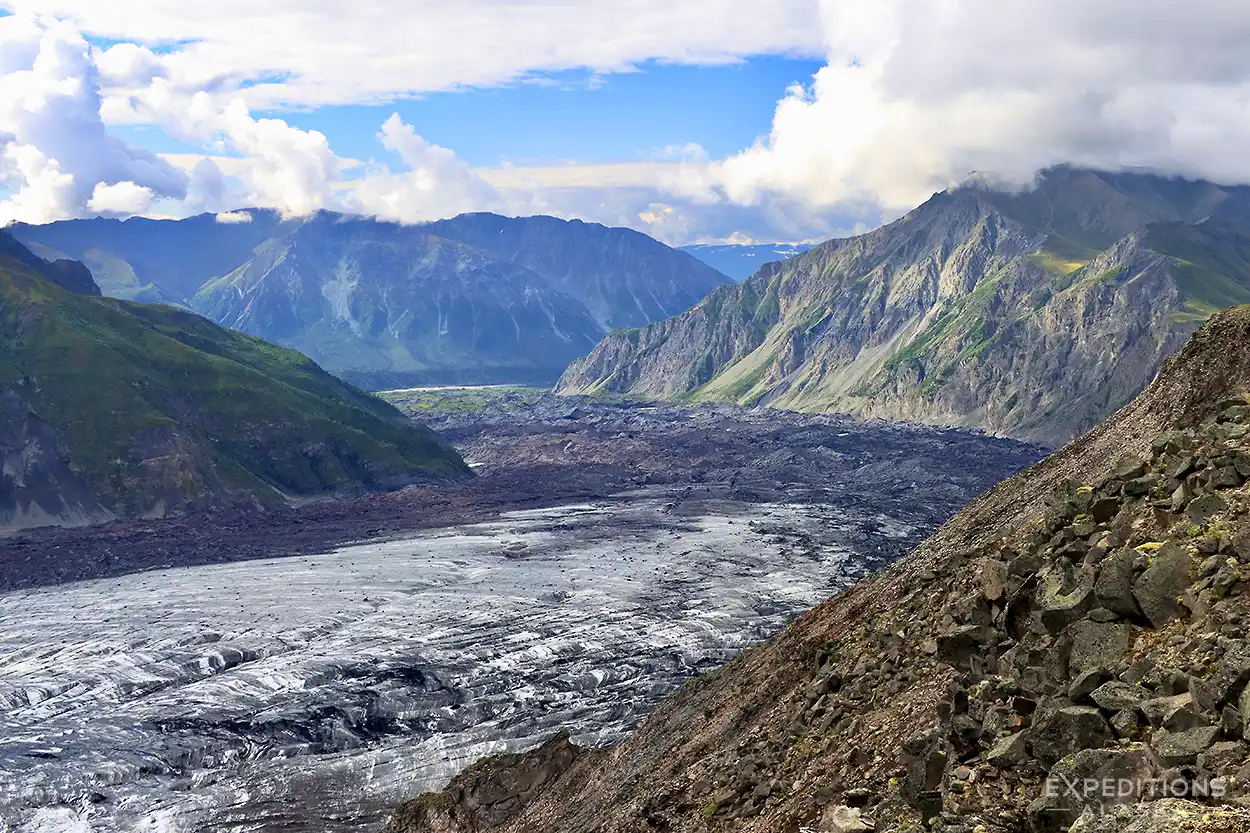
We’ve also had trips where clouds sat on the plateau for days and the wind never stopped.
Our air taxi prefers to fly us in and out early in the morning because afternoon katabatic winds can delay flights. Plan on early morning flights.
Bring layers. Bring good rain gear. Bring a warm hat and gloves even in summer. The plateau doesn’t care what month it is.
Trip Snapshot
Bush plane from McCarthy
Gentle rolling terrain
Limited (lakes & springs)
360° mountains & glaciers
Beginner-friendly
Families, first-timers
Exposed, windy
Itinerary & Logistics
We’ll meet you in Anchorage, Alaska and travel to either McCarthy or Glennallen, depending on the trip schedule.
From there, we fly into the park. The flight itself is stunning. You’ll pass over the Chitina River (or Copper if we fly in from Glennallen), glaciers, and remote valleys before landing on the plateau airstrip.
We either camp near the strip or backpack to a better site. That first afternoon is usually spent setting up camp, getting oriented, and maybe doing a short hike to stretch legs.
The middle days are for exploration. We hike. We explore. We adjust plans based on weather, energy levels, and what the group wants to see.
On the final day, we pack up and hike back to the airstrip for pickup. Flight back to McCarthy or Chitina. Trip ends.
Is This Trip Right For You?
Here’s the honest assessment.
If you’ve never backpacked in Alaska and you’re nervous about whether you can handle it, this trip is probably your best bet. The terrain is forgiving. The distances are short. The camping is good. And the views are world-class.
If you’re an experienced backpacker looking for a challenge, this probably isn’t it. We have plenty of harder trips that’ll test you. This one won’t.
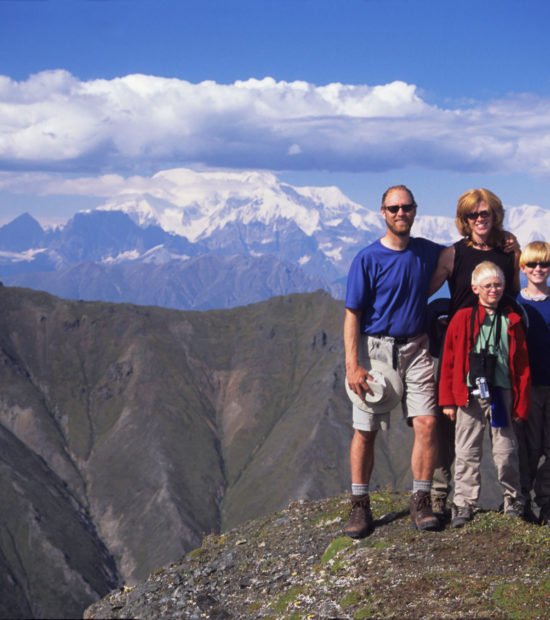
If you’re a family with kids who can hike 3-5 miles in a day carrying a light pack, this works. We’ve done it with families. Kids love exploring the plateau, finding antlers, watching ground squirrels, and camping under the midnight sun.
If you’re recovering from an injury or taking older parents on a trip or just want to see Alaska without destroying yourself, this is perfect.
The Wrangell Plateau is accessible wilderness. It’s not easy. But it’s achievable. And the reward-to-effort ratio is about as good as it gets in Alaska.[/read_more_section]
What Draws Us Here?
We’ve been looking for this trip for years.
Most of our trips reward you with incredible scenery after you’ve earned it. Steep climbs. Heavy packs. Challenging terrain. And that’s fine. That’s Alaska. But we wanted something different. Something for families with kids. For folks who want wilderness but aren’t ready for the full backcountry experience. For people who’ve always wanted to visit Alaska but thought backpacking here was out of reach.
The Wrangell Plateau delivers.
Trips FAQs
-
How difficult is the hiking?
Mild. The terrain is gentler than most of our trips, but you’re still hiking several miles a day over uneven ground with no trails.
Expect 3-7 miles per day depending on which hikes we do. Elevation gain is typically 500-1,000 feet per day, which is reasonable.
-
Do we need backpacking experience?
For the basecamp option, no. If you can carry a pack for a quarter-mile and camp in a tent, you’re fine.
For the basepack option, you should have some backpacking experience because you’ll be carrying a full pack for 1-2 miles over rolling terrain.
If you don’t have experience and would like to give it a shot, let’s chat.
-
Is this trip good for kids?
Yes.
We’ve done this trip with kids as young as 8. They need to be able to hike 3-5 miles comfortably and carry a light pack.
The terrain is easier than most Alaska hiking, and there’s plenty to explore.
-
How are the bugs?
Much better than lower elevations. The plateau is high, cold, and windy, which keeps mosquito populations down. Bugs are rarely a problem here.
-
Will we see wildlife?
-
What about weather delays?
Bush plane operations depend on weather. If our air taxi can’t fly due to conditions, we’ll stay on the plateau until they can. This is why we recommend building an extra day into your travel schedule and purchasing trip insurance.
-
How cold does it get?
Daytime temps in summer range from upper 40s to low 60s. Nights drop into the 40s. Wind makes it feel colder. Bring warm layers even in July and August.
-
Can we hike on glaciers?
Possibly. If conditions are good and the group is interested, we can approach the Cheshnina Glacier. We bring crampons or microspikes.
This is optional and dependent on conditions and group ability.
-
What's included in the trip?
Round-trip flights from McCarthy or Chitina to the plateau, all group camping gear (cook tent, pots, fuel, bear spray, etc.), professional guide service, and assistance with logistics. Food can be provided for an additional cost. See our What’s Included Backcountry FAQs page for full details.
-
How many people per trip?
Maximum 5 guests per guide. Smaller groups are common and allow for more flexibility.
-
When is the best time to go?
Late June through mid-September. July and August offer the warmest weather. Late August brings fall colors and fewer bugs. Early season (June) can have lingering snow but also wildflowers.
-
Can we book a basecamp trip (or basepacking trip) if we don’t own any camping gear?
You sure can.
Fully outfitting your trip is a small additional fee. The exact amount will depend on your trip length, as well as what stuff you need.
For single individual items, contact me and we’ll see what you need and work that out.
A tent (1, 2 or 3 person) is $50.00 per person for the trip. If you just want us to handle food and you have all your own gear (tent, etc) we can do that as well.
Longer trips (5+ days) the food costs go up. But most basecamps are not longer.
We do provide sleeping bags or sleeping pads or backpacks (except for the scheduled photo tours we include sleeping pad). If you’re doing a basepack, you’ll need your own (or rented) backpack. We do rent backpacks, sleeping bags or sleeping pads, but we can point you toward some places that do.
-
Do you have a Gear Check List?
Oh yeah. Right here
Upon your reservation I’ll also send out a detailed Trip Information Packet with more than enough information on gear to keep you busy. Until then the above check list is a good outline of what you need.
-
I have a gear question?
I know you do.
There are of gear questions.
There are also of info on this site about gear.
Please do some reading. Start on the Backpacking FAQs page. Use the blog and browse the Gear Categories pages there. You can also use the search function on the sidebar of any blog post.
Seriously, there is a of info on this site. There is also quite a bit more info in your trip info packet. Read it thoroughly.
If what you need to know is not on the site, ask me , rather than via email.
-
Can I take a look over your food form?
Would you like to?
Sure. Here’s the form we have guests complete for us when they ask us to do food. It’s a pretty detailed questionnaire. We’ll compile that and make our trip menus from there. Nobody goes hungry.
-
Do we carry the food on backcountry trips?
Yes.
Most guides organize bear canisters into breakfast, lunch, dinner, snacks, and refrigerated items. We’ll pre-pack everything, and provide you with a packed bear canister. We’ll then sort out whatever overflow food we have as well (we use bear-proof bags called Ursacks for that – superduper useful).
These all have different weights and depending on how much weight you want to carry, you can grab the bear canister that best matches the load you think is feasible.
-
Do we need to plan any of the meals?
No. Just fill out our food forms and we will take care of planning, buying, and packing the food. We will hand you a canister full of food at the start of your backcountry trip. This will be your group’s entire food split into packable portions.
-
Do we pack for vegan, gluten free, or specialized diets?
Absolutely.
Many of our guides are or have been vegetarian or have dietary needs of their own.
Our food forms are comprehensive and cover any of your meal preferences.
If you are a picky eater, we want to serve you what you want. Don’t be shy. Be as precise in your meal forms as you desire.
-
I have a few more questions about your food
-
How should I structure my travel arrangements?
Travel Suggestions
- Do NOT book your commercial flight early the next morning. The later the better. Better still, the day after that,
- Book a refundable/changeable ticket for your return flight home, and
- Purchase travel insurance.
Weather delays are always possible in the backcountry with bush planes.
The more cushion you give yourself before a committed departure flight home, the better.
Definitely don’t try to book something out on the evening of our return. Or the next morning. We be back by then, but there are so many moving pieces to these trips, it’s much better to not have the stress of having to re-arrange flight schedules. Even if it’s just for something simple like road construction delays or flat tires, or a healthy travel schedule is one with some slack built into it.
-
Can we leave our overnight gear somewhere in McCarthy?
Yes, you can leave a small overnight bag with the van for your hike, for your pre and post trip stuff. Please don’t bring a suitcase and a whole bunch of stuff. A small pack or bag is fine.
If you have a bunch of pre-trip or post-trip stuff, see if you can leave it with your hotel in Anchorage and pick it up on your return. Most hotels in Anchorage are fine with this and do it regularly.
-
Cancellation policy
Reserving your place on a trip requires a 50% deposit. Deposits are non-refundable. All trips be paid in full 45 days prior to the scheduled departure date.
If the client cancels on a trip paid in full, 80% of the price can be deferred and applied to another trip that is scheduled to occur within the next 12 months, provided that all three of the following occurs:
i) Expeditions Alaska, LLC is able to fill the cancelled spot,
ii) Expeditions Alaska LLC is able to fill the the trip that the client cancelled on, and
iii) 30 days (or more) notice is given.If a client cancels a trip and Expeditions Alaska is not able to completely fill that trip, regardless of the number of original participants in that trip, Expeditions Alaska will not defer or refund any portion of the cancelling client’s payment.
Expeditions Alaska, LLC cannot guarantee that a spot will be available on a scheduled trip in the next 12 months. If no spot is available and you cannot use your deposit in those 12 months, the deposit is forfeited and non-refundable.
If cancellation is within 30 days of the trip, only 50% of the fee can be carried over to a future trip. The remainder is forfeited and non-refundable.
No refunds, credit, or other reimbursements are given for cancellations within 14 days of the trip departure.
Expeditions Alaska, LLC reserves the right to cancel and/or modify the itinerary of a trip for any reason. If Expeditions Alaska cancels a trip you will be refunded your payment in full, minus a $250 administrative fees plus any unrecoverable deposits Expeditions Alaska, LLC made to organize the trip. If Expeditions Alaska cancels changes the date of a trip and you can no longer attend, you will be refunded your payment, minus a $250 administrative fees plus any unrecoverable deposits Expeditions Alaska, LLC made to organize the trip.
If weather or other factors delay or impede your trip, there will be no refund of fees. Expeditions Alaska, LLC is not responsible for any other costs incurred by the client as a result of the cancellation, delay, or modification of a trip.
Additional costs incurred through weather delays and itinerary changes are the responsibility of the client.
Additional costs incurred by the client, such as changes to flights or additional costs, etc, are the sole responsibility of the client.
-
I Have More Questions
I know you do. I do as well.
I recommend starting with the General Trip FAQ page
More questions? Email me or call me and we’ll go through them.
Upon your reservation I’ll also send out a comprehensive trip information packet that covers just about everything and more you might imagine about your trip.
You May Also Like