I thought this video might be both entertaining and useful to visitors to the website. Here, Andy Seeger shows off his fashion-sense and creative ingenuity with ‘Shower Cap Hat’ – a cheap workable solution to protecting your camera gear from bad weather on backpacking trips. Backpacking is ALL about compromise; weight, bulk and space, durability, multi-use, etc … these are things to consider when packing for your trip.
Rather than carry an expensive and heavier camera rain cover, a cheap plastic shower cap fits perfectly. it’s lightweight, packable, durable, light and easily available. What’s more, as Andy says, you can even get water with it. 🙂
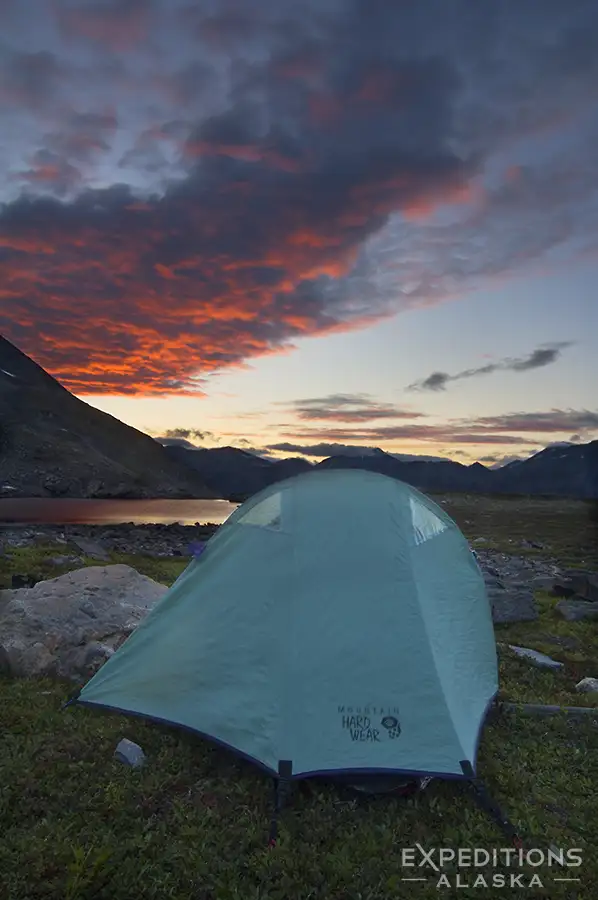
Campsite in the Chugach Mountains, Wrangell-St. Elias National Park Alaska.
Hey Folks
Here’s a short post with some tips for you on picking a campsite in the backcountry. Why a post about picking a campsite? I think it’s useful because many folks overlook this part of a trip, as most people are (typically) so used to backpacking and hiking on trails in the Lower 48 states that it doesn’t really occur to them until it’s time to set up a tent. And by then, it’s too late.
Your campsite is your home, albeit ever so temporarily, and it’s well worth taking a couple of steps toward setting up home for the evening in a setting that you enjoy. Backpacking all day with a heavy load through rugged but beautiful mountains is hard work, and an important part of the trip, to us, is enjoying a great campsite.
What Makes a Great Backcountry Campsite?
1. Low Impact Camping Principles
Firstly, it needs to be “low impact.” Essentially, low impact campsites are those that don’t leave undue stress on the landscape, or on other visitors to the park, both while you’re camped there and after you’re gone. There are a number of elements that are important, and I’ll stress a few of them here (this is not a comprehensive list).
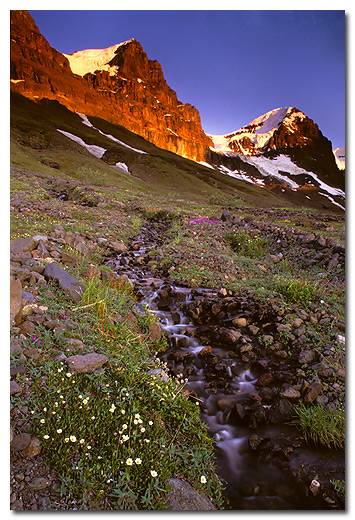
Mountain Avens and Dwarf Fireweed, Hole in the Wall, Skolai Pass, Wrangell St. Elias National Park and Preserve, Alaska.
Hey Folks,
It’s always nice when a magazine editor wants your photo for their story, and you get published.
But it’s WAY nicer when you get published in a magazine you enjoy, read and value. This image posted here is in the current edition of backpacker magazine, page 65 – full page vertical, which is nice. The image accompanies an article on backpacking “the Goat Trail”, in Wrangell-St. Elias National Park and Preserve.
This was the first route I ever hiked in Wrangell-St. Elias, and definitely a favorite of mine, so having my image chosen to accompany the story represents much more than just another published photo and a check to me.
The Route
It’s also cool for me because a few of my friends are published in the same edition of the magazine. It’d be remiss of me not to mention Bret Edge, and Ron Niebrugge, all of whom are photographers I admire.
This short video was taken on the Skolai Pass Alaska Landscapes Phototour, fall 2009. We had a great trip, some great weather, some great people, and loads of fun. This particular afternoon we put in some miles hiking out along the Russell Glacier toward Mt Bona and Mt Churchill, to awesome peaks 16 000 and 15 000 feet high, respectively.
The Russell Glacier runs right up to the north face of Mount Bona, and inspiring sight.
We had a fantastic hike, enjoyed lunch on the high flat plateau, and then walked back toward camp at Chitistone Pass for the afternoon, and to shoot the evening light on the mountains.
I must say, we had a simply unbelievable evening, with gorgeous alpenglow on the mountain peaks. It was a lot of fun being in the right place at the right time for some photography. That doesn’t happen everyday, but when it does, it makes al those hours and miles worthwhile.
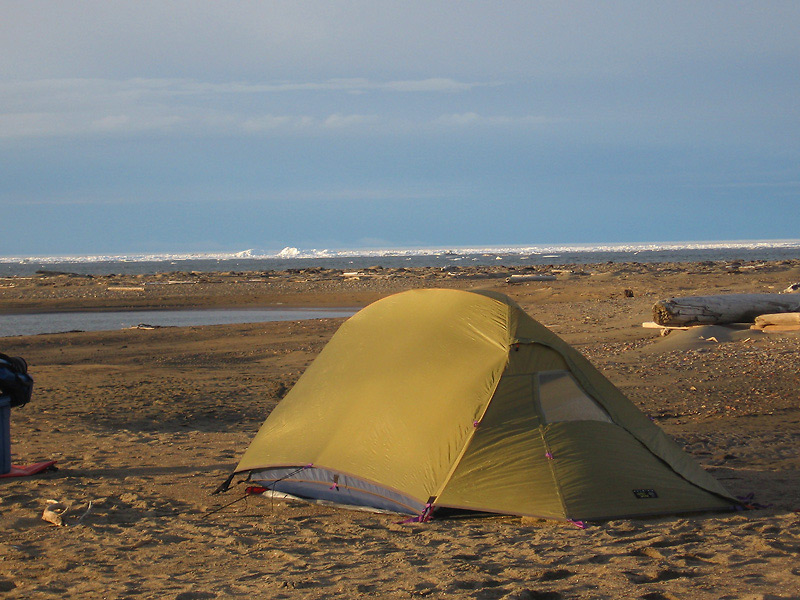
Camped by the Beaufort Sea, Arctic Ocean, at the mouth of the Canning and Staines River.
Hey Folks,
Here’s an image from our campsite on the Arctic Ocean, at the end of the Canning River float trip.
This trip is such a great multi-day raft trip and we can’t wait to get back on it. What makes this trip so special is that we go from the Brooks Mountain Range, starting almost on the Continental Divide, and run all the way out of the mountains, across the coastal plain to the coast, ending at the Arctic Ocean (UPDATE: due a changing landscape, we no longer paddle all the way to the ocean. We float out to the coastal plain, but stop and takeout a little ways short of the coastline. Carl, 2025).
It’s a potpourri of terrain and ecosystems, and really gives a sense of how enormous the place is. We probably cover close to 150 miles or so.
The bird life on the trip is quite incredible, waterfowl such as tundra swans and longtail ducks, loons, eiders and more. Golden eagles and Rough-legged hawks are commonly spotted, and snowy owls as well, from time to time. It’s definitely a bird lover’s treat.
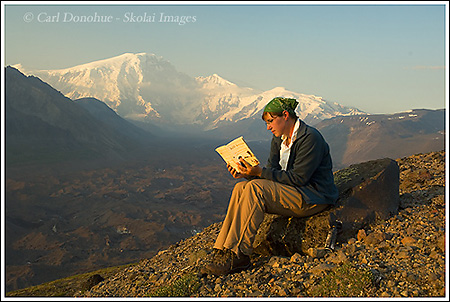
School teacher Natalie keeps up with her reading on the Sanford Plateau backpacking trip, Wrangell-St. Elias National Park, Alaska.
We got an email about backpacking in Alaska. “Never done it, thought about it, and I’d really like to give it a try”. My response was “Well, you’re in the right place”. We mapped out a plan and Natalie came all the way up to Alaska for what was her first backpacking trip. Ever. Never been backpacking anywhere and here she was backpacking in Alaska. That’s some gumption.
Kudos to Natalie. And she crushed it.
We walked the Sanford Plateau in Wrangell-St. Elias National Park in July 2009, and the weather was as good as it gets. After dinner up on the Plateau one evening, the sun going down to the north lit up the entire region. Mt. Drum, Mt. Zanetti, Mt. Wrangell, Mt. Sanford, all of them glowing. Four peaks over 12,000 feet, Sanford topping out above 16,000.
Natalie wanted some photos of her reading a book that she could show to her school students when she returned to teaching after the summer. I took a couple of her in front of Mt. Drum, and a few with the awesome west flank of Mt. Sanford as a backdrop. You can also see some of the glacial moraine in the valley below, a remnant of the receding Sanford Glacier.
Natalie wanted some photos of her reading a book she could show her students back home. I took a couple in front of Mt. Drum and a few with the west flank of Sanford as a backdrop. You can see the glacial moraine in the valley below, a remnant of the receding Sanford Glacier.
We hiked across the lower portion of the moraine and climbed up onto the plateau the following morning. It’s a steep climb, but so worth the effort. Once you’re up there, the walking is easy. Wide open tundra in every direction, and views that make you understand why people come backpacking in Alaska in the first place.
This trek was a first for Natalie, she’d never taken on quite a trip like a backpacking trip in Alaska before,
Sporting a Montbell Thermawrap synthetic fill jacket in Powerline Pass, with friends
Hey folks,
I thought I’d write a quick post about insulation for hiking.
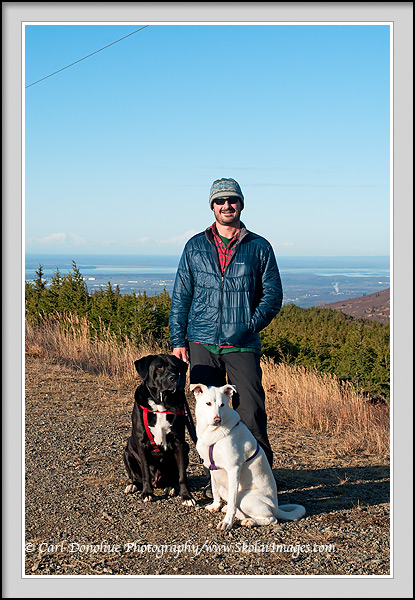
This year, I made the switch from a pile fleece jacket to a synthetic fill jacket. The jacket that I virtually lived in all backpacking season long, (on plenty of day hikes as well, including this walk up to Powerline Pass near Anchorage with Keba and Musa) was the Montbell Thermawrap.
At under 9oz, it’s hard to beat for weight savings. It’s certainly MUCH lighter than any of my fleece jackets, and far more stuffable.
Packed into its little stuff sack, it takes up no space in the backpack at all. And it’s insanely warm for something so tiny. It definitely is warmer than either my 200 weight or 300 weight polartec fleece jackets, and is also extremely windproof.
I hope this finds you all well and gearing up for a great summer. This post is an add-on to our Explore Alaska Backpacking informational series. It seems like winter solstice has only just been and gone, and it’s already march. Spring’s right around the corner, and then summer will be underway! I’m enjoying the winter, but am ready for summer – warmer weather, sunshine, longer days, and flowers and green vegetation is always welcome! And, best of all, more backpacking!
Preparing for the Alaska Backpacking Season
One of the questions I receive most, especially this time of year, is how best to prepare for the coming Alaska backpacking season. The short answer is, it doesn’t matter – just do something – the fitter you are, the safer your trip is! However, I think a few specific things can help:
Make Training a Regular Habit
a) make it regular. Whatever your exercise regime, try hard to make it happen every day – not every second day, or 3 days a week
So, I’m back to the ‘photos from the past’ section. I’ll post a few more from my recent stay in the park, but wanted to post this, a favorite of mine, from Denali National Park a few years.
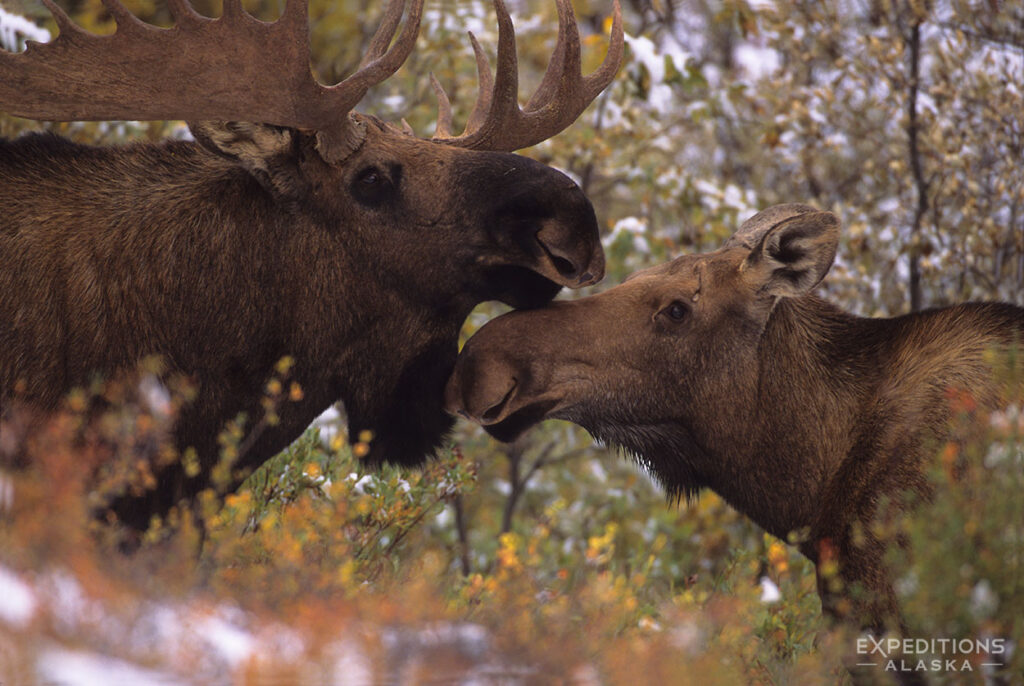
This was probably one of the greatest days I ever had photographing. I hiked my tail off all morning after this bull moose – I was just finishing breakfast on what was to the be the last day of a 2 day stay in Denali Park, and I really wanted to get something worthwhile.
The weather was pretty gnarly, but it was my last day, and I hadn’t much to show for 12 days of staying hunkered down in my little 1 person tent in wind, rain, sleet, snow and cold.
An oldie but a goodie. A favorite photo of mine from a decade or so ago in Denali National Park.
Hey Folks,
The Unexpected Bus Ride
So here’s the reason why the bus that I thought would take me to the park entrance (see this post). I got on the bus and heard the driver talking about ‘wonder if the wolves would still be there’.
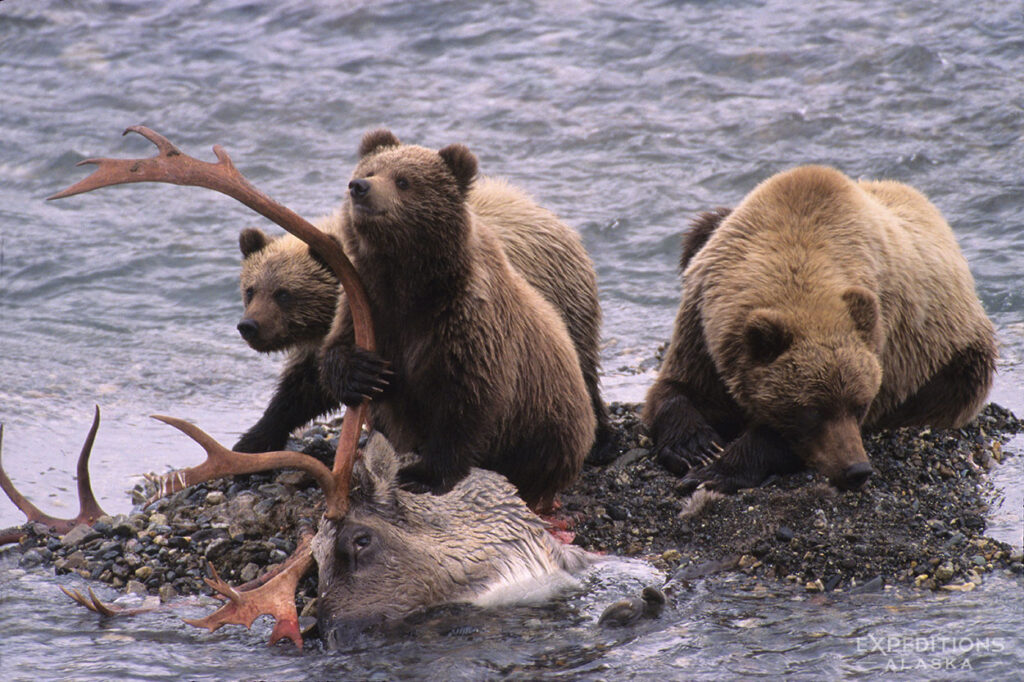
Turns out a pack of wolves had killed a caribou bull not far off the road, and the whole pack had been feeding all morning whilst I was walking around the backcountry chasing some stupid moose.