Here’s a shot of one of my favorite places in Wrangell-St. Elias National Park and Preserve; Viking Lodge Cabin. The cabin is not far off the Nabesna Road, which is nice; accessible. Unlike most public use cabins in the park, this cabin requires reservations, though that also means when you arrive, you know ahead of time you don’t have to share the cabin with anyone else who might show up. There is no fee to use the cabin, which is nice. It’s quite a treat, being able to head out in the winter and have a cozy, comfortable cabin to relax in.
An old barrel stove sits in the middle of the cabin, and warms the cabin pretty quickly, even in the depths of winter. It makes the world of difference after a day out in the mountains, skiing or snowshoeing, to come back to a warm cabin, rather than a cold tent. Perhaps in the morning it makes even more difference, waking up and having a nice warm pair of boots sitting by the cabin, rather than crusty frozen boots outside the door.
If you have a nice, large computer screen and broadband connection, what I REALLY recommend you do is go to my page on Vimeo and click the ‘HD’ button underneath the thumbnail. You can watch and listen to this video in full HD resolution, at 720 x 1280. It’ll take a moment to load, but is (hopefully) well worth the time.
Hey Folks,
50 photos for 50 years!
Dec 6, 2010, marks the 50th anniversary of the Arctic National Wildlife Refuge, or ANWR. Over 19 million acres of wild lands, the refuge is a treasure, home to thousands of creatures and features; the caribou herds, the Brooks Mountains, the broad coastal plain, migratory birds and countless other gifts to this world. A beautiful landscape that warrants our respect, not our exploitation.
I hope you like this. These photos and this music is my simple tribute to this special place. Happy Birthday ANWR – and cheers to many, many more.
For more ANWR photos, visit the ANWR Photo Gallery. If you’d be interested in joining us for an upcoming ANWR Rafting and hiking trip, visit this page.
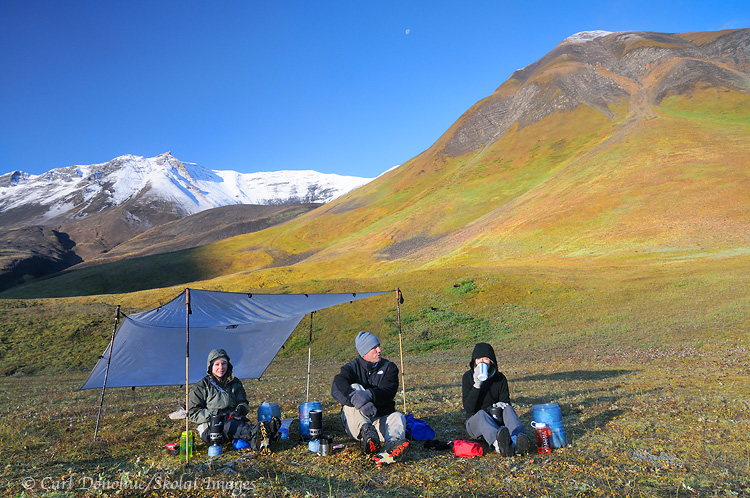
Coffee and breakfast one frosty morning, after a cold, wet and snow evening. The Siltarp 2 is an awesome piece of gear. Click the image above to view a larger version of the photo.
Hey Folks,
One of the questions I received via email after I recently posted my backpacking gear list concerned the tarp I carry.
1 Integral Designs sylnylon 8′ x 10′ tarp and MSR Groundhog stakes
Today we carry a teepee style tent of some kind, whether it’s no longer available) GoLite Shangri Las 5 or something from Seek Outside.
Why, if I’m carrying a tent, do I also carry a tarp or cook tent? Good question.
It doesn’t matter whether we’re hiking in Gates of the Arctic National Park or backpacking in Denali National Park, We cook, eat, do dishes and store all food quite a distance from where our tents are; the standard distance is 100 yards, but that can vary with the circumstances, IMO. Safe to say that’s a good distance to maintain. The further the better.
When the weather’s bad, the tarp feels like a life saver. That tiny little shelter makes the world of difference when you get to camp. I can get changed out of any wet hiking gear, put on all my dry, warm layers (including some nice warm, dry socks!!! 🙂 ), to go cook and eat comfortably, warm and dry rather than wet and cold and rained on. It’s particularly nice in the morning, knowing I can get up from my tent and go make coffee under the tarp. I wouldn’t go backpacking without a tarp (or similar).
I find 2 hiking poles, or sometimes 4, works well to build a nice shelter to eat under. This is one of the reasons I like the full-size hiking poles, those that max up to 140cm. Many of the more compact lighterweight poles aren’t really long enough to do effective double duty under the tarp – they’re too short. Headroom matters!
Fresh winter snow covers a young willow sapling, Wrangell Mountains, Wrangell-St. Elias National Park and Preserve, Alaska.
Hey Folks
It’s been a busy fall for me, and I’m working on updating all the image galleries on the site. I apologize for the inconvenience, if any, and how it takes. Website work isn’t as much fun as hiking or photographing.
Please let me know if you see any glitches or anything. There’s always little errors that creep in, but I think I caught most of them.
I’m slowly working on getting all the galleries redone; new images, larger images, and a consistent display. Hopefully it’ll be an improvement.
The image to the right here is from Wrangell-St. Elias National Park, high in the Wrangell Mountains. I love getting up high in winter, treeline or above, as the light is sublime. I was super lucky to find this young snow-laden willow sapling, as the first wind after a snowfall will blow the snow from this brush in a New York Minute. Next time I headed up to this area, the snow was completely gone from the willow, it’s bare, winter dormant branches protruding from the snow like rusted fingers.
This coming winter I hope to get some more images like this. Nothing like great light, fresh deep powder and some alpine country for good fun. I’ll have the skis out, the camera handy, and coffee in the thermos!
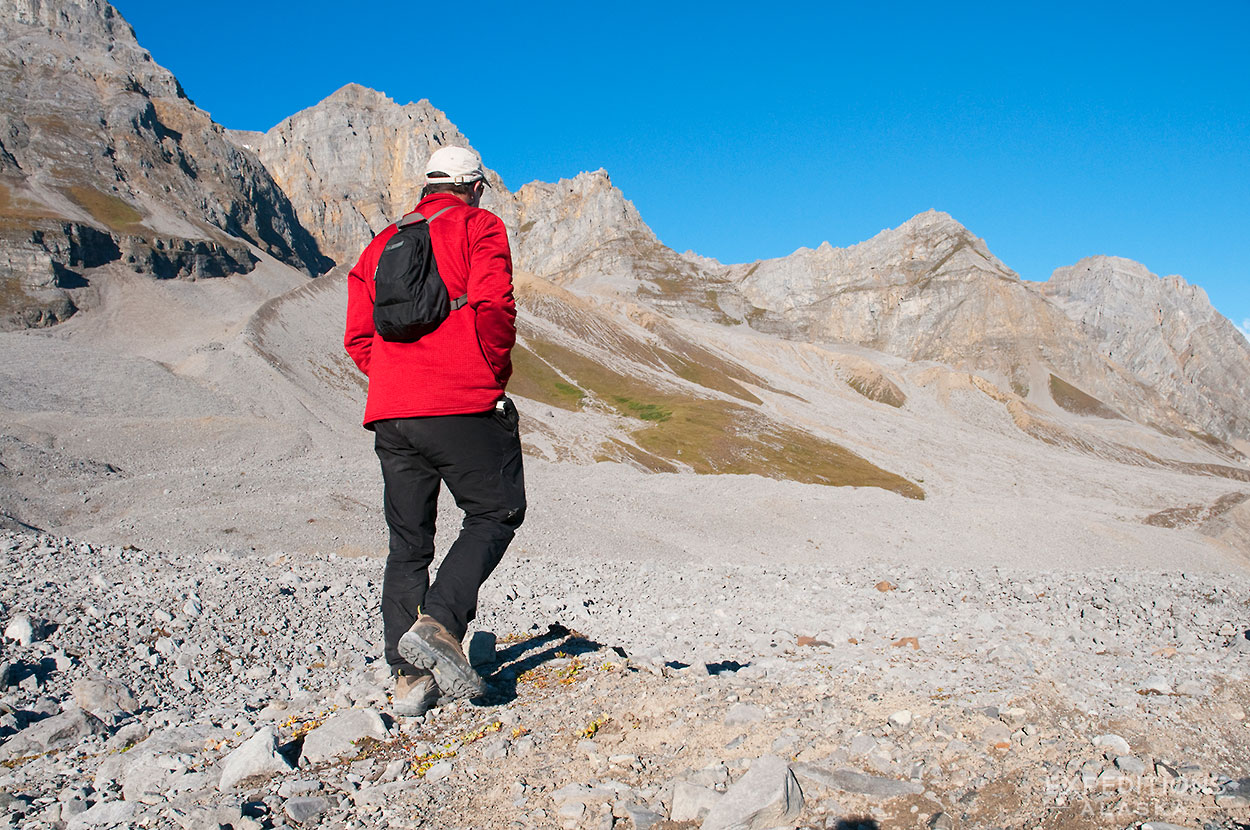
Hiking along the lateral moraine of Kennicott Glacier, near Mount Blackburn, Wrangell-St. Elias National Park and Preserve, Alaska. Now THAT’S an ultra-light backpacking system. 😁
Hey Folks,
OK, here’s a (slightly outdated) list of my backpacking gear I thought I might put together, and have taken WAY too long to get it online. I would like to preface this post with a comment about gear; backpacking is NOT about gear, and I’m not a big advocate of the all too common push to make it about that.
Who Am I
I’d also like to remind you I’ve been backpacking in Alaska for nearly 30 years as I write this. I’ve done solo trips for 6 weeks in remote parts of Alaska, and walked in most of the larger wilderness regions of this state. I’ve got a ton of experience here (as well as outside Alaska), and I’ve dealt with plenty of gear that worked well and not so well.
Feel free to disagree with my choices, of course. Much of this is subjective. But here are my thoughts on what works well.
Backpacking Gear – Let’s Get Started
Backpacking is about being ‘there‘. The gear can help facilitate doing that comfortably, but don’t think that this piece of gear or that piece of gear will magically turn a disastrous trip into a glorious one. And don’t think your pack will suddenly become unbelievably light because you buy an expensive down sleeping bag, and that you’ll now start prancing up over those mountains. Everything is part of a SYSTEM, and learning how to manage that system (including carrying it) is integral to having a good kit.
That said, here it is; hopefully, this list might be useful to someone wanting to look at what gear I use, or what backpacking gear they might want to look into if they’re heading to Alaska. It’s not at all a list of ALL the gear I have/use, but a general list of the gear I typically bring on just about any Alaska backpacking trip.
An adult grizzly bear standing, back turned, mouth open, in long grass, Katmai National Park and Preserve, Alaska.
Sometimes You Get So Close
Here’s a photo that might be of interest to photography fans here. To me, this photo expresses what nature photography is all about. It’s definitely what we focus on in our wildlife photo tours. Shooting, re-shooting, shooting some more, time and again, and doing everything you can to ‘get that shot’, and still coming home empty handed.
How so?
One of the photos I REALLY want is a big ole grizzly bear standing upright, with a nice background. So far, I’ve not yet made that image. I’ve been fortunate enough to have a few opportunities, and unfortunate enough to blow every single one of them.
To catch a nice, full-frame shot of a bear standing upright means anticipation, as well as luck. More often than not, when I’ve been close enough to make a shot like this, I’m shooting with the camera/lens in a horizontal position, and when the bear stands, I can’t fit it all in the frame. It’s simply too easy to miss this kind of shot and too hard to actually nail it.
Why Standing Bear Shots Are So Hard
Adult bears rarely stand upright, and when they do, they don’t do it for very long. Generally the behavior is a ‘look around’; something alarms the bear and they stand up to get a better view, sniff the air, and see whether they need to flee, or ignore the potential danger. A few seconds is all they stand for, most of the time, and they drop back to all fours.
That means to make the photo, the photographer has to be in position and ready for the shot ahead of time; there simply isn’t time to switch the camera/lens to a vertical position and shoot – well, I should say RARELY is there time to switch. Sometimes it happens, but not often.
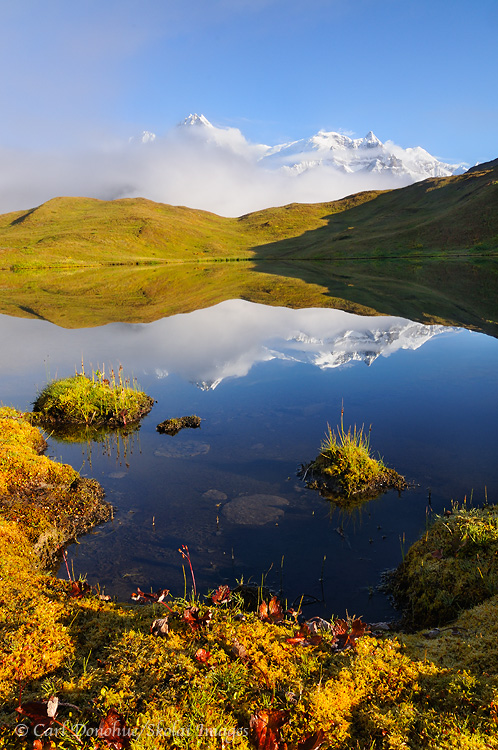
Dawn light on the Wrangell Mountains and reflection in an alpine tarn near Hidden Creek and the Lakina River, Wrangell-St. Elias National Park and Preserve, Alaska. Please click on the image to view a larger version of the photo.
A Magical Morning in the Wrangells
Here’s another photo from the trek we did in August, from the Fosse, near the Kennicott Glacier, over to Hidden Lake, up the Hidden Creek drainage, and down to the Lakina River. What an absolutely gorgeous morning this was!
We’d spent the previous day basecamped near here, and it rained and sleeted virtually all day long. Rather than pack up wet and move on, we simply dayhiked and spent another night here. The main hope was to avoid packing up camp in the rain, but part of me was also hoping maybe, just maybe, we’d get a break, and score some nice light in the morning. Fingers crossed, I went to bed listening to the endless patter of rain on my tent, the temperatures sinking ever lower and lower.
The Perfect Light
The rain ended around 3am, and the temperature had dropped further. I went back to sleep hoping against all hope the skies might clear up.
Unfortunately, I slept too soundly, and missed first light, but immediately upon waking, I knew things must be good. It was very cold, definitely below freezing, and silent. A good sign. I unzipped my tent door and viola! What a sight!
I threw on some clothes, and got outside to photograph as quickly as I could. I woke the folks on the trip, the Ball family from Texas, because I knew they’d love to see this. ‘Wow’ was all Saundra uttered when their tent door slid open.
‘Wow’ was right. This was definitely a ‘wow’ morning. Indeed, a ‘wow’ trip, but this morning the ‘wowest’ of them all. Fresh snow covered the peaks just west of us, and the air was so wonderfully clean the light literally dripped off the mountains. Absolutely amazing morning.
A Memorable Trek to the Lakina River
We photographed for a couple of hours, had a great breakfast, packed up camp, and took a fantastic hike down the valley into the Lakina. We spent the following evening camped on a gravel bar in the Lakina river drainage, with a gorgeous sunset over Castle Peak. This was a great, great trip, and one I’m so glad the Ball family got to share. They still hold the record for ‘worst weather yet’ on a trip, their infamous Skolai-Wolverine backpacking trip of August 2006. I can’t think of anyone who needed some really great weather on their Alaska trip than these great people, and I was so glad they got it this time. Good times for sure!
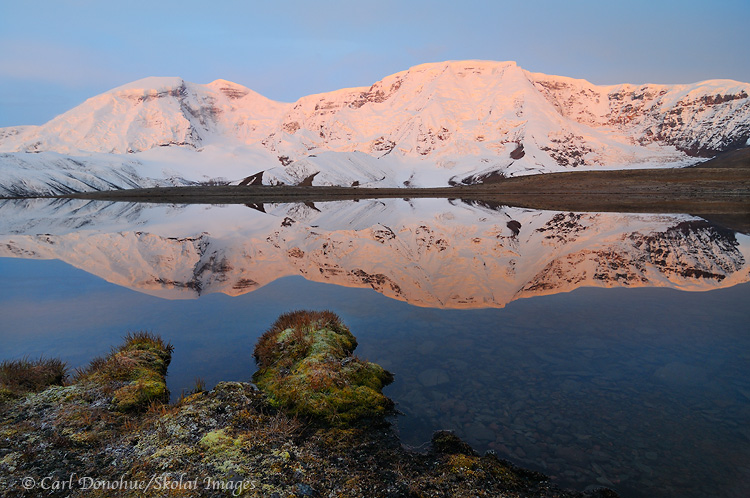
Wrangell-St. Elias National Park and Preserve is home to the Wrangell Mountains. Mt Jarvis, 13 421′ high, stands east of Mt Wrangell, and catches the first light of the day. Early morning (pre-dawn) alpenglow reflection in a high alpine tarn, Wrangell-St. Elias National Park and Preserve, Alaska.
Hey Folks
Mt. Jarvis, in the Wrangell Mountains, and reflection in the early pre-dawn glow. This kind of light is sooooo subtle; it’s really a reflection of the light on the clouds to the east, still quite a while before the first real alpenglow lights up the east. This is from our Wrangell Ramble backpacking trip.
By that time, of course, a slight breeze had stirred up the lake’s surface and the reflection was gone. Once the alpenglow faded, the breeze ebbed, and the surface stilled. Nice, but the moment was gone.
Sometimes when I photograph a scene like this I’ll zoom in to have no foreground elements other than the reflection, such as just above the moss and grass above. Usually, however, I prefer to anchor the scene with something, and I like the way the foreground here kind of complements the lines of the reflection. It is also balanced by the negative space in the lower right hand corner.
A split density filter (or several) is a must have for this kind of shot (unless you choose to do multiple exposures and blend them afterward. And, of course, a tripod. Always bring a tripod.
Updated: As of 2026, I still bring a tripod any longer. Modern mirrorless and high end cameras are so good with ISO that I can compensate for small apertures with higher ISO and still produce quality images. But I still use a tripod, even backpacking, because it helps with composition and taking our time. Get a lightweight, small tripod, strap it to your backpack, and you’ll appreciate it when you set up for that sweet landscape shot.
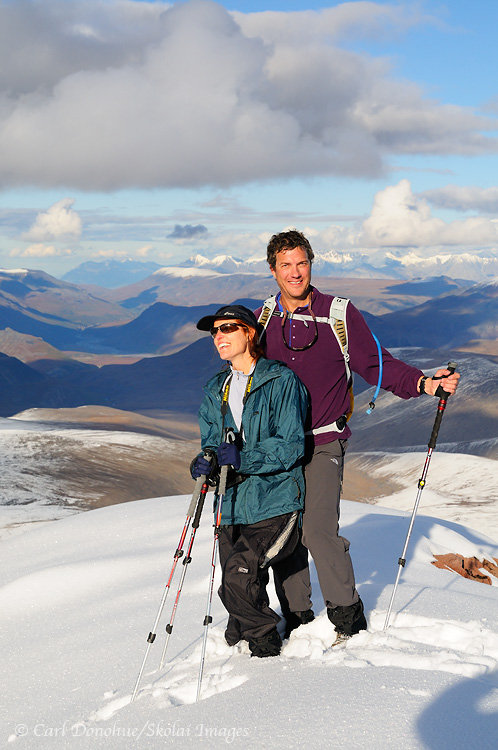
Brad and Tracey take in the views from 8200′. Near Mt Jarvis, Wrangell-St. Elias National Park and Preserve, Alaska.
Hey Folks,
Here’s a quick one from the backpacking trip around Mt Jarvis. Brad and Tracey, soaking up some sunshine on Day #1. We hiked from the airstrip up to a killer campsite, then clambered up on to this ridge, summiting at around 8200′. We’re just yards from the east flanks of 13 000′ Mt Jarvis here, and the views are superb.
We spent a while here, then descended back to camp for some hot food and a fun evening, enjoying the grand scenery. Nothing quite like being high in the Wrangell Mountains on a sunny afternoon!
Kudos to Brad and Tracey for slogging through way too much slushy, wet snow. We were all saying we should’ve brought skis with us; I’d have blasted some huge telemark turns on the way back down. 🙂 Well .. I’d have tried, anyway.
UPDATED, 2025: This is now part of our Wrangell Ramble backpacking trip in Wrangell-St. Elias National Park. We’ve explored this northern section of the park a lot, and it holds some exceptional backpacking. Not without its challenges, but it’s great place to explore. We’ve hiked most of the landscape from Mesa Lake in the eastern edge of the range to Dadina River and Wrangell Plateau; so we know what we’re talking about in this area.
That’s all for now. I’ll be back from my current trip to Katmai, photographing Grizzly Bears, and will try to post some images from that trip later. I’m sure it’ll be a blast, and I hope to have a bunch of cool new bear photos. We’ll see how that goes. Until then, be safe.
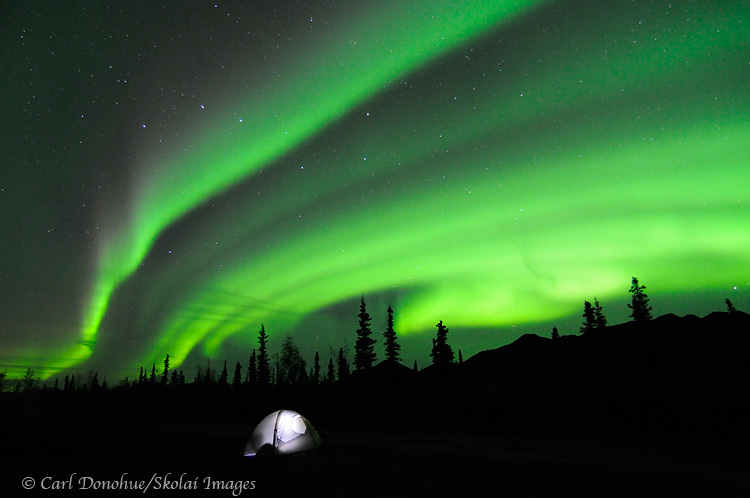
The aurora borealis (northern lights) light up the night sky above a tent. Campsite in the Mentasta Mountains, boreal forest, Wrangell-St. Elias National Park and Preserve, Alaska.
Hey Folks,
From my last summer/fall camping trip in Wrangell-St. Elias National Park, for this year – well, so far, anyway. If you think sleeping in the big city is hard, with all those big city lights, try sleeping in a tent under this kind of light. 🙂
What a treat it is to see the aurora borealis (or ‘northern lights’). Nothing quite touches that experience for a little slice of magic. It’s mystical, each and every time.
Fall is a great time to photograph the aurora – the skies are dark, often clear, and it’s not yet 40 below zero, like it can be in the dead of winter.
The Photo Tip
For shooting the northern lights,
I crank up the ISO of the camera,
open the lens to its widest aperture, and
shoot with as high a shutter speed as I can.
Fast lenses, like a 1.8 or even a 2.8 make a big difference.
They’re also heavier than smaller aperture lenses, which makes it a trade-off for a backpacking trip. Sometimes though, such as when the aurora borealis is out, that trade-off becomes moot. The extra weight is well worth the effort. A small headlamp to light up the tent, set up the tripod, and click the shutter. Good night folks.
Wanna learn even more about photographing the northern lights? Study this guide.