This year seems to definitely be the year that photographers want to head north to photograph the northern lights here in Alaska; the number of websites that have suddenly added an “Alaska Northern Lights Photo Tour” to their schedule seems to have tripled yet again in about 6 months.
That, and considering the number of photographers heading up here on their own, or with friends, to photograph the Aurora borealis this winter/spring means we’ll very likely see dozens, if not hundreds, of really, really amazing northern lights photographs from this coming season. I know I’m sure looking forward to seeing all the great images.
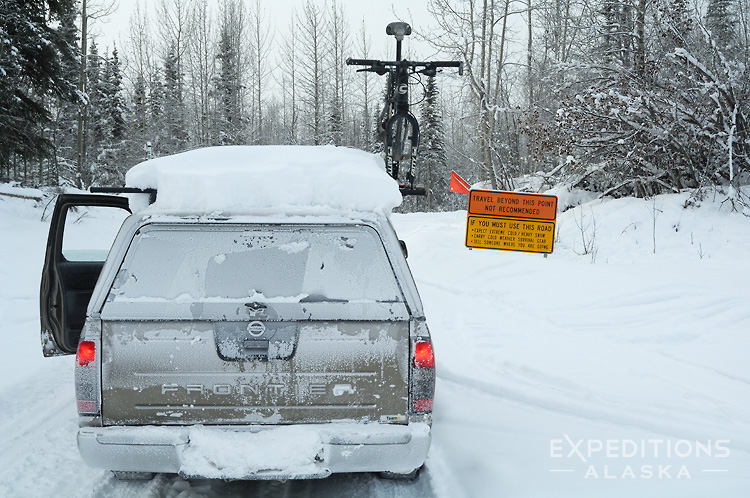
Why Winter Driving in Alaska Is Different
Given this influx of folks from “down south”, I thought a good subject to write about, one that I hope many people will find useful, might be winter driving and winter travel in Alaska.
Coming, as I did when I moved here, from a background of very little real “winter conditions”, I had a lot to learn when I arrived (including what to wear for cold weather), and some of that might be helpful for others headed this way. Not just about the physical driving on snow and ice. What to bring with me. What hazards I’m likely to encounter. And on and on.
Just a quick post to announce the calendar winners from the recent giveaway are Natalie, David and Jason. Happy New Year to these three, and the calendars are in the mail. Congrats all, and thanks to everyone for your entries. Tons o’ fun!
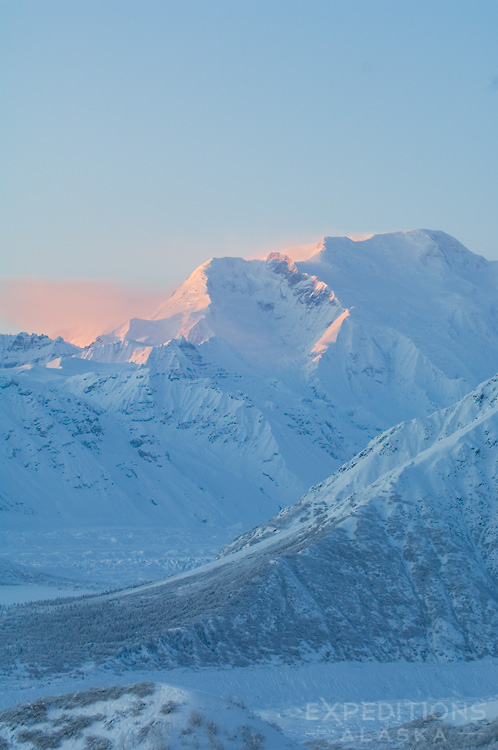
The name of the mountain was Mount Blackburn, from Wrangell-St. Elias National Park and Preserve. The photo in this post was taken from the other side (east) of the mountain, winter solstice a few years ago. Mount Blackburn stands 16 391′ high, and is the 5th highest peak in the United States, the tallest in the Wrangell Mountains.
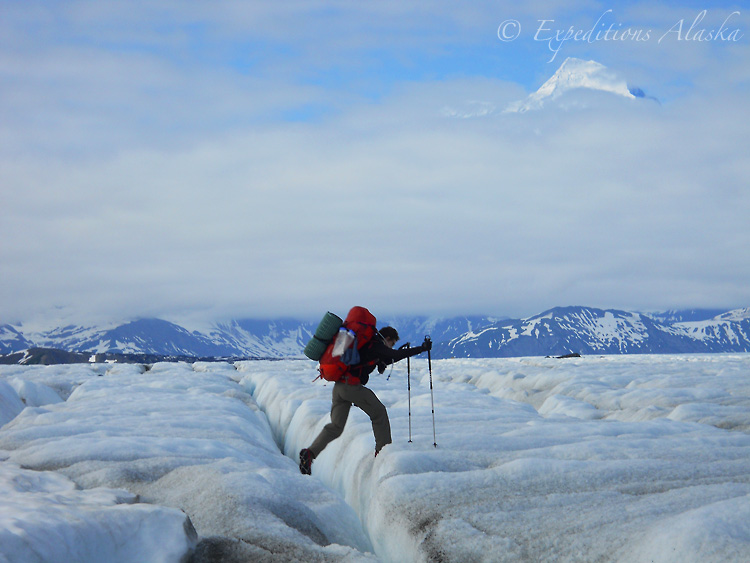
Jodee steps across a crevasse on the Malaspina Glacier, with 18 008′ tall Mt. St. Elias peaking thru the clouds in the background.
Hey Folks,
What better way to celebrate the new year than a quick tip of the hat to Expeditions Alaska’s trip of the year for 2012? The winner, for me, was the Malaspina Glacier traverse we did in August.
12 awesome days on the southern coastal edge of Wrangell-St. Elias National Park and Preserve, I led a group of 5 hardy adventurers over the largest piedmont glacier* in North America, down to the beach, and along the coast to our pickup place.
Plan B
A sketchy start, as our backcountry bush pilot informed us, right before we departed, that we wouldn’t be able to fly to our intended destination in the Samovar Hills. The huge snowfall we’d had over the previous winter hadn’t yet melted out enough to land safely at the remote backcountry strip.
A week in arctic Alaska, photographing Nanuq, the magnificent polar bear? An awesome, awesome trip. I took 3 people up earlier this month for a fantastic week, where we were so lucky to get to spend time up close and personal with polar bears; literally, dozens and dozens of polar bears. US F&WS estimates there were nearly 80 bears in the area in sept/oct.
These 2 youngsters were an absolute treat to watch, as they tussled and wrestled and ran and frolicked on the ice. With a great local Alaska native (Inupiaq) guide, we were able to watch these bears for several hours; everyone came home with thousands of great polar bear photos. I grabbed this quick video when I had to stop shooting and change memory cards in one of my SLR cameras. The bears were so much fun to watch.
Next year I’ll be back for another round, leading a small photo tour for a week in the arctic, photographing the polar bears. Space is limited; I’ll keep the group to a maximum of 4 photographers and myself. I’ll have full details online this week, but the dates are scheduled for Oct. Drop me a note if this is something you’re interested in, as this trip will very likely fill quickly.
Cheers
Carl
PS: Oh, someone asked about the music track; it’s a little R&B groove I recorded (on guitar) with my friend Steve F on bass years and years ago. I found a copy of it and thought it’d be a cool track for this video. Steve sounds great on bass, as always.
It sounds better L-O-U-D, so turn your speakers up to 11.
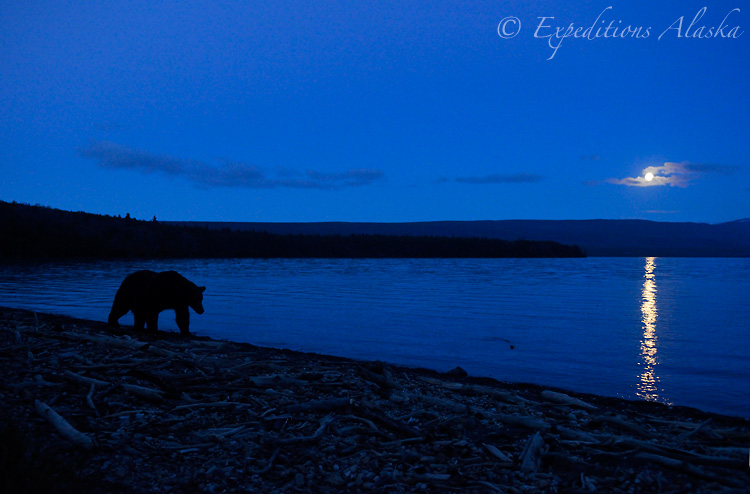
A brown bear walking by the edge of a lake under a moonlit sky.
Hey Folks,
Slowly catching up on image processing and whatnot after a full season of adventure. This year I ran a few new trips, which I’m looking forward to continue to explore over the coming years, but also enjoyed returning to some of the old favorite haunts. This image if from the Grizzly Bears in the Fall tour, a favorite of mine and popular tour every year.
Shooting these “animals in the landscape” style of photo is always difficult, as there are so many elements to combine. They also tend to work much better when shooting solo, as it’s difficult to get a group of people, even a small group, all in exactly that optimal spot for such a composition. As such, I tend to shoot more of the tighter “portrait” style shots on photo tours, and fewer of the animal in a greater landscape.
That said, I tend to really enjoy the wider image; my preference for wildlife photography is either to go extremely tight on framing the subject, or very wide. One of the folks on the trip shot this frame with about 16mm (I was at 28mm), and I really like this version; very sparse.
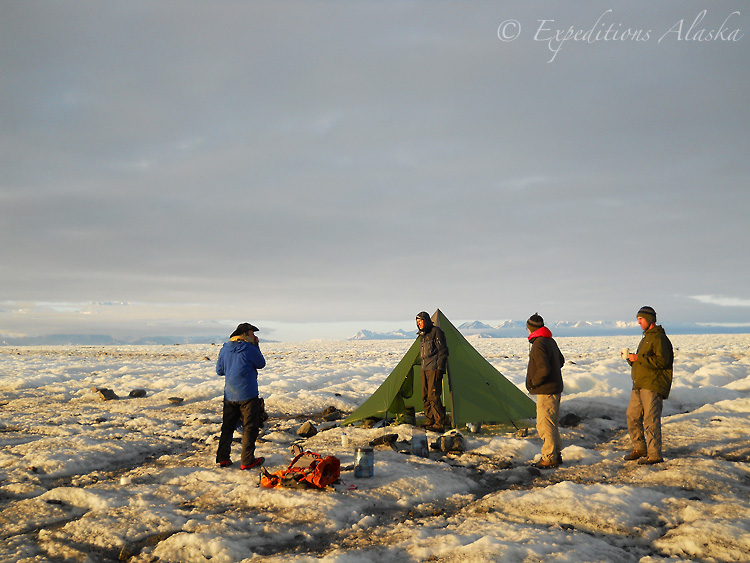
Our kitchen setup on the Malaspina Glacier, one gorgeous evening. Last night on the ice before we crossed the moraine and left the ice. The night after this we were camped on the beach. For a larger version of this photo, click the image above.
Hey Folks
This past August, we just did an EPICtraverse across the Malaspina Glacier. Our original plan had been to fly from Yakutat to the Samovar Hills, and hike south. Due to the insane amount of snow in the area last winter (Yakutat got 350-360 inches), we weren’t able to land at the strip we’d hoped to fly into. A last minute change of plan meant flying to Kageet Point, Icy Bay, and hiking east from there, before picking up the original route, and following it south to the coastline, then east again to our intended pickup spot. This added about 35-40 miles to our route, but with an adventurous and experienced group of folks, it was worth it.
We spent 5 of the 9 nights on the ice of the Malaspina Glacier; the Malaspina is the size of Rhode Island, over 40 miles and nearly 30 miles long. Contrary to what wikipedia might tell you about the glacier, it DOES reach the coast, and so should rightfully be called a tidewater glacier, not a piedmont glacier. We packrafted around the lagoon the ice calves into on the beach, and it’s most definitely coastal.
Camping on ice has its challenges. Finding a nice flat spot can be tough, but especially finding a nice flat spot with enough rocks around to use for holding the tent/tarp in place. Sometimes we’d find wonderful, long flat stretches of ice, perfect for tentsites, but not a rock in sight. You can’t drive tent stakes into ice (unless you carry ice screws, of course -major overkill for a tent). But usually it didn’t take too long to find a good spot.
Secondly, insulation. A regular sleeping pad just doesn’t cut it. I used an Exped Downmat 7 UL, and it was great. Warm, comfortable, and not too heavy.
Other choices include using 2 pads, one hard-cell foam pad like a z-rest or similar underneath an inflatable Neo Air or thermarest pad. Sergei used the Exped Downmat 9, which was easily the best (most comfortable and warm) choice. A deflated packraft under the tent all offered some protection from the ice underneath.
Overall, it was a grand backpacking trip. The weather wasn’t too bad at all, which made a great difference. Camping on an expanse of ice like that for a week, with no real wind or rain to deal with, made the trip a lot of fun. A great group of folks, 4 of which have now done 4 or more different backpacking trips with me, and some world class adventure. Good, good times.
An adult brown bear (Ursus arctos) resting on driftwood near the beach at Hallo Bay, Katmai National Park and Preserve, Alaska. Please click on the image above to view a larger version of this photo.
Hey Folks,
Just returned from a brown bear photo tour over to Katmai National Park, where we photographed brown bears at Hallo Bay and Kukak Bay; we were super lucky to get some great light, great bears, and some really cool photo opportunities. This young bear was hanging around a pile of driftwood in Hallo Bay, and the rich greens of the sedge grasses beyond made a nice soft background.
It took a little bit of work to scramble around over these logs and whatnot, carrying over 20lbs of camera gear, to get in a good position for photography, but I think it was well worth it.
Photography Tip
Make the Effort to Move
Oftentimes making the effort to move and get in position is the real difference between making a photo, and making the wildlife photo you want. It could be the direction of light, the background, the angle of view, proximity to the subject, or a combination of countless other variables that really makes the difference.
It’s far too easy to hike a bit, set up a tripod, point the camera at a subject, then try to zoom in or out, without moving and improving the image. The best advice I might offer is to continually be looking for ways to improve the image you see through the viewfinder.
Sometimes it’s simply not possible or practical to change it much; safety or disturbing the subject, or other photographers in the area all might restrict where we set up and how much we move. But keep your eyes posted around you, and look for ways to improve your image simply by moving your position. You’ll be glad you did.
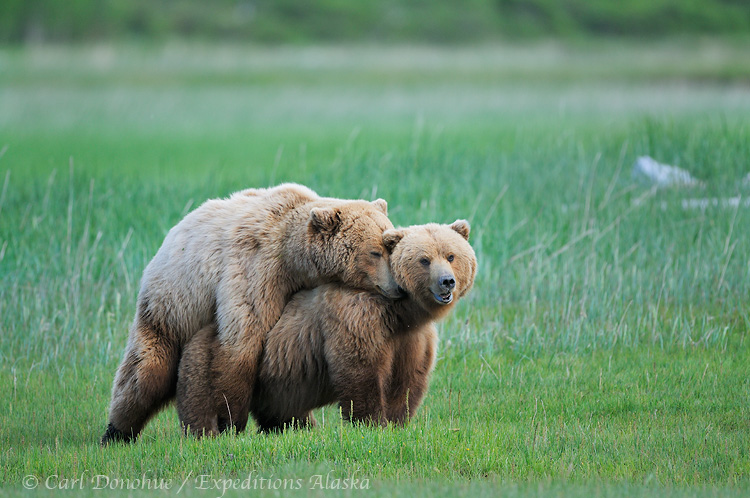
Brown bears (Ursus arctos) breeding (or mating) at Hallo Bay, Katmai National Park and Preserve, Alaska.
Image of the month for this month is this photo of a breeding brown bear pair at Hallo Bay, Katmai National Park and Preserve, Alaska, on the coastal brown bear photo tour last week.
It was an amazing trip, with some great photo opportunities, perhaps the highlight of which was this breeding pair we found at Hallo Bay.
Twice we were able to watch and photograph this behavior, which was definitely a rare opportunity.
Females will often breed with more than one male during the short (2 month) breeding or mating season. We watched minutes earlier as this sow rejected the advances of another, much larger male, who then chased this male away, then himself walked off up the bay. This smaller male returned, and bred with the sow for 15-20 minutes.
The larger male then returned, and this guy left. The larger male hung around the sow for another hour or so, but didn’t have the good fortune of this guy, that we saw.
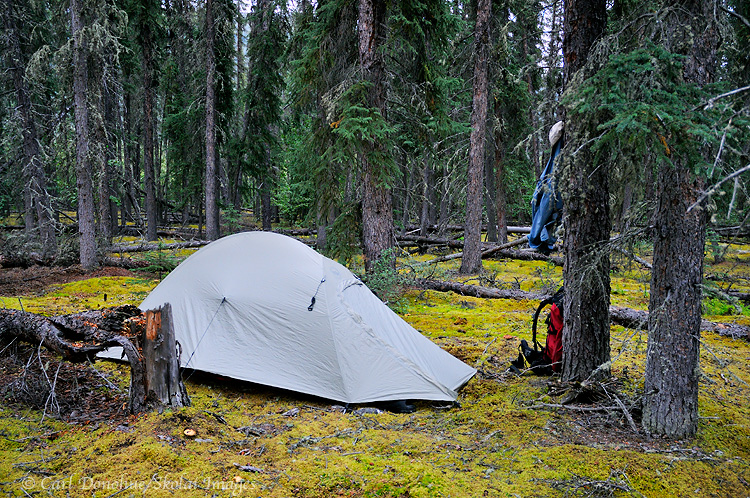
Camping in the boreal forest in the Brooks Range, near the Arrigetch peaks. Gates of the Arctic National Park and Preserve, Alaska.
[UPDATED: Feb 2026]
Hey Folks,
Well, it’s well and truly spring here in Alaska, and the summer/fall hiking season right around the corner. So for anyone heading north this summer, this page might be of interest to you. Gates of the Arctic National Park is one of the less visited national parks in the state, which makes it a great place to explore and “get away”. Miles upon miles of mountain wilderness, boreal forest and alpine tundra make it a diverse and fascinating hiking region.
At the same time, it’s also a challenging expedition. Logistics for getting there, getting ‘in’ to the park, hiking across muskeg, dealing with mosquitoes, bears, rivers, and trail-less terrain can be intimidating. Hopefully some of this is helpful.
Getting to Gates of the Arctic
Your options for hiking in Gates of the Arctic National Park, for most folks, start with Fairbanks. You want to head north, either up the Dalton Highway (Haul Rd), or fly.
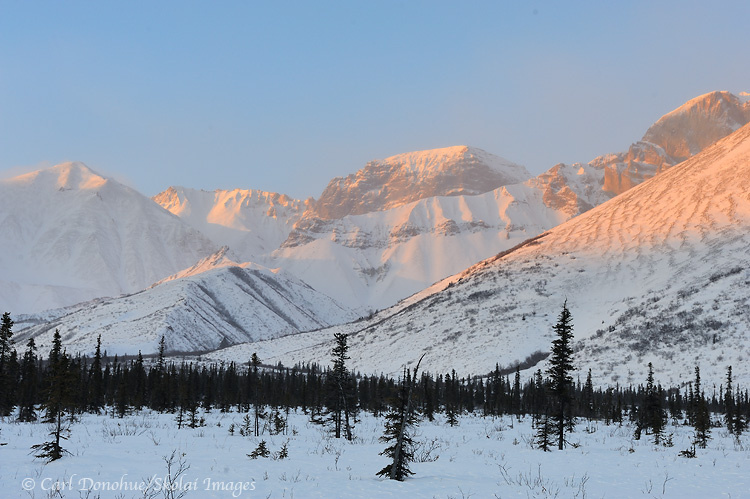
The Wrangell mountains, near Nabesna, catch the first rays of the day. Sunrise near Jack Creek, Wrangell-St. Elias National Park and Preserve, Alaska.
Hey Folks,
Welcome to Expeditions Alaska. I’ve thought for a long time now about changing the name, so here it is. I’ve still got a few things to tweak over the coming weeks, so if you run across any glitches, please let me know.
This image was taken early one morning on the recent snowshoe/photography trip we took to Wrangell-St. Elias National Park. The folks who were drawn for the trip, Paul, Doug, Ryan and Jim were great fun, and it was really nice to have such a good troop of folks along.
We were treated to some awesome weather the whole time, which made the trip an easy time, for sure. Sunny skies and very little wind can make March a good time in Alaska.
We snowshoed, no skiing, as the group preferred to hike and photograph rather than ski around. I’ll try to post some more images from the trip soon enough. In the meantime, I hope you enjoy this one from one great morning out near Nabesna.
Oh yes, one more thing to add; I’ll throw up this photo in honor of Anchorage breaking its own record for most snow in a winter. Happened today – Wax ’em up!